A local authority or government body can have significant control over a company. When that body is an other registrable person (ORP), PSC03 is the notice for adding its details to Companies House. An ordinary individual shareholder or a relevant legal entity belongs on a different PSC form.
Who belongs on PSC03?
The form’s ORP category covers a corporation sole, a government or government department, an international organisation whose members include at least two countries or territories or their governments, and a local authority or local government body in the UK or elsewhere. The GOV.UK publication page lists these categories separately from an individual person.
Use PSC01 to notify an individual PSC and PSC02 for a relevant legal entity. PSC03 identifies an ORP becoming registrable. When a previously registered person ceases to qualify, the separate PSC07 notice of ceasing to be a PSC covers that event.
This guide uses the November 2025 PSC03, version 4.0, under section 790LA of the Companies Act 2006. Determining whether a body meets the control conditions can require a review of ownership and voting arrangements. A company secretary or legal adviser can help establish the category before information is entered.
How to fill in the ORP details and the two dates
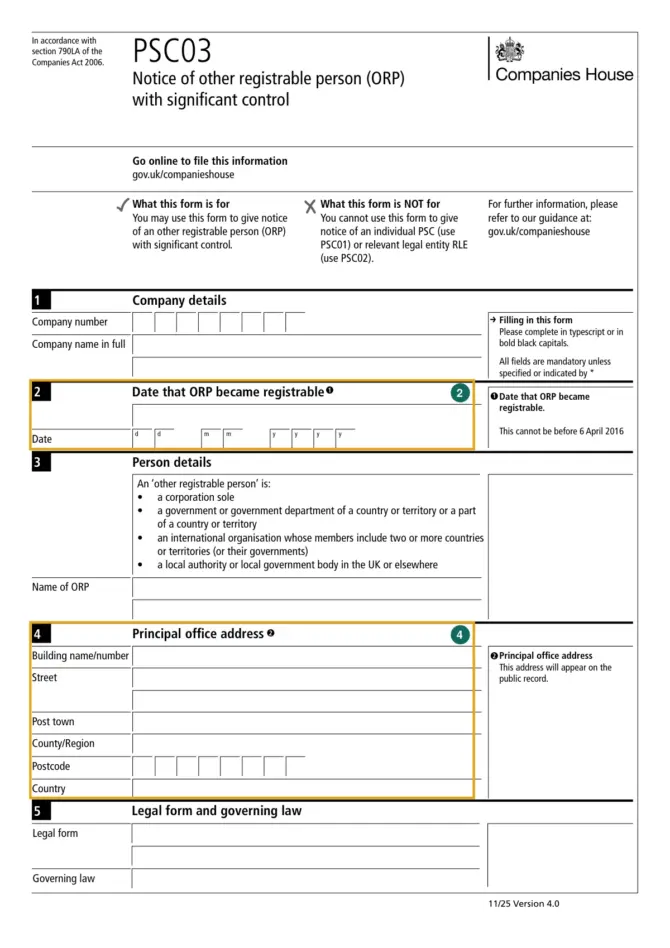
Prepare the registered company identification, the ORP’s name and principal office address, and its legal form and governing law. Section 2 and section 9 record different events: becoming registrable and the company’s receipt of confirmation.
| Section | Information needed | How to read the field |
|---|---|---|
| 1 | The company’s full name and number. | Match the Companies House public record. |
| 2 | The date the ORP became registrable. | Use the date of that event, which cannot precede 6 April 2016. |
| 3 | The ORP’s name. | Identify the body being reported. |
| 4 | The principal office address, including country and postcode where applicable. | This address will appear on the public record. |
| 5 | Legal form and governing law. | Record the body’s legal form and the law governing it. |
| 9 | Confirmation date. | Enter when the company had confirmation of both ORP status and all required particulars; if received separately, use the later date. |
| 10 | The authenticator’s printed name. | The form expressly says a signature is unnecessary. |
The marked first page highlights section 2, the registrable date, and section 4, the principal office address. Section 9 appears on the third page. A date copied from the first page will only be correct there if it also describes when the required confirmations were obtained.
Selecting the nature of control
Section 6 asks how the ORP controls the company. The shareholding and voting-rights questions each offer three bands: more than 25% but no more than 50%; more than 50% but less than 75%; and 75% or more. Choose one band within each applicable question. Exactly 50% falls in the first band; exactly 75% falls in the third.
For example, if a local authority holds 60% of the shares and 60% of the voting rights directly, both questions use the middle band. This illustrates the printed thresholds, assuming the body’s status and those holdings have been established. It does not determine the classification of a more complex ownership arrangement.
A separate condition covers the right to appoint or remove a majority of the board. The final significant-influence-or-control statement in section 6 is only selected when none of the preceding conditions applies. The form’s instruction is to mark every applicable condition, while selecting only one percentage band for each ownership question.
Sections 7 and 8 deal with control through a firm or trust. Section 7 describes a firm that is not a legal person under its governing law, where the ORP has significant influence or control over the firm’s activities and the members hold the stated company rights. Section 8 addresses the corresponding trust and trustee conditions. Complete these sections from the relevant arrangement; they describe different routes of control from direct ownership in section 6.
Official PDF, online filing and paper submission
The Companies House PSC03 page links both the online PSC service and the November 2025 PDF. Companies House recommends the online route and says postal forms take longer to process. For paper filing, print at full size on white A4 paper and use typescript or bold black capitals.
Section 10 allows authentication by a director, secretary, authorised person or one of the office-holders listed alongside that field. Enter the printed name of the person authenticating the notice. The form includes a separate instruction for a Societas Europaea and defines an authorised person by reference to sections 270 or 274.
The final page directs posted notices to the appropriate address on the Companies House offices page. It also says certain forms can be uploaded; the publication page’s online PSC link is the route it specifically provides for updating this information.
What the final-page checklist asks you to check
Companies House warns that notices with missing or incorrect information may be returned. Its PSC03 checklist checks the company name and number, the date the ORP became registrable, complete ORP details, the nature of control and authentication.
Everything on the form will appear on the public record, including optional presenter contact details if supplied. The principal office address is also explicitly marked as public on the first page. Enter the information required for the ORP without adding unrelated personal details.
Sources and form version
- PSC03, November 2025, version 4.0, Companies House.
- Give notice of other registrable person with significant control, GOV.UK, updated 18 November 2025.