The Additional Dwelling Supplement (ADS) is added to Land and Buildings Transaction Tax when a buyer ends the day of a Scottish residential purchase owning more than one dwelling without having replaced their only or main residence. Revenue Scotland’s examples include a buyer whose sale of the old home was delayed while the new purchase went ahead on the planned date. Once the previous main residence is sold within the time allowed, the ADS can be reclaimed. RS-0005 is Revenue Scotland’s ADS repayment claim form, Revision 1.4 (September 2025), and it is the route Revenue Scotland gives to an agent who did not submit the original LBTT return.

Who uses RS-0005 and who claims another way
Revenue Scotland’s claim page splits ADS repayment claims by who is making them:
- the agent who submitted the original LBTT return amends that return in SETS, the Scottish Electronic Tax System, and uploads the evidence there
- a new agent, one who cannot amend the original return in SETS, completes RS-0005 and emails it to lbtt@revenue.scot
- a buyer claiming without an agent uses the online repayment claim on the Revenue Scotland portal; paper claims sent by post are no longer accepted
- an attorney or guardian acting for a buyer uses a separate repayment form published as a Word document, also emailed to lbtt@revenue.scot
RS-0005 still has a “No agent” option in Section 1 and a buyer’s declaration in Section 8, but the claim page points buyers acting for themselves to the online process. Revenue Scotland’s taxpayer guide for that process (April 2024) says it takes about 5 to 10 minutes, cannot be saved as a draft, and that all buyers should be present when it is completed.
Companies and other non-individuals have no replacement ground to claim on: the technical guidance at LBTT10017 says a non-individual is not regarded as replacing an only or main residence, so ADS applies to each dwelling it buys for £40,000 or more, other than certain trust purchases.
Conditions for getting the ADS back
The repayment rules are in paragraph 8 of schedule 2A to the Land and Buildings Transaction Tax (Scotland) Act 2013. For a purchase with an effective date on or after 1 April 2024, all of these must be met:
- the buyer, or one of joint buyers, disposes of a dwelling within 36 months of the effective date of the purchase on which ADS was paid
- the dwelling disposed of is not the one bought in that transaction
- it was the only or main residence of the buyer, or of one of the joint buyers, at some point in the 36 months ending with the effective date
- the dwelling bought has been occupied as the only or main residence of the buyer, or of all the joint buyers
Where the effective date is on or before 31 March 2024, the window is 18 months, beginning the day after the effective date, and the 18-month look-back applies to the residence test. For those older purchases, Revenue Scotland’s general ADS page says joint buyers can claim if all of them meet all the conditions, with one exception: for spouses, civil partners and cohabitants only one of them needs to have sold, but both must have lived in the old home and must live in the new one. For later purchases the 2024 wording applies: one buyer’s sale and one buyer’s past residence are enough, all buyers must occupy the new home, and where every joint buyer owns another dwelling, all of them must meet the conditions. The worked example at LBTT10070 shows a pre-April 2024 claim failing because the second civil partner had never lived in the old home.
The effective date is generally the date of settlement or completion, according to LBTT10011. Leaving a rented property is not a disposal, since a disposal can only be made of a property the buyer owns.
LBTT10070 says Revenue Scotland has no power to consider exceptional circumstances. It cites the First-tier Tribunal decision MacQuarrie v Revenue Scotland [2024] FTSTC 2: the previous home sold more than three weeks after the deadline because of cladding problems, and the appeal was dismissed.
When to claim: within 12 months or later, up to 5 years
The original LBTT return, with the ADS calculated and paid, is due within 30 days of the effective date. If the previous main residence sells after the effective date but before that return is made, LBTT10050 says the ADS does not need to be paid at all.
Once the ADS has been paid, there are two ways back, and Section 3 of RS-0005 asks which applies:
- within 12 months of the filing date of the original return, the claim is an amendment of that return under section 83 of the Revenue Scotland and Tax Powers Act 2014
- after that, it is a claim for repayment of overpaid tax under section 107 of the same Act, which LBTT10070 says must be made within 5 years of the tax return due date
Revenue Scotland’s claim page describes a claim made more than 12 months after the filing date as one made more than 12 months after the date the new property was bought, and asks for proof of sale in that case.
How to fill in RS-0005 section by section
RS-0005 is a fillable six-page PDF. Before starting, find the return reference of the original LBTT return; if you do not have it, the form says the agent who submitted the return can give you a copy of the submission receipt, which shows it. Sections that do not apply to the claim can be left blank, but every question marked with an asterisk in a section that does apply has to be answered, and the form warns that omissions may lead to rejection.
| Section | What it asks | Where the answer comes from |
|---|---|---|
| 1 About the person dealing with this transaction | No agent, agent (individual) or agent (organisation); agent or organisation name, address, telephone and email; optional DX number and agent reference; a yes or no authority to act statement. | The agent’s own details. An individual agent gives a first name and surname. Choosing “No agent” skips to page 3. |
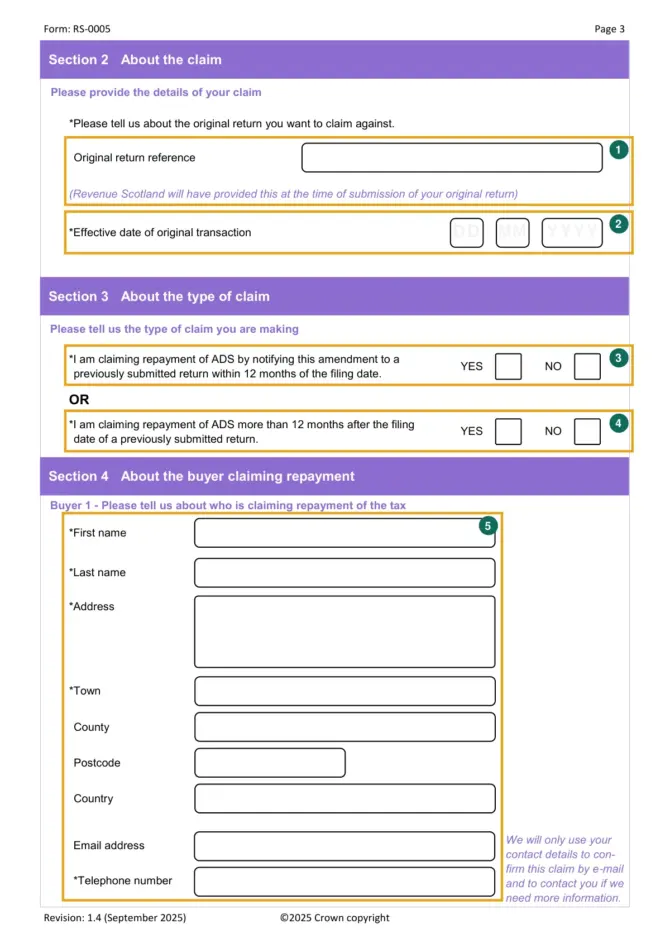
| 2 About the claim | Original return reference and effective date of the original transaction (DD MM YYYY). | The submission receipt of the LBTT return on which ADS was paid. The online guide says the reference starts with “RS”. |
| 3 About the type of claim | Yes or no to a claim within 12 months of the filing date, and yes or no to a claim more than 12 months after it. | The filing date of the original return. |
| 4 About the buyer claiming repayment | Buyer 1 and buyer 2: name, address, telephone (required) and email (optional). | The buyer or buyers of the property on which ADS was paid. For more buyers, add an RS-0003 Additional Details form. |
| 5 About the previous main residence | Address, town, county and postcode of the home sold. | The disposition or Land Register documents for the sale. |
| 6 About the date of sale | Date of sale of the previous main residence, DD/MM/YYYY. | The sale documents or the solicitor’s letter giving the date of sale. |
| 7 Repayment | Amount claimed in pounds; account holder, account number, sort code and bank or building society; an agent’s confirmation that the buyers authorised repayment to that account. | The ADS figure on the original return. Repayment goes only to an account of a named buyer or of the authorised agent. |
| 8 Declaration | Either the agent’s declaration for the buyers or the buyer’s own declaration; signature and date for buyer 1 or the agent, and for buyer 2 if there is one. | A typewritten name is accepted as the electronic signature. |
Page 3 carries the boxes that tie the claim to the original transaction. In the marked image, 1 and 2 are the return reference and effective date in Section 2, 3 and 4 are the two Section 3 questions, and 5 is buyer 1 in Section 4.
On the amount in Section 7: if Multiple Dwellings Relief was claimed on the purchase, the ADS was worked out on the average consideration, and LBTT10070 says that is the amount that can be reclaimed. Where one purchase included the new main residence and another dwelling, such as a separate holiday cottage, LBTT10016 says the ADS was charged on the extra dwelling’s share of the price. The ADS rate depends on the effective date:
| Effective date | ADS rate |
|---|---|
| On or after 5 December 2024 | 8% of the purchase price |
| 16 December 2022 to 4 December 2024 | 6% |
| 25 January 2019 to 15 December 2022 | 4% |
| Before 25 January 2019 | 3% |
The 6% rate still applies to an effective date on or after 5 December 2024 if the contract was entered into on or before 4 December 2024.
An agent confirms the buyers’ authority twice: in the authority to act statement in Section 1 and in the authority to receive repayment box in Section 7. Page 1 of the form adds that an authorised agent must provide a mandate to act.
Evidence to send with the claim
Page 1 of RS-0005 asks for proof of sale and two items of proof that the buyers lived in the previous home as their main residence at some point in the relevant period. The claim page lists what Revenue Scotland accepts:
- a copy of the disposition of sale
- a copy of the Land Registration documents
- a letter from your solicitor that clearly states the date of sale
- a copy of a Council Tax bill
- a copy of a utilities bill
- a copy of a bank statement
The first three show the sale and the last three show residence. The claim page asks for proof that all buyers occupied the previous home, and the April 2024 taxpayer guide says all relevant buyers, at any time in the 18 or 36 months ending on the date the new main residence was bought. LBTT10070 quotes the tribunal in Crawley v Revenue Scotland [2024] FTSTC 1: occupation alone does not establish residence, and its nature, quality, length and circumstances are weighed.
Where to send RS-0005 and what happens next
Download RS-0005 from the ADS repayment page on revenue.scot, which also links the SETS login, the online claim for buyers and the attorney or guardian form. Email the completed form and the evidence to lbtt@revenue.scot. Revenue Scotland may ask extra security questions to confirm who is claiming.
Revenue Scotland aims to process a claim within 10 working days of receiving all the information it needs and repays the ADS with interest, at the higher of 0.5% a year and the Bank of England base rate. It may open an enquiry into the claim and, according to LBTT10070, may withhold the repayment until the enquiry ends. The form warns that an omission, error or inaccuracy may lead to financial penalties or prosecution.
Official PDF: RS-0005 — Official PDF (revenue.scot)
Questions about ADS repayment claims
Can a buyer post a paper ADS repayment claim?
Revenue Scotland no longer accepts paper claims by post. Buyers claiming for themselves use the online claim, and RS-0005 is sent by email.
What if the old home sells after the 36 months?
No repayment can be claimed. LBTT10070 says the legislation gives Revenue Scotland no power to consider exceptional circumstances, and the tribunal upheld that in MacQuarrie.
Does selling a buy-to-let flat count?
Only if the buyer lived in it as an only or main residence at some time in the 36 months before buying the new home (18 months for purchases up to 31 March 2024). LBTT10070 gives the example of a let property that was never the buyers’ home, where no repayment is due.
Sources
- RS-0005 Additional Dwelling Supplement Repayment Claim Form, Revision 1.4 (September 2025), Revenue Scotland
- How to claim a repayment of Additional Dwelling Supplement (ADS), Revenue Scotland
- The Additional Dwelling Supplement (ADS), Revenue Scotland
- LBTT10050 and LBTT10070, ADS return, payment and amendments, Revenue Scotland
- LBTT10011 and related ADS key terms, Revenue Scotland
- LBTT10016 to LBTT10067, ADS rules for particular transactions and buyers, Revenue Scotland
- Repayment of ADS, how-to guidance for taxpayers, April 2024, Revenue Scotland
- Land and Buildings Transaction Tax (Scotland) Act 2013, schedule 2A, paragraph 8, legislation.gov.uk
- Revenue Scotland and Tax Powers Act 2014, section 83, legislation.gov.uk
- Revenue Scotland and Tax Powers Act 2014, section 107, legislation.gov.uk