DS01 is the application directors make when they want Companies House to remove a company from the register and dissolve it. The February 2026 paper form (version 9.0) has four numbered sections: company details, the application declaration, the directors’ authentication and a closing section on what must happen once the application has been made. Companies House asks you to use the paper form only if you cannot apply online.
Can your company apply to be struck off?
The guidance on striking off lists what disqualifies a company. In the 3 months before the application it must not have traded or carried on business, changed its name, or disposed for value of property or rights it held for the purpose of disposal for gain in the normal course of trading. A name change filed on NM01 in that period therefore rules out a DS01 until the 3 months have passed. The only activity allowed in that window is what is needed to decide on or make the application, to conclude the company’s affairs (settling trading debts, for example) or to meet a statutory requirement.
A company also cannot apply while it is the subject, or proposed subject, of insolvency proceedings such as liquidation, including a petition presented but not yet dealt with, or of a section 895 scheme with its creditors or members. GOV.UK’s overview also excludes a company with an agreement with its creditors, such as a Company Voluntary Arrangement, and points companies that fail these conditions to voluntary liquidation. The full list is in sections 1004 and 1005 of the Companies Act 2006, which the declaration in section 2 of the form refers to. An LLP cannot use DS01; the form sends it to LL DS01.
Closing the company down before you apply
Once the company is dissolved, its bank account is frozen and any credit balance, remaining assets and future payments, HMRC refunds included, pass to the Crown. Getting any of it back means restoring the company to the register. The GOV.UK guide therefore asks you to deal with assets first, for example closing bank accounts and transferring domain names, and to share assets among the shareholders before the company is struck off. The Companies House guidance adds that HMRC cannot process or issue a refund to a dissolved company, so a pending refund claim needs to be settled before the application goes in.
Final statutory accounts and a Company Tax Return go to HMRC, stating that they are the final trading accounts and that the company will soon be struck off. Final accounts do not have to be filed with Companies House. A company with employees or subcontractors tells HMRC that it is stopping, and a company that stops trading must cancel its VAT registration.
How to fill in DS01, section by section
Complete the form in typescript or bold black capitals. All fields are mandatory unless the form marks them with an asterisk, and the company name and number must be given in full, matching the Companies House register.
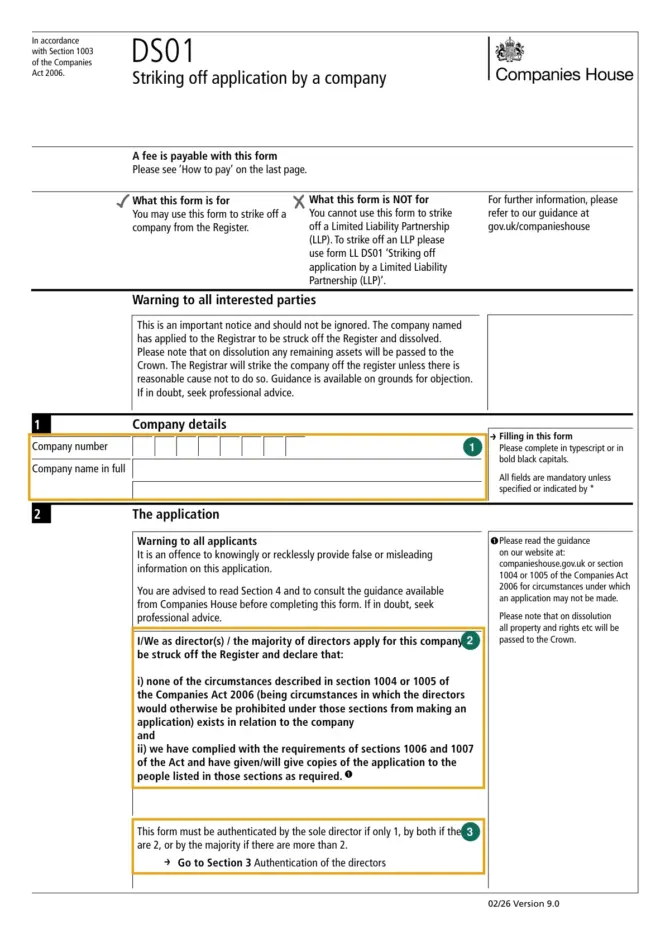
| Section | What goes in | What to check first |
|---|---|---|
| 1 Company details | Company number and the company name in full. | The company’s entry on the register; no abbreviations. |
| 2 The application | Nothing to write. By authenticating, the directors declare that no section 1004 or 1005 circumstance applies and that copies have been or will be given under sections 1006 and 1007. | The 3-month and insolvency conditions above. |
| 3 Authentication of the director(s) | Forename, surname and authentication date (day, month, year) for each director authenticating on behalf of the company. | How many directors are currently appointed. |
| 4 What to do next | Nothing to write. It sets out the 7-day notification duty and when DS02 must be used. | The list of people who must receive a copy. |
| Presenter information | Optional contact name, company name, address, DX and telephone. | Anything entered here is visible to searchers of the public record. |
The number of directors who must authenticate depends on how many there are: the sole director if there is only one, both if there are two, and a majority if there are more than two. The checklist gives the example of 4 out of 6 directors. Section 3 has room for four directors; if more need to authenticate, add the DS01 continuation page, which has the same forename, surname and date boxes.
Section 2 also carries a warning that it is an offence to knowingly or recklessly give false or misleading information in the application. GOV.UK’s strike-off guide says a dishonest application can lead to a fine and possible prosecution.
Who must receive a copy within 7 days
Within 7 days from the day the application is made, a copy goes to everyone in these groups, as listed in the Companies House guidance:
- members, usually the shareholders
- existing and likely creditors, such as banks, suppliers, former employees the company owes money to, landlords or tenants, guarantors, personal injury claimants, HMRC and the Department for Work and Pensions
- employees
- managers or trustees of any employee pension fund
- any directors who did not sign the application
The duty continues after that first round. Anyone who becomes a director, member, creditor, employee or pension fund manager or trustee after the application is made must also get a copy within 7 days, until the company is dissolved or the application is withdrawn. A copy can be posted to or left at an individual’s last known address, or a company’s principal or registered office. For a creditor, it can also go to the place of business the company dealt with over the current debt, such as the branch that invoiced it, and to each such place if there is more than one. Both the form and the guidance advise keeping proof of delivery or posting.
Failing to notify is an offence. The DS01 form gives the maximum as 12 months in prison for English or Welsh companies and 6 months for Scottish or Northern Irish companies. The Companies House guidance adds that withholding a copy with the intention of concealing the application can lead to up to 7 years in prison and an unlimited fine, and that directors can be disqualified for up to 15 years.
Why paper DS01 forms are returned
The publication page for DS01 says many paper forms are sent back because they are incorrect, which delays the application. The reasons it gives most often:
- no printed name for a director in section 3 (on version 9.0, the forename and surname boxes)
- no date next to a director’s entry (the authentication date boxes)
- fewer than a majority of directors have completed section 3; with 2 directors both must do so, with 3 at least 2
- the £18 fee is missing
- the cheque is drawn on the account of the company being struck off
- the company name or number is incomplete or does not match the register
That page still describes section 3 in terms of signatures and a “Signature Date” field, while version 9.0 asks each director to confirm “I am authenticating this form on behalf of the company” and give a name and authentication date. The checklist on page 3 of the form also asks you to attach the continuation page where it is needed.
Fee and where to send DS01
Applying online through the Companies House close-a-company service costs £13, paid by debit or credit card. The paper application costs £18 and can only be paid by cheque or postal order, made payable to “Companies House”. The fees were updated on 1 February 2026. Companies House says paper applications sent by post usually take much longer to process, which could delay the strike off.
The form points to the Companies House office page for the postal address. That page says documents for companies registered anywhere in the UK go to the main office: Companies House, Crown Way, Cardiff, CF14 3UZ (DX 33050 Cardiff). A stamped addressed envelope and a copy of your covering letter get you an acknowledgement of receipt, though not of registration.
Official PDF: DS01 — Official PDF (assets.publishing.service.gov.uk)
What happens after Companies House accepts it
Companies House examines the application and writes to say whether the form was filled in correctly. If it is acceptable, it registers the application on the public register, sends an acknowledgement to the address on the application, notifies the company at its registered office and publishes a notice of the proposed strike off in the Gazette for the part of the UK where the company was incorporated: London for England and Wales, Edinburgh for Scotland, Belfast for Northern Ireland.
If there is no reason to delay, the company is struck off not less than 2 months after that first notice. A second Gazette notice then confirms that it has been dissolved. Interested parties can object once the first notice appears, and the objection has to arrive at least 2 weeks before the strike-off date given in the notice.
If the company stops being eligible before the application is finally dealt with, for example because it starts trading again or becomes insolvent, the application must be withdrawn on DS02 or through the online service. A company that simply changes its mind can also withdraw while it is still on the register. Only one director needs to sign the DS02.
Sources
- Companies House DS01, striking off application by a company, 02/26 version 9.0
- DS01 continuation page, 02/26 version 9.0
- Strike off a company from the register (DS01)
- Important: before you apply to strike off your company
- Striking off or dissolving a limited company
- Strike off your limited company from the Companies Register
- Companies House: access and opening, sending documents by post