CS01 is the paper confirmation statement: at least once every 12 months a company tells Companies House that the information on its register entry is up to date, and confirms that its intended future activities are lawful. Version 7.0, dated February 2026, comes with six additional parts. Part 5, made under section 30(2) of the Economic Crime and Corporate Transparency Act 2023, collects a registered email address, and Part 6 collects identity verification details for each director.
Who has to file a confirmation statement, and by when?
Every company files one, dormant and non-trading companies included, and the duty applies even when nothing has changed during the review period. Companies House guidance sets the review period at 12 months from incorporation for the first statement, then 12 months from the confirmation date on the previous statement. Once that period ends, there are 14 days to deliver the statement. Section 2 of CS01 repeats the rule: the form must arrive within 14 days of the confirmation date you enter.
You can check the confirmation date and filing deadline on the company’s entry in the Find and update company information service, and sign up for email reminders. Failing to file can lead to a fine of up to £5,000, and the company may be struck off the register.
A company being restored to the register has to use the paper CS01. Its confirmation date is the one that was due before the company was struck off; if that date is uncertain, the GOV.UK publication page asks you to contact Companies House before completing the form.
Changes that go on other forms first
CS01 cannot record changes to officers, people with significant control (PSC), the registered office address or the single alternative inspection location (SAIL). Those changes, and a change of registered email address, have to be filed separately, before the confirmation statement or at the same time. A new director goes on AP01, a director leaving on TM01, a change to an existing director’s name or address on CH01, and a person ceasing to be a PSC on PSC07.
Identity verification is now a condition of acceptance. Companies House guidance says it will not accept a company’s confirmation statement until all of its directors have verified their identity. A director verifies only once and then has a Companies House personal code; the company needs each director’s code for Part 6. PSCs must verify as well, on a timetable that depends on their situation, but Part 6 is not for their codes.
How to fill in CS01, section by section
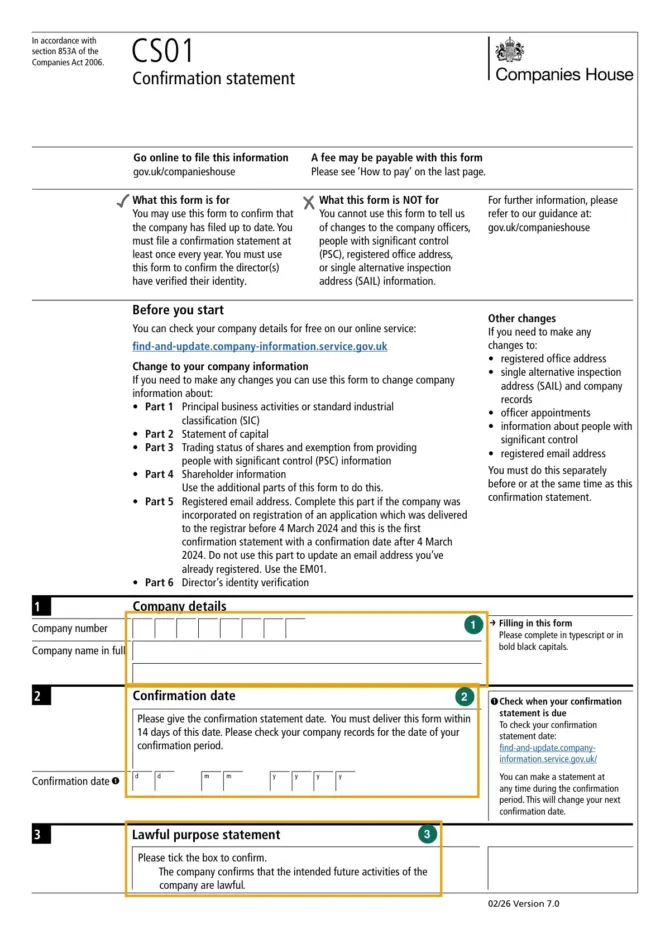
The main form is three pages: sections 1 to 4 and a final page with the checklist, presenter details and payment. Complete it in typescript or bold black capitals. Parts 1 to 6 are separate PDFs on the publication page; send only the parts that apply, at the same time as the main form.
| Section or part | What you enter | When it is needed |
|---|---|---|
| 1 | Company number and company name in full. | Always. Copy them from the public register. |
| 2 | Confirmation date, as day, month and year. | Always. Deliver CS01 within 14 days of it. |
| 3 | Tick the lawful purpose statement. | Always. The checklist lists it as a separate item. |
| 4 | Printed name of the person authenticating the statement. | Always. No signature is needed. |
| Part 1 | New SIC codes (A1) and codes no longer used (A2), up to four of each. | Only if the SIC codes changed in this confirmation period. |
| Part 2 | Statement of capital (B1) and prescribed particulars per share class (B2). | If share capital or the particulars changed since the last statement of capital. |
| Part 3 | Trading status of shares (C1, C2) and PSC exemption (C3). | First time this information is given, or if it changed. |
| Part 4 | Shareholder changes: D1 for non-traded companies, D2 for certain traded companies. | If shareholder information changed. Not for companies without share capital or DTR5 companies. |
| Part 5 | One registered email address (E1). | Only if the company has never given one; see the conditions below. |
| Part 6 | Each director’s name, date of birth, verification tick and personal code (F1 to F3). | For every current director whose details have not already been provided. |
For section 2, the form asks you to check the date against the company’s records of its confirmation period. The lawful purpose tick in section 3 confirms that the company’s intended future activities are lawful.
Section 4 states that everything the company had to deliver under section 853A(1)(a) of the Companies Act 2006 for the period ending on the confirmation date has been delivered or is being delivered with the statement. The person whose printed name goes under it may be a director, the secretary, a person authorised under section 270 or 274, a Charity Commission receiver and manager, a CIC manager or a judicial factor. For a United Kingdom Societas, replace “director” with the organ of the UKS the person belongs to.
Parts 1 to 4: SIC codes, share capital and shareholders
Part 1 uses SIC 2007 codes. List new codes in A1 and codes to drop in A2. If no code fits, write a short description of the main business activity instead. GOV.UK points to the condensed list of SIC codes for this.
Part 2 needs both B1 and B2. In B1, use one currency table per currency (for example sterling in table A and euros in table B) and give each class of shares, the number of shares, the aggregate nominal value and any total amount unpaid, which includes share premium. Totals in different currencies are listed separately, as in £100 + €100. B2 then describes, for each class, the voting rights, the dividend rights, the capital rights on a distribution or winding up, and whether the shares are redeemable. Part 2 is not required for a company without share capital.
Part 3 starts with C1: were any shares admitted to trading on a market during the confirmation period? If not, go straight to Part 4, section D1. If they were, C2 asks whether the company was, throughout the period, a traded company and an issuer to which DTR5 applies (chapter 5 of the FCA Disclosure and Transparency Rules). C3 asks whether the company is, or has ever been, exempt from providing PSC information; a “yes” means ticking one of four statements (voting shares on a UK regulated market, on an EU regulated market, on a market in Schedule 1 of the 2016 PSC Regulations, or the exemption no longer applies). A “no” leads to Part 4, section D2.
In Part 4, D1 lists the shareholders of a non-traded company in alphabetical order, with joint holders listed one after another. For each, give the name (no address), class of share, shares held at the confirmation date and any shares transferred with the date the transfer was registered, then tick whether the list is enclosed on paper or in another format. D2 is for traded companies outside DTR5 and covers anyone who held at least 5% of the issued shares of a class at the end of the period: name, address, class and number of shares. Continuation pages exist for the statement of capital, the prescribed particulars and both shareholder tables; they are optional.
Part 5 registered email and Part 6 director verification
Part 5 is for a company whose incorporation application reached the registrar before 4 March 2024 and which is filing its first confirmation statement with a confirmation date after 4 March 2024. It also applies to a company dissolved before that date that delivers CS01 as part of a restoration. Give one email address that would, in the ordinary course of events, reach someone acting for the company. Companies House uses it to contact the company and does not publish it. An address already registered is changed through EM01 or the registered email address service, not Part 5.
Part 6 takes one page per director. F1 is the director’s name as it appears on the company record, plus date of birth. F2 is a tick confirming that the director has verified their identity under the Companies Act 2006, and the director’s 11-character Companies House personal code. F3 asks whether that name matches the verified name; if it does not, choose a reason: legally changed name, preferred name, translation or a different naming convention, error on the public register, or prefer not to say. Corporate directors and PSCs are outside Part 6.
Both pages carry a barcode that must not be covered and are kept off the public record. Apart from the Part 5 email address and the identity verification details, everything on CS01 goes on the public record, including any presenter contact details you add on page 3.
Fee and payment period
Filing online costs £50 and filing a paper CS01 by post costs £110. The fee is due only with the first confirmation statement in each 12-month payment period, which runs from the date of incorporation. For older companies it ends on the anniversary of the return date of the last annual return (AR01). The payment period cannot be changed and is separate from the review period. A second statement filed later in the same payment period carries no fee.
With a paper form, pay by cheque or postal order made payable to “Companies House”. The file-online page adds that the company number should be written on the back of the cheque.
Where to send a paper CS01
The online WebFiling service needs the company’s password and authentication code; without them, register for online filing first. On paper, print the form at full size on white A4. Companies House accepts uploads of certain forms in place of posting. Posted documents go to the main office for companies registered anywhere in the UK: Companies House, Crown Way, Cardiff, CF14 3UZ, or DX 33050 Cardiff.
Official PDF: CS01 — Official PDF (assets.publishing.service.gov.uk)
What gets a CS01 returned or refused
Guidance says the statement is not accepted until every director has verified their identity. The checklist on page 3 adds that Companies House may send back a form that is completed incorrectly or has information missing, and lists what it looks for:
- a company name and number that match the public register;
- the lawful purpose statement in section 3 ticked;
- SIC, capital, trading status and shareholder changes shown on Parts 1 to 4, and other changes filed on their own forms before or with CS01;
- Part 5 enclosed when the company has no registered email address yet;
- Part 6 completed for directors whose verification details have not been given;
- a printed name in section 4;
- the £110 fee with the first paper statement in the payment period.
Questions about the confirmation statement
Can I file the confirmation statement before the review period ends?
You can file at any time in the period. The date you choose becomes the new confirmation date and the next review period starts the following day.
Can CS01 change the registered office address?
It cannot. A new registered office address is filed separately, before the confirmation statement or at the same time.
Sources
- Companies House CS01, confirmation statement, 02/26 version 7.0
- GOV.UK: Confirmation statement (CS01), with Parts 1 to 6 and continuation pages
- CS01 Part 1: change your standard industrial classification (SIC) code
- CS01 Part 2: change your statement of capital
- CS01 Part 3: change your trading status of shares, or exemption from providing PSC information
- CS01 Part 4: change your shareholder information
- CS01 Part 5: registered email address
- CS01 Part 6: director’s identity verification
- Companies House: filing your company’s confirmation statement
- GOV.UK: file your confirmation statement with Companies House
- Companies House: access, opening times and sending documents by post