Form 92A205 is the Kentucky inheritance tax return written for small estates: ten assets or fewer, no federal estate tax return, and none of the lifetime gifts, retained life interests or recently inherited property that would push the estate onto the long Form 92A200. On three pages it lists what the decedent owned, subtracts the allowed expenses and works out the tax for each beneficiary who is not exempt. The revision printed on the form is 92A205 (6-16), and the Department of Revenue (DOR) still offers that version.

Who files Form 92A205, and when no return goes to DOR
Kentucky taxes the beneficiary’s right to receive the property, so the relationship to the decedent decides whether anything is owed. DOR’s inheritance tax page says a return must only be filed by the personal representative when any part of the estate passes to taxable beneficiaries or a federal Form 706 is required. Beneficiaries fall into three classes:
| Class | Who is in it | Exemption and rate |
|---|---|---|
| A | Surviving spouse, parent, child, grandchild, brother, sister, half-brother, half-sister | Exempt for deaths after June 30, 1998 |
| B | Niece, nephew, half-niece, half-nephew, daughter-in-law, son-in-law, aunt, uncle, great-grandchild | $1,000 exemption, 4% to 16% |
| C | Everyone else, including cousins, nieces and nephews by marriage, great-nieces and great-nephews | $500 exemption, 6% to 16% |
The packet’s exemption list spells out who counts as a child: a child by blood, a stepchild, a child adopted during infancy, or a child adopted as an adult who was reared by the decedent during infancy. Charitable, educational and religious organizations exempt under KRS 140.060 owe no tax either.
When everything passes to Class A relatives or exempt organizations and no federal estate tax return is required, Form 92A205 is not needed. DOR accepts an Affidavit of Exemption, Form 92A300 (9-13), for final settlement of the estate in court. The affiant is the fiduciary or a beneficiary, the affidavit is sworn before a notary public, and it is filed only with the court: DOR says not to send it a copy. The No Tax Due return, Form 92A201, is the return DOR provides for estates that pass entirely to those exempt beneficiaries.
If tax is due, the short form may be used for a resident or nonresident decedent when all six conditions printed at the top of page 1 are met:
- No federal estate tax return is required.
- The estate consists of 10 items or less.
- No gifts or transfers were made within three years of death without full consideration.
- No real or personal property was transferred with a retained life interest.
- The decedent held no power to appoint property and had no use of qualified terminable interest property.
- The decedent had not received property from another decedent within five years on which inheritance tax was paid.
If any condition fails, the estate files Form 92A200. Page 1 also cites KRS 140.190: the beneficiaries as well as the personal representatives may be held personally liable for the tax.
How to fill out page 1 of Form 92A205
Page 1 holds the identifying details, the totals carried from pages 2 and 3, and the signatures. The PDF on DOR’s site has no fillable fields, but the packet instructions say the forms may be duplicated on a computer and the space for each item made larger or smaller. The numbers in the image were added for this guide and are not printed on the form.
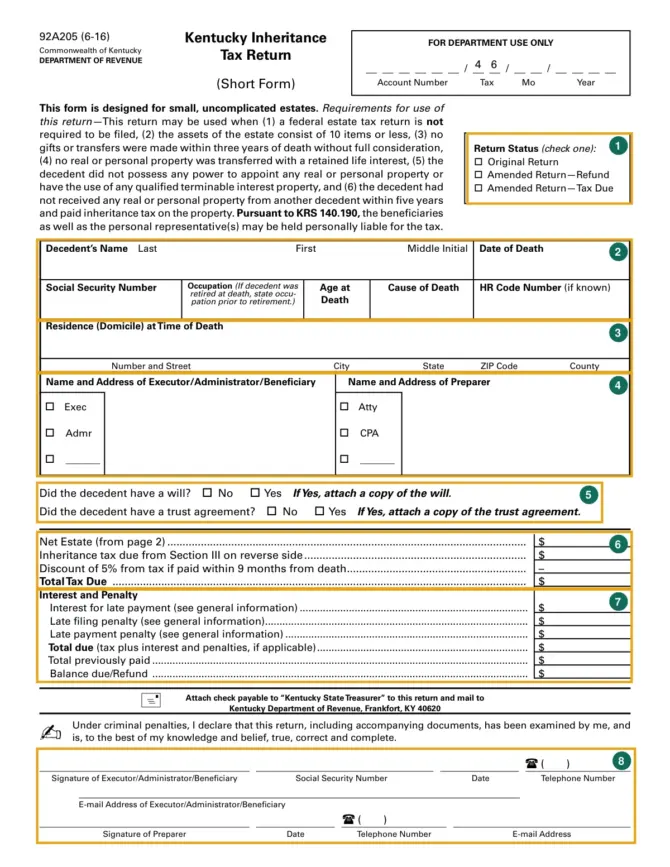
| Marker | Part of page 1 | What goes in it |
|---|---|---|
| 1 | Return Status | Original Return, Amended Return (Refund) or Amended Return (Tax Due). Check one. |
| 2 | Decedent’s name, date of death, Social Security number, occupation, age at death, cause of death, HR code number | For a decedent who was retired, the occupation before retirement. The HR code number only if known. |
| 3 | Residence (domicile) at time of death | Number and street, city, state, ZIP code and county. |
| 4 | Name and address of executor, administrator or beneficiary; name and address of preparer | Check Exec or Admr, or write the role on the blank line. The preparer side has Atty, CPA and a blank line. |
| 5 | Will and trust agreement questions | A Yes answer means a copy of the will or trust agreement goes with the return. |
| 6 | Net Estate through Total Tax Due | Net estate from page 2, inheritance tax from Section III, minus the 5% discount if paid within 9 months of death, giving Total Tax Due. |
| 7 | Interest and Penalty | Interest, late filing penalty, late payment penalty, Total Due, Total previously paid and Balance due/Refund. |
| 8 | Signatures | The executor, administrator or beneficiary signs with Social Security number, date, telephone and e-mail; the preparer signs with date, telephone and e-mail. |
The signer declares under criminal penalties that the return and the documents with it are true, correct and complete. The box marked For Department Use Only, at the top right, is DOR’s. The interest and penalty lines in marker 7 come into play only when the return is filed or the tax paid more than 18 months after death.
Section I: the gross estate on page 2
Section I lists every item the decedent owned or had an interest in. For each one the form asks for a description and location, how it was owned (individually, or jointly with or without survivorship), the date it was placed in joint names, the co-owner’s name, the fair cash value of the 100% interest at the date of death and the decedent’s share. The survivorship and date columns are marked REQUIRED on the form.
The DOR guide’s examples of taxable property include bank accounts even outside Kentucky, certificates of deposit, stocks and bonds, life insurance payable to the insured or the estate, annuities, household goods, automobiles, boats and travel trailers, income tax refunds and jewelry. DOR’s page says all property of a Kentucky resident is subject to the tax except real estate located in another state.
- Each parcel of real estate needs its own Form 92A204, Real Estate Valuation Information Form.
- Stocks and bonds need a balance sheet dated nearest the date of death plus a statement of net earnings and dividends for the five years before death. The form gives a financial institution’s monthly statement as an example.
- DOR’s March 2026 presentation says stocks are valued at the average of the high and low selling price on the date of death, or, if the exchanges were closed that day, the average for the last working day before and the first working day after.
- The same presentation says alternate valuation is not allowed. Brokerage accounts and IRAs are reported with their cash, accrued interest and dividends, and any annuities held in the account.
Section II: deductions and the net estate
Funeral expenses, the monument and the cemetery lot with its maintenance are added into a subtotal that may not exceed $5,000. Below it come personal representatives’ commissions, attorneys’ fees, appraisers’ fees and court costs, and the decedent’s share of mortgages and liens. Other debts of the decedent are itemized only if they total more than $500. Total Gross Estate minus Total Deductions is the Net Estate, which is copied to page 1.
DOR’s 2026 presentation adds three limits. Administration expenses such as attorney’s fees and the personal representative’s commission can be deducted on the inheritance tax return or on the Kentucky fiduciary income tax return, Form 741, not on both. Trustee fees are not deductible. Real estate selling costs count as administration expenses when the will directs the executor to sell; otherwise the executor gives DOR the reason the sale was necessary.
Section III: tax for each beneficiary on page 3
Page 3 is printed sideways. Each heir, beneficiary or exempt organization gets a line with relationship, Social Security number, age, distributive share and tax. The distributive shares must add up to the net estate, so Class A relatives are listed with their shares even though their tax is zero. The table instructions say to compute each beneficiary’s tax separately and not to subtract the exemption from the share, because the table already applies it.
Using the resident table, a niece (Class B) whose share is $25,000 falls in the $20,000 to $30,000 bracket: $860 plus 6% of the $5,000 above $20,000, or $1,160. A cousin (Class C) with $10,000 owes $30 plus 6% of the $9,000 above $1,000, or $570. If the tax is paid within nine months of death, the 5% discount takes $58 off the niece’s tax. The total of the Tax column goes to page 1 as Inheritance tax due from Section III.
For a nonresident decedent, the exemption is prorated by the share of the net estate that is taxable in Kentucky, and the packet has a separate nonresident table.
Deadline, discount, installments and late charges
When tax is due, the return must be filed within 18 months of the date of death. DOR’s page says filing should not wait for a federal estate tax closing letter or for real estate to be sold. The tax is meant to be paid with the return, and any payment made within nine months of death earns the 5% discount.
A beneficiary whose tax is more than $5,000 may pay in 10 equal annual installments, the first one with the return. The election is made on Form 92A928 when a timely return is filed, and the deferred amount carries interest starting 18 months after death.
- Interest runs from the end of the 18 months until the tax is paid. The packet says the inheritance tax law has no provision to waive interest.
- Late filing penalty: 2% of the total tax due for each 30 days or fraction, at least $10 and at most 20%.
- Late payment penalty: 2% of the total tax due for each 30 days or fraction, at least $10 and at most 20%. It does not apply if at least 75% of the tax was paid on time.
- Both penalties accrue from 18 months after death and may be waived for reasonable cause as defined in KRS 131.010.
The interest rate table in the February 2018 packet ends with 5% for 2017. DOR now sets the rate each January: its notice for 2026 puts the tax interest rate at 7% and says taxes not paid on time accrue 9% under KRS 131.183(2)(a)2. The inheritance tax packet refers to the rate in KRS 131.010(6) and does not say which of the two applies to inheritance tax paid after 18 months, so ask the Financial Tax Section at (502) 564-4810 for the figure before you pay.
Where to mail Form 92A205 and the official PDF
Attach a check payable to “Kentucky State Treasurer” to the return and mail both to Kentucky Department of Revenue, Frankfort, KY 40620. For overnight delivery DOR’s page gives Kentucky Department of Revenue, 501 High Street, Frankfort, KY 40601-2103. Questions go to the Financial Tax Section, Station 61, at the same street address, phone (502) 564-4810, fax (502) 564-2695.
The Form 92A205 PDF on DOR’s site is revision 6-16, tagged as current in DOR’s forms library, and it is the same three pages found in the Inheritance and Estate Tax Forms and Instructions packet (revised February 2018). The packet holds the general information, the tax tables, Forms 92A200, 92A201, 92A204, 92A928, 92A936 and 92A300. DOR’s inheritance tax page notes that the inheritance tax forms are current as of tax year 2012, and the forms in the packet are for dates of death on or after January 1, 2005.
Releasing bank accounts, stocks and safe deposit boxes
Banks and brokers do not need a DOR consent before transferring a Kentucky decedent’s property. A DOR notice in the packet, Form 92F001 (3-12), says that since July 1, 1998 no prior written consent (lien release) is required for transferring specific property of a resident or nonresident decedent. It grants a blanket release on real estate, stocks, bonds, cash accounts, trust funds, life insurance, retirement accounts and safe deposit box contents, and lets a bank open a decedent’s box without DOR or the local PVA present. The notice may be copied as proof that the lien no longer exists, but it does not relieve personal representatives or beneficiaries of tax they owe.
After the return is filed
DOR sends an Acceptance Letter, or a No Tax Due Letter, if the return is accepted as filed. If DOR changes the tax, it sends an audit report, which includes protest information when more is owed; an overpayment is refunded by check. A correction can be made by letter or on Form 92A200, with any added tax and interest paid at the same time; a refund claim includes the amended tax computation. DOR keeps an inheritance tax return for 20 years after the acceptance letter, and a copy can be requested in writing by the attorney, preparer, personal representative or a residuary beneficiary.
What to enclose with Form 92A205
- A check payable to the Kentucky State Treasurer for the balance due.
- A copy of the will and of any trust agreement, if the page 1 answers are Yes.
- Form 92A204 for each parcel of real estate.
- Balance sheets and five years of earnings and dividend statements for stocks and bonds.
- Form 92A928 if a beneficiary elects installments.
- Any disclaimer, renunciation, pre-marital agreement or adoption papers, and a court order setting aside personal property under KRS 391.030(1)(c), if they apply.
Questions about Kentucky inheritance tax filings
Where is a disclaimer filed, and by when?
DOR’s 2026 presentation says a disclaimer of a bequest in a will is filed with the district court, and a disclaimer of jointly owned property with the trustee or custodial institution, in both cases within nine months of death. A disclaimed bequest passes to the beneficiary’s issue unless the will names a contingent beneficiary, and otherwise falls into the residue.
What if the decedent made a gift within three years of death?
The short form cannot be used when a gift was made within that period without full consideration. Such gifts are presumed to be made in contemplation of death, and an estate that disputes this submits a written statement with documentation along with Form 92A200.
Official sources
- Kentucky Department of Revenue, Form 92A205, Kentucky Inheritance Tax Return (Short Form), revision 6-16
- Kentucky Department of Revenue, Kentucky Inheritance and Estate Tax Forms and Instructions, revised February 2018
- Kentucky Department of Revenue, Inheritance Tax
- Kentucky Department of Revenue, A Guide to Kentucky Inheritance and Estate Taxes, 92F101 (1-21)
- Kentucky Department of Revenue, Affidavit of Exemption, Form 92A300 (9-13)
- Kentucky Department of Revenue, Kentucky Inheritance Tax presentation, March 16, 2026
- Kentucky Department of Revenue, Form 92A204, Real Estate Valuation Information Form