Every partnership, S corporation and general partnership that files Kentucky Form PTE prepares a Kentucky Schedule K-1 (Form PTE) for each owner. It is not a copy of the federal K-1. The amounts are figured under Kentucky law, so depreciation, the IRC §179 deduction and gains on assets can differ from the federal schedule, and a resident owner uses that difference to adjust Kentucky income.
The 2025 schedule runs six pages and carries the revision code 41APTE(K-1)(10-25). Pages 1 to 4 hold the entries. Pages 5 and 6 are the owner’s instructions, and the Form PTE instructions say the K-1 goes to each owner together with instructions. The 2025 version is used for calendar year 2025 and for fiscal years that begin in 2025.

Who prepares the Kentucky K-1 and who receives one
The entity prepares the schedule, and a line on page 1 names the issuer type: partnership, S corporation or general partnership. One K-1 is made for each partner, member or shareholder, and Form PTE Item H asks for the number of K-1s issued or received and the number of owners included in the return.
On the owner’s side, page 5 states that owners are taxed on their share of the entity’s income whether or not it was distributed. A resident S corporation shareholder reports 100 percent of the share. A nonresident reports the part attributable to the business in Kentucky, unless the entity is withholding for that owner under KRS 141.206. For every type of entity, page 5 adds that pass-through income is not exempted by reciprocal agreements between Kentucky and other states.
Item C lists the owner types the entity can report, from individuals and trusts to corporations, ESOPs and other pass-through entities. Each of those owners carries the figures to its own Kentucky return.
Filling in the identification block and items A to E
The top of page 1 asks for the owner’s identifying number, the entity’s FEIN and its Kentucky Corporation/LLET account number. The account number box says it must be 9 digits, with leading zeros when the number has 6 digits. The same three numbers repeat at the foot of pages 2, 3 and 4. A box beside the entity’s address is checked when the entity is a qualified investment pass-through entity.
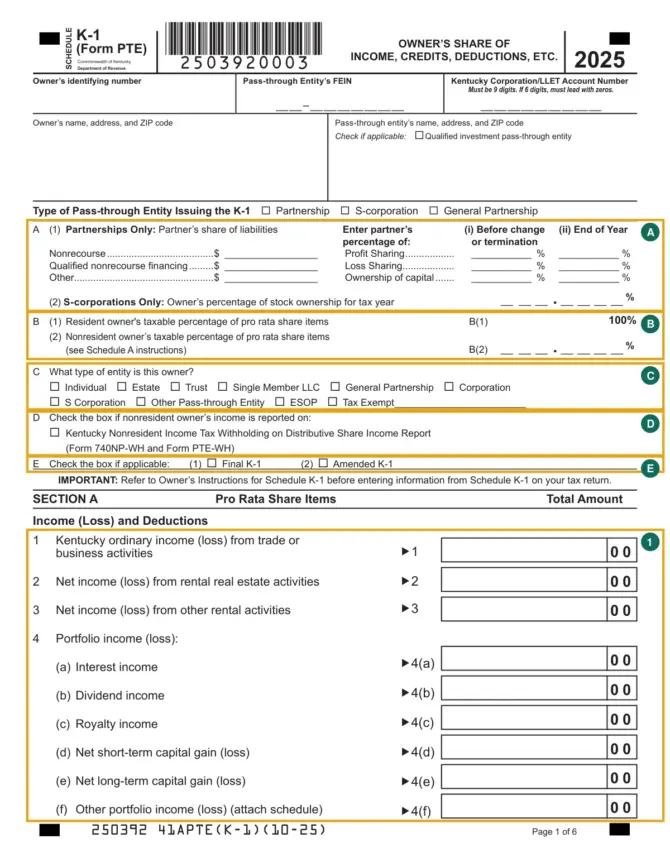
| Item | What goes there |
|---|---|
| A(1) | Partnerships only. The partner’s share of liabilities split into nonrecourse, qualified nonrecourse financing and other, plus the profit sharing, loss sharing and capital ownership percentages before a change or termination and at the end of the year. |
| A(2) | S corporations only. The shareholder’s percentage of stock ownership for the tax year. |
| B(1) | Preprinted at 100% for a resident owner. |
| B(2) | The nonresident owner’s taxable percentage. The form points to the Schedule A instructions; Schedule A, Part I computes the apportionment fraction (line 3, or line 12 for an entity required to use three-factor apportionment under KRS 141.121). |
| C | One box for the owner type: individual, estate, trust, single member LLC, general partnership, corporation, S corporation, other pass-through entity, ESOP or tax exempt. |
| D | Checked only when the nonresident owner’s income is reported on Form 740NP-WH and Form PTE-WH. |
| E | E(1) for a final K-1; E(2) for an amended K-1. |
The amounts in Sections A to D are the owner’s full pro rata share. The instructions say not to multiply them by the B(2) percentage on the K-1 itself; the nonresident owner applies B(2) on the owner’s return.
Section A line by line
Section A mirrors Kentucky Schedule K. Added across all K-1s, lines 1 through 22 must equal Schedule K lines 1 through 22. When lines 1, 2 or 3 combine more than one activity, or a loss comes from an at-risk activity, the entity attaches activity-by-activity details to the K-1.
| Line | Owner’s share of | Where the entity takes the figure |
|---|---|---|
| 1 | Kentucky ordinary income (loss) | Form PTE, Part I, line 21 |
| 2, 3 | Rental real estate; other rental activities | Federal Schedule K, adjusted for Kentucky law differences (Form 8825 goes with Form PTE) |
| 4(a) | Interest income | Federal Schedule K, less tax-exempt U.S. government interest, plus interest on other states’ obligations |
| 4(b), 4(c) | Dividends; royalties | Federal Schedule K |
| 4(d), 4(e) | Net short-term and long-term capital gain (loss) | Kentucky Schedule D lines 7 and 15 when Kentucky basis differs; otherwise the federal Schedule D lines |
| 4(f) | Other portfolio income (loss) | Attach a schedule |
| 5 | Guaranteed payments | Partnerships only |
| 6 | IRC §1231 net gain (loss) | Kentucky Form 4797 line 7, or federal Form 4797; casualty and theft gains go on line 7 |
| 7, 8 | Other income (loss); charitable contributions | Schedules attached; contributions split by the 50, 30 and 20 percent limits, applied to Kentucky amounts |
| 9 | IRC §179 expense deduction | Kentucky Form 4562 line 12 (attach federal and Kentucky Form 4562) |
| 10, 11 | Deductions related to portfolio income; other deductions | Line 10 excludes expenses tied to tax-exempt income |
| 12(a)–(b)(2) | Investment interest expense; investment income on lines 4(a), 4(b), 4(c), 4(f); investment expenses on line 10 | Federal Schedule K, adjusted |
| 13(a)–(c) | Nonrefundable tax credits, entered by code | Code list in the Form PTE instructions |
| 14–16 | Refundable credits: certified rehabilitation, Kentucky Entertainment Incentive, decontamination | General partnerships only, with the certification or approval attached |
| 17(a), 17(b) | Type and amount of IRC §59(e)(2) expenditures | Federal Schedule K, Form 1120S line 12c or Form 1065 line 13c |
| 18, 19 | Tax-exempt interest; other tax-exempt income | Line 18 covers U.S. government obligations and those of Kentucky and its political subdivisions |
| 20 | Nondeductible expenses | Includes state taxes measured by income |
| 21 | Property distributions other than dividends reported on Form 1099-DIV | Form 1120S line 16d or Form 1065 lines 19a and 19b, adjusted |
| 22 | Supplemental information | Attached schedule, for example §179 recapture and oil and gas depletion data |
| 23 | S corporations only: dividend distributions paid from accumulated earnings and profits | Form 1120S line 17c, adjusted |
Lines 4(d), 4(e), 6 and 9 are the lines the instructions tie to Kentucky’s depreciation and §179 rules. Kentucky allows a §179 deduction of $25,000 for property placed in service after September 10, 2001 and before January 1, 2020, and $100,000 for property placed in service on or after January 1, 2020, without the federal phase-out. Once an entity has taken MACRS bonus depreciation or §179 above those amounts, the instructions say the differences continue through the life of the assets.
Line 13 takes a code and an amount. The 2025 instructions list 21 codes, among them KSBTC (Kentucky Small Business), CR (certified rehabilitation), QR (qualified research facility), ENDOW, DS (distilled spirits), INV (inventory) and KQBI, the broadband credit for purchases made on or after January 1, 2025. DOR’s Pass-Through Entities page says business tax credits, including the refundable pass-through entity tax credit available to owners when the entity elects to pay tax at the entity level, pass to owners on Schedule K/K-1 line 13. The 2025 code list in the Form PTE instructions has no separate code for that refundable credit, and line 13 is headed “Nonrefundable” on the form. An entity that made the PTET election and needs to report that credit should confirm the code with the Pass-Through Entity Branch at 502-564-8139.
Sections B, C and D: LLET and apportionment figures
Section B is marked “Required” on the form. Lines 1 to 4 carry the owner’s share of Kentucky gross receipts, total gross receipts, Kentucky gross profits and total gross profits from Schedule L. Line 5 is the owner’s share of the nonrefundable LLET credit, which the instructions compute as Form PTE, Part II, lines 4 and 6 added together, less $175.
Section C gives Kentucky receipts and total receipts from Schedule A, Part I, lines 1 and 2. Section D, headed 3-Factor Apportionment (KRS 141.121), adds Kentucky and total property (Schedule A lines 5 and 6) and Kentucky and total payroll (lines 8 and 9). An owner that files its own Schedule A, a corporation or another pass-through entity, reports the apportioned factors received on K-1s in Section B of the Schedule A continuation sheet.
For an individual S corporation shareholder, the PTE instructions describe the LLET credit as the shareholder’s share of the current-year LLET after credits, reduced by $175. It can be used only against income tax on income from that S corporation; any remainder is disallowed.
How a resident owner uses Section E
Section E is for Kentucky residents filing Form 740 and does not tie to Schedule K. It compares the Kentucky K-1 with the federal K-1:
- Line 1 takes the Kentucky K-1 amounts from Section A, lines 1 through 7 and 9, plus the parts of lines 8, 10 and 11 that do not pass to Schedule A as itemized deductions. The label printed on the form itself reads “lines 1 through 6, 9, and portions of lines 7 and 11”; the fuller wording here is from the owner’s instructions on page 5.
- Line 2 does the same with the federal K-1: Form 1120S lines 1 through 11 and the parts of line 12 that do not pass to Schedule A, or Form 1065 lines 1 through 12 and the parts of line 13 that do not pass to Schedule A.
- Line 3 is the difference. When line 1 is larger, it is an addition on Schedule M, line 2. When line 2 is larger, it is a subtraction on Schedule M, line 11.
When both lines are losses, the smaller dollar amount is subtracted from the larger; when one is income and the other a loss, the two amounts are added. If Form 8582-K is required, passive activity amounts are excluded from Section A lines 1, 2 and 3 and worked through Form 8582-K. Capital gains and losses on 4(d) and 4(e) that are subject to the capital loss limit stay out of lines 1 and 2 and go through federal Schedule D recomputed with Kentucky amounts.
With made-up figures: if the Kentucky lines net to $37,000 on line 1 and the federal lines net to $32,000 on line 2, line 3 is $5,000 and goes on Schedule M, line 2 as an addition.
Reporting the K-1 on Form 740-NP, Form 741 or a business return
A nonresident filing Form 740-NP uses the amounts as shown when B(2) is 100 percent. Below 100 percent, Section A lines 1 through 6 and 9, the relevant parts of lines 7 and 11, and the part of line 17(b) deducted this year are multiplied by B(2). Line 12(a) and the Schedule A parts of lines 8 and 10 are not multiplied, because Form 740-NP page 4, line 34 applies its own percentage to them.
| K-1 line | Form 740-NP entry |
|---|---|
| 1–3, 4(c), 9 | Federal Schedule E using Kentucky amounts (lines 1 to 3 go to Form 8582-K when it applies) |
| 4(a) | Form 740-NP, page 4, line 3 |
| 4(b) | Form 740-NP, page 4, line 4 |
| 4(d), 4(e) | Federal Schedule D using Kentucky amounts, or Form 8582-K |
| 5 | Guaranteed payments; the owner’s instructions name the item without a Form 740-NP line |
| 6 | Federal Form 4797 and Form 740-NP, page 4 |
| 8, 10 | Schedule A (Form 740-NP) |
| 4(f), 7, 11, 12, 17–23 | The lines named in the federal Schedule K-1 instructions |
An individual owner, resident or nonresident, also enters the net distributive share (Section A lines 1 through 6 and 9 with the relevant parts of 7 and 11, times B(2) for a nonresident partner) on line 2 of the Kentucky LLET credit worksheet in the Form 740, 740-NP or 741 instructions. Losses held back by the passive activity or capital loss limits are left out of that figure. Estates and trusts carry the K-1 to Form 741.
A corporate partner or member uses the share included in its Kentucky taxable income (times B(2) for a nonresident partner or member) on line 2 of the Corporation LLET Credit Worksheet in the Form 720 instructions, and Section B line 5 on line 7 of that worksheet. A pass-through entity that owns an interest in another one enters the LLET credit from the K-1s it received on Form PTE, Part II, line 4, and copies of those K-1s must be attached to claim it.
Nonresident individual owners can also be covered by withholding. The entity files Form 740NP-WH with a Form PTE-WH for each nonresident individual by the 15th day of the fourth month after the year ends, reporting at 4.0 percent, and gives two copies of Form PTE-WH to each such owner. When distributive share income is that owner’s only Kentucky-source income, the withholding report satisfies the owner’s filing requirement; the owner may still file Form 740-NP or Form 741 to use credits and deductions. The instructions list four cases with no withholding, among them a partner or member that is itself a pass-through entity and an individual owner of a qualified investment partnership.
When owners must have the K-1, and amended copies
The instructions require each K-1 to be completed and given to the owner, with instructions, on or before the day Form PTE is filed with the Department of Revenue. Form PTE is due on the 15th day of the fourth month after the taxable year ends, moved to the next business day when that date is a weekend or legal holiday. For a calendar-year 2025 entity that was April 15, 2026.
Form 720EXT filed by the original due date gives six more months to file Form PTE. A general partnership may file Form 40A102 by that date and include a copy with the return. An S corporation or limited liability pass-through entity with a federal extension gets the same time if a copy of federal Form 7004 is attached to the Kentucky return when it is filed. The Kentucky 720-EXT guide covers that slip. An extension does not extend the time to pay tax, and the K-1 deadline stays tied to the day Form PTE is actually filed.
When an amended Form PTE changes income or how income or other information is distributed to owners, amended K-1s are filed with it, a copy goes to each owner, and box E(2) is checked. The filing tips add that any adjustment to LLET or distributive share calls for corrected Kentucky K-1s to all partners, members or shareholders. After a federal partnership audit, the partnership notifies each direct partner of its share of the final federal adjustments, and each direct partner taxed under KRS 141.020 or 141.040 files a federal adjustments report within 180 days of the final determination date.
Where to get the 2025 form and where it is filed
DOR posts the 2025 Schedule K-1 (Form PTE) as a fillable PDF on revenue.ky.gov; the copy checked for this guide is coded 41APTE(K-1)(10-25). Under the Form PTE instructions, a copy of each owner’s K-1 is attached to Form PTE and a copy is kept with the entity’s records.
For tax years beginning on or after October 1, 2021, pass-through entities with federal gross receipts of $1,000,000 or more must file Form PTE and pay electronically. A waiver request on Form 8948 (K-C) goes by email to DORWEBRESPONSEPASSTHROUGHENTITY@ky.gov before a paper return is filed, and the approved form is attached to that paper return.
Paper Form PTE returns with a payment go to Kentucky Department of Revenue, Frankfort, KY 40620-0021, with checks payable to the Kentucky State Treasurer. Returns with no tax due or a refund request go to Kentucky Department of Revenue, Frankfort, KY 40618-0010. General partnerships owe no payment with Form PTE. Questions go to the Pass-Through Entity Branch, 501 High Street, Station 52, Frankfort, KY 40601-2103, phone 502-564-8139.
This guide follows DOR’s 2025 documents. Questions about how a particular federal item should be split between Kentucky K-1 lines belong with a tax adviser or the Pass-Through Entity Branch.
Official PDF: Schedule K-1 (Form PTE) — Official PDF (revenue.ky.gov)
Official sources
- Kentucky Department of Revenue, Schedule K-1 (Form PTE), Owner’s Share of Income, Credits, Deductions, etc., 2025, 41APTE(K-1)(10-25) (revenue.ky.gov)
- Kentucky Department of Revenue, Instructions for Form PTE, Kentucky Pass-Through Entity Income and LLET Return (2025) (revenue.ky.gov)
- Kentucky Department of Revenue, Schedule A, Apportionment and Allocation, 2025, 41A720A (10-25) (revenue.ky.gov)
- Kentucky Department of Revenue, Pass-Through Entities (revenue.ky.gov)