An extension request does not postpone Delaware corporate income tax payment. CIT-EXT calculates the expected unpaid liability after estimated payments and a credit carryover. This guide uses the 2025 form, revision 20250528, for calendar 2025 and the applicable fiscal year ending in 2026.
Who uses CIT-EXT and when a federal extension applies?
Corporations with a Delaware corporate income tax filing obligation use this payment-and-extension route. The 2025 CIT-TAX instructions say a six-month automatic federal extension also extends Delaware filing by six months; attach its copy to the final Delaware return. Payment of anticipated Delaware liability remains due by the original deadline.
An S corporation’s return and the Secretary of State’s franchise tax are separate matters. Incorporation in Delaware alone does not always create a corporate income tax filing obligation; the instructions describe exemptions. Confirm the income tax obligation before using CIT-EXT.
Completing the identity fields and seven-line worksheet
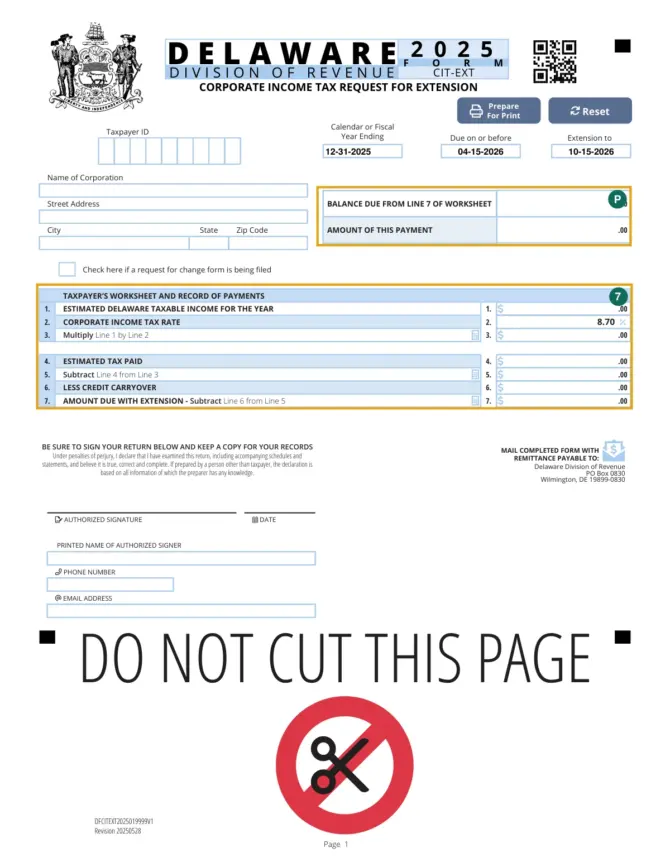
Enter the taxpayer ID, corporation’s legal name, street address, city, state and ZIP. Match the calendar or fiscal year ending date to the return. Complete the due-on-or-before and extension-to dates for that period; the interactive calendar-year defaults are December 31, 2025, April 15, 2026 and October 15, 2026.
| Field | What to enter or check |
|---|---|
| Request-for-change checkbox | Mark only when a request-for-change form is also being filed; it does not itself supply that separate request. |
| Worksheet 1–3 | Line 1: estimated Delaware taxable income. Line 2: the printed 8.70% corporate rate. Line 3: line 1 multiplied by line 2. |
| Worksheet 4–5 | Line 4: estimated tax already paid. Line 5: line 3 minus line 4. |
| Worksheet 6–7 | Line 6: credit carryover. Line 7: line 5 minus line 6, the amount due with the extension. |
| Upper payment boxes | Copy line 7 to Balance due from line 7 of worksheet; separately enter the amount actually remitted. |
| Declaration | Authorized signature, date, printed authorized signer name, phone and email. |
Estimate taxable income using the 2025 CIT-TAX instructions, including the applicable modifications and allocation rules. The worksheet starts with Delaware taxable income, not gross receipts. Reconcile estimated payments and carryovers against the account before subtracting them. For a taxable-income estimate of $10,000, the printed rate produces $870 before payments or credits.
Due dates, late payment and additional filing time
The corporate return is due on the 15th day of the fourth month after year-end. CIT-EXT must be filed by that original due date with the anticipated balance. For calendar 2025, the April 15, 2026 request deadline and October 15, 2026 extended filing date have both passed at this review; this form cannot create a timely extension retroactively.
Unpaid tax can attract interest and penalties despite extra filing time. A request beyond the automatic six months must be made by letter by the extended deadline, and the approval letter must accompany the final return. Refer to the linked CIT-TAX instructions for the applicable late-filing, late-payment and interest calculations.
Where to send the signed page and payment
Make the remittance payable to Delaware Division of Revenue and mail the complete form to Delaware Division of Revenue, P.O. Box 0830, Wilmington, DE 19899-0830. The form expressly says not to cut the page. Use its Prepare For Print control when completing the interactive PDF and retain a copy.
Keep the worksheet, payment confirmation and federal extension or Delaware approval relied on. Delaware CIT-VCH covers a corporate electronic-filer payment voucher; it is a different document from this extension request. If an expired deadline or account credit is disputed, obtain the Division’s account-specific instructions before relying on an extension.
Official PDF: Form CIT-EXT — Official PDF (revenuefiles.delaware.gov)