FID-EXT requests time to file Delaware’s fiduciary income tax return, FID-TAX. The 2025 copy, revision 20250808, prints an April 30, 2026 application deadline and October 15, 2026 extended filing date. Payment of the estimated unpaid tax accompanies a timely request.
Which estates and trusts use this request?
The FID-TAX instructions cover resident estates and trusts required to file a federal return, including the stated Delaware-addition test, and nonresident estates and trusts with Delaware-source income meeting that test. They also identify estates and trusts receiving Delaware-source S corporation or other pass-through income. The trustee, executor, administrator or personal representative handles the filing.
Use FID-EXT for the fiduciary return. A deceased individual’s final personal return is a separate filing. Do not assume a federal extension alone establishes the initial Delaware fiduciary extension: the instructions expressly require FID-EXT for the automatic state extension.
How to fill in the identity, period and payment boxes
Gather the estate or trust ID, fiduciary details, annual tax estimate and payment records. The two amount boxes and the fiscal-period area are marked on the illustration.
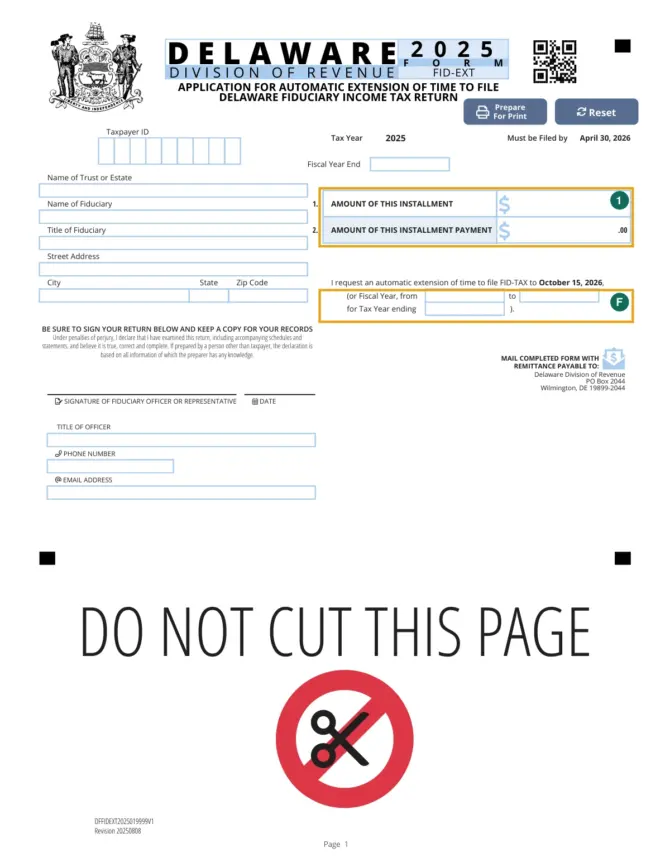
| Field | What to enter or check |
|---|---|
| Taxpayer and fiduciary | Taxpayer ID, name of estate or trust, fiduciary’s name and title, street, city, state and ZIP. |
| Tax year and fiscal year end | The form is for tax year 2025; enter the fiscal year-end where applicable. |
| Line 1: Amount of this installment | Enter the installment amount associated with the extension request, based on the estimated unpaid yearly liability. |
| Line 2: Amount of this installment payment | Enter the remittance being made. It is not a calculation of the full annual tax. |
| Extension paragraph | The calendar request runs to October 15, 2026. For a fiscal-year request complete the From, To and Tax Year Ending fields. |
| Declaration and contact | Fiduciary officer or representative signature, date, officer title, phone and email. |
The form supplies no tax-rate worksheet. Calculate the anticipated remaining liability from the applicable FID-TAX instructions and reconcile existing payments. Do not treat this as a quarterly estimated-tax voucher; those use FID-EST. Sign the declaration even if the amounts were entered by a preparer.
When the extension applies and how later time is requested
Calendar-year fiduciary returns are due April 30 following year-end. Fiscal-year returns are due by the last day of the fourth month after year-end. File FID-EXT by the original due date and pay the estimated balance. The automatic calendar-year filing extension is to October 15.
For this 2025 copy, April 30 and October 15, 2026 have passed. Sending it afterward does not establish a timely extension. Unpaid balances accrue the interest described in the FID-TAX instructions from the original payment date.
For further time beyond October 15, the instructions require filing a photocopy of the approved federal fiduciary extension before the automatic state extension expires. Attach that approved federal copy to the final return as well. The federal approval determines the further state date under that rule.
Where to mail and what records to keep
Make payment payable to Delaware Division of Revenue. Send the signed, uncut page and remittance to Delaware Division of Revenue, P.O. Box 2044, Wilmington, DE 19899-2044. Do not mail cash. Keep the completed request and payment evidence.
Delaware FID-VCH is the separate fiduciary electronic-filer payment voucher. Retain federal approval where the later-extension rule applies, and resolve an expired or uncertain extension directly with the Division before assuming additional time.
Official PDF: Form FID-EXT — Official PDF (revenuefiles.delaware.gov)