The Form 656 PDF that the IRS posts by itself opens with a warning that it is not a stand-alone form and is intended for tax professionals. Individuals who want an offer in compromise considered are told to use the Form 656 Booklet, Form 656-B, which wraps Form 656 together with the financial statements, one for individuals and one for businesses, that decide how much to offer.
The booklet is a 32-page PDF, revision 4-2026. Form 656 itself is seven pages dated April 2026 and starts on page 23 of the file, after Form 433-A (OIC) and Form 433-B (OIC). The program it belongs to settles a tax debt for less than the full amount owed when the taxpayer cannot pay in full or full payment would cause financial hardship, and the IRS looks at income, expenses and equity in assets.
Who the IRS will consider an offer from
Before an offer is looked at, four conditions have to be met: all required returns filed, a bill received for at least one of the debts on the offer, all required estimated tax payments for the current year made, and, for a business owner with employees, the federal tax deposits for the current quarter and the two before it. An open bankruptcy rules out an offer, an open audit or innocent spouse claim should be resolved first, and a deactivated ITIN has to be reactivated through Form W-7.
A person who can pay in full through an installment agreement, equity in assets, or both will generally be turned down. The IRS also does not compromise restitution assessments, periods referred to the Department of Justice, liabilities reduced to judgment, or section 965 liabilities for which the 965(i) election was made. A business with trust fund taxes is not eligible until the trust fund portion is paid or the IRS has made Trust Fund Recovery Penalty determinations on all responsible people, except for victims of payroll service provider fraud.
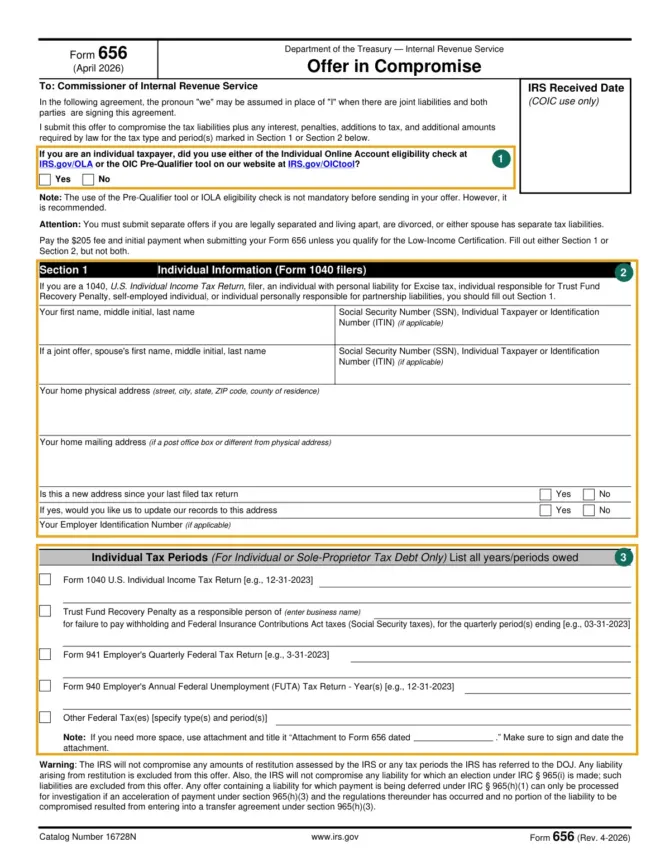
Two tools test eligibility beforehand: the Offer in Compromise Pre-Qualifier at IRS.gov/OICtool and the check inside the Individual Online Account. Neither is mandatory, but Form 656 asks on page 1 whether an individual used one.
Three forms, one offer amount
The offer amount does not come from Form 656. It comes from the financial statement, and Form 656 is where it is entered, at that figure or above it unless Section 3 explains why not.
Form 433-A (OIC) is for individuals: wage earners, sole proprietors, people responsible for a Trust Fund Recovery Penalty, people personally liable for a partnership debt when the partnership is also making an offer, and those acting for the estate of someone who died. Form 433-B (OIC) is for corporations, partnerships and LLCs. Both list assets, income and expenses, and both ask for copies of supporting documents, never originals. Both enter real estate at current market value times .8, less the loan balance. The booklet adds that allowances such as $1,000 on a bank balance or $3,450 on a car apply only to individuals, and only once the IRS decides the debt cannot be paid in full.
The last section of each statement turns the remaining monthly income into a minimum. On the individual form, the remaining monthly income is multiplied by 12 if the offer will be paid in five or fewer payments within five months, and by 24 if it will be paid over 6 to 24 months. The result is added to available assets. The business form works the same way with Box D, and it lets the business leave out equity in income-producing assets other than real estate. Paying faster gives a smaller minimum. A person who cannot pay the calculated amount enters what they can pay on Form 656 and explains the special circumstances in Section 3.
Form 656, section by section
| Where | What it asks | What to watch |
|---|---|---|
| Page 1, top | Whether an individual used the Individual Online Account check or the Pre-Qualifier tool | Separate offers are required if the spouses are legally separated and living apart, are divorced, or either one has separate tax liabilities |
| Section 1 | Names, SSN or ITIN, home addresses, EIN if any, and the tax periods owed | For Form 1040 filers, excise tax, Trust Fund Recovery Penalty, the self-employed and partnership liabilities; periods are listed as dates such as 12-31-2023 |
| Page 2 | Low-Income Certification boxes and the income chart | Individuals and sole proprietors only |
| Section 2 | Business name, address, EIN and contact, with the periods owed | Used instead of Section 1 for a corporation, partnership, LLC or LLP; Form 433-B (OIC) goes with it |
| Section 3 | The reason for the offer, one box only | Doubt as to collectibility, or effective tax administration for economic hardship (individuals only) or for public policy or equity; the last two need a written explanation |
| Section 4 | Lump sum or periodic payment and the offer amount | Whole dollars, more than $0 |
| Section 5 | Which tax year or debt a payment should be applied to; EFTPS or Online Account payments | The application fee and payments made after acceptance cannot be designated |
| Section 6 | Source of funds, filing and payment requirements | Boxes confirming returns, estimated payments and tax deposits are current |
| Sections 7 to 9 | Offer terms (a to x), signatures, paid preparer | Section 7 holds the 24-month rule, the 30-day appeal deadline and the five-year compliance term |
Section 6 carries a filing requirement with a time window: include a complete copy of any return filed within 10 weeks of sending the offer, marked as a copy. A person who has filed but has not yet been billed should wait for the bill, since an offer without a bill for at least one debt can be returned.
Under Section 7 the taxpayer agrees, among other terms, to extend the time the IRS has to assess the tax (7(p)), to let the IRS contact third parties and request a consumer report (7(s)), and not to file amended returns for the listed years (7(e)). A representative needs a signed Form 2848; Form 8821 lets someone only receive confidential information.
When the fee and payments are due
Every offer carries a $205 application fee and an initial payment, unless the individual qualifies for the Low-Income Certification. Which payment option is chosen sets the initial payment:
- Lump sum: 20% of the offer amount with the application, and the rest in five or fewer payments within five or fewer months of the date of acceptance.
- Periodic payment: the first monthly payment with the application, then monthly payments for a total of 6 to 24 months, on a day of the month between 1 and 28. The payments have to continue while the IRS reviews the offer.
Total payments must equal the full offer amount. An offer cannot be paid with an expected or current tax refund, money already paid, funds attached in collection, or an anticipated benefit from a capital or net operating loss. Payments go through EFTPS or the Individual Online Account on the same day the offer is mailed or filed. Otherwise a personal check, cashier’s check or money order is made payable to “United States Treasury”, with one check for the fee and a separate one for each payment, and no cash. Section 5 lets the taxpayer say which year or debt a payment applies to. Without that, the IRS applies it in the government’s best interest.
Low-income certification
An individual or sole proprietor qualifies if adjusted gross income on the most recent Form 1040, or household gross monthly income from Form 433-A (OIC) times 12, is at or below the chart’s amount for the family size and region. A business other than a sole proprietorship, or an offer filed for a deceased person, does not qualify, and the IRS verifies the claim. The April 2026 chart reads:
| Family size | 48 states, D.C. and territories | Alaska | Hawaii |
|---|---|---|---|
| 1 | $39,900 | $49,875 | $45,900 |
| 2 | $54,100 | $67,625 | $62,225 |
| 3 | $68,300 | $85,375 | $78,550 |
| 4 | $82,500 | $103,125 | $94,875 |
| Each additional person | add $14,200 | add $17,750 | add $16,325 |
The chart continues to a family of eight. A qualifying applicant sends no fee and no payments, and the form says in capitals not to include any. Money sent voluntarily is applied to the tax debt and not returned. The first payment is due 30 calendar days after the offer is accepted, unless an amended offer sets another date.
Spouses, businesses and combined debts
A couple with joint debts and also separate debts sends two Forms 656, one each, listing that person’s joint and separate debts. A spouse who does not want to be part of the offer can be left out, and the other submits a Form 656 for the joint debt. Legally separated or divorced spouses cannot make a joint offer. Someone with both personal and business debt sends two Forms 656, each with its own fee and payment. A partner cannot compromise an individual share of a partnership debt, because the partnership has to submit its own offer.
Where to send it, or applying online
Individuals can apply through the Individual Online Account, which prepares the forms, calculates a potential offer, takes the payments and submits the offer electronically. Anyone mailing the package sends it to the Centralized Offer in Compromise Unit, and the address depends on the state:
- AL, AZ, CA, CO, GA, HI, ID, KY, LA, MD, MS, ND, NM, NV, OK, OR, SD, TN, TX, UT, VA and WA: Memphis IRS Center, COIC Unit, P.O. Box 30803, AMC, Memphis, TN 38130-0803; telephone 844-398-5025.
- All other states, PR and foreign addresses: Brookhaven IRS Center, COIC Unit, P.O. Box 9007, Holtsville, NY 11742-9007; telephone 844-805-4980.
The package is Form 656, the signed financial statement or statements, supporting documents, the application checklist printed in the booklet, and payments sent by check. A copy stays with the taxpayer. Someone who applied online does not mail a duplicate.
Official PDF: Form 656 — Official PDF (irs.gov)
After the offer is sent
Once an authorized IRS official signs, the offer is pending. The IRS may levy up to that point, and it can file a Notice of Federal Tax Lien at any time. If the IRS has not told the taxpayer otherwise in writing within 24 months of the date the Memphis or Brookhaven unit received the offer, it is accepted by law, and the IRS page describes the same two-year automatic approval, excluding time spent on an appeal. An installment agreement that was already approved pauses while the offer is considered.
An accepted offer comes with five years of filing and paying on time. A default means liability for the original debt, less payments made, plus interest and penalties. Liens are generally released within 45 days after the final payment is received and verified, and some details of the accepted offer are open for public inspection for one year. A rejection can be appealed to the IRS Independent Office of Appeals by requesting a hearing in writing within 30 days of the rejection notice. The application fee is not returned after a rejection, and payments are applied to the debt.
Why offers come back without a decision
- A required return is missing. The IRS applies the initial payment to the debt and returns the offer and fee, and there is no appeal.
- The fee or initial payment was not made at the time of submission, or a payment was returned for insufficient funds.
- The fee was combined with other tax payments, which the form says can delay processing.
- Periodic payments stopped before a final decision letter. The offer is returned with no appeal rights.
- A request for more information was answered late.
- No bill had been received for any debt on the offer.
- Returns, estimated payments or tax payments fell behind while the offer was under consideration.
Questions
Does an offer stop interest and penalties?
No. They continue to accrue while the offer is considered, and the taxpayer remains liable for the full amount until all terms are met.
What if the debt itself is wrong?
A taxpayer with a legitimate doubt about owing the tax files Form 656-L, Doubt as to Liability, and resolves that before any offer based on ability to pay.
Sources
- Internal Revenue Service, Form 656 Booklet (Form 656-B), Offer in Compromise, Rev. 4-2026, including Form 656, Form 433-A (OIC) and Form 433-B (OIC) (irs.gov)
- Internal Revenue Service, Form 656 (stand-alone PDF for tax professionals), Rev. 4-2026 (irs.gov)
- Internal Revenue Service, Offer in compromise (irs.gov)