A nonprofit with $199,000 in gross receipts and $510,000 in assets at year end cannot file Form 990-EZ, even though it passes one of the two tests. The short return is for organizations that are under $200,000 in gross receipts and under $500,000 in total assets at the same time, and missing either limit by a dollar sends the filing to Form 990.
The 2025 Form 990-EZ is four pages (created 5/2/25) with six parts, and the Instructions for Form 990-EZ (2025) are dated January 15, 2026. Parts I to V apply to every filer. Part VI is for section 501(c)(3) organizations only, and a long list of yes/no questions in Part V decides which schedules travel with the return.
Who files 990-EZ, and who files something else
The instructions sort filers by size. Gross receipts “normally” of $50,000 or less means Form 990-N, the electronic notice, unless the organization chooses to file a full return. Under $200,000 in gross receipts and under $500,000 in total assets means Form 990-EZ or, by choice, Form 990. At $200,000 or more in gross receipts, or $500,000 or more in total assets at the end of the year, Form 990 is required. An organization that files 990-EZ voluntarily when it does not have to must still file a complete return, schedules included.
Gross receipts here are everything received from all sources during the year, with no costs subtracted. Item L gives the formula from Part I: add lines 5b, 6c and 7b to line 9. An organization that reports $188,000 of total revenue on line 9 but has $9,000 on line 5b, $4,000 on line 6c and $2,500 on line 7b has gross receipts of $203,500, which is over the limit, so it files Form 990 even though line 9 looks small.
Four kinds of organization file Form 990 whatever their size: sponsors of donor advised funds, operators of a hospital facility (with Schedule H), section 501(c)(29) nonprofit health insurance issuers, and controlling organizations under section 512(b)(13) that had certain transfers with a controlled entity. A central organization filing a group return also uses Form 990, and a private foundation uses Form 990-PF.
Churches and their integrated auxiliaries, section 501(c)(1) corporations, governmental units and certain political committees file neither form, whatever their receipts. Section 527 political organizations file unless their gross receipts are under $25,000. A section 4947(a)(1) nonexempt charitable trust with no taxable income can file Form 990-EZ in place of Form 1041 by checking the box on line 43.
The heading, items A to L
Everything above Part I is the heading, and item H is the one the instructions single out as making a return incomplete when it is skipped.
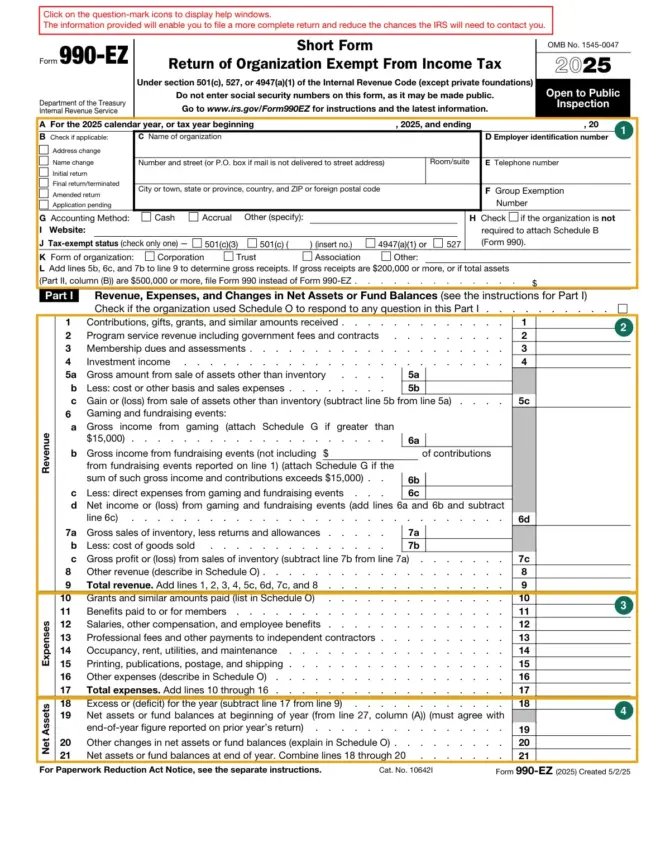
| Item | What goes in | What the instructions add |
|---|---|---|
| A | Calendar year 2025, or the fiscal year that began in 2025 | Both dates of a fiscal year go on page 1 |
| B | Check boxes for address change, name change, initial, final, amended, application pending | A name change needs the amendment to the organizing document attached; a final return needs Schedule N |
| C | Legal name and address | A different working name goes after the legal name with “a.k.a.” |
| D | Employer identification number | An organization has one EIN; a subordinate filing its own return uses its own, not the central organization’s |
| H | Box checked, or Schedule B attached | One or the other is required whether or not line 1 has an amount |
| J, K | Exempt status and legal form | For a section 501(c) other than (3), write the subsection number in the parentheses |
| L | Gross receipts | Lines 5b, 6c and 7b added to line 9 |
Item H needs an answer even from an organization that received no gifts at all. The box certifies that Schedule B is not required, and the test depends on the type of organization. Under the general rule, check it if no single contributor gave $5,000 or more, adding up every gift of $1,000 or more from the same contributor. A 501(c)(3) that meets the 33⅓% public support test and checks line 13, 16a or 16b on Schedule A, Part II, uses the greater of $5,000 or 2% of line 1 instead. Section 501(c)(7), (8) and (10) organizations attach Schedule B for a gift of any size made for charitable and similar purposes, and for any other gift of $5,000 or more.
Part I, revenue and expenses, line by line
| Lines | What they ask | Where the instructions draw the line |
|---|---|---|
| 1 | Contributions, gifts, grants | Gross amounts, deductible or not; noncash gifts at fair market value; donated services and use of facilities are not reported (state law may require it); uncollectible pledges and refunds go to line 20, not netted here |
| 2 | Program service revenue | Tuition, admissions, clinic charges; a government payment goes here when the service benefits the agency itself, on line 1 when it serves the public |
| 3 | Membership dues | Dues that compare reasonably with the benefits; the excess is a contribution |
| 4 | Investment income | Interest, dividends, rents, royalties; investment management fees are not netted but go to line 13 |
| 5a to 5c | Sales of assets other than inventory | Securities may use average-cost basis; unrealized gains and losses stay off this line |
| 6a to 6d | Gaming and fundraising events | Gross income, direct expenses on 6c, net on 6d (see below) |
| 7 to 9 | Inventory sales, other revenue, total revenue | Line 7 is gross sales less cost of goods sold; describe line 8 on Schedule O |
| 10 to 16 | Grants paid, member benefits, salaries, professional fees, occupancy, printing and postage, other | Line 12 includes the employer’s payroll taxes; line 10 grantees over $5,000 are listed on Schedule O |
| 17, 18 | Total expenses, excess or deficit | A deficit is shown in parentheses or with a minus sign |
| 19 to 21 | Net assets at the start, other changes, net assets at the end | Line 19 is last year’s ending figure; changes on line 20 are explained on Schedule O |
Fundraising dinners and auctions cause trouble on line 6, because one payment can be part revenue and part gift. Suppose a $75 ticket buys a meal with a retail value of $30. The $30 is revenue on line 6b, and the other $45 is a contribution, reported on line 1 and again inside the parentheses on line 6b. Direct costs of the event go on line 6c; the costs of soliciting the $45 gift go on lines 12 through 16. If the benefits are only of nominal value, the whole payment is a contribution.
Two thresholds on line 6 bring in Schedule G. Gaming income above $15,000 on line 6a means Schedule G, Part III. If gross income from fundraising events plus the contributions from them is more than $15,000, Part II applies. A 990-EZ filer does not complete Part I of Schedule G.
Parts II to IV: balance sheet, programs, people
Part II asks for the balance sheet at the beginning and the end of the year, and a substitute balance sheet is not accepted. Column (A) with nothing to report gets a zero. Land and buildings the organization uses go on line 23 at book value, while property held for investment goes into line 22. Line 27, column (B), must agree with line 21, and total assets of $500,000 or more on line 25, column (B), mean Form 990 was the right form.
Part III starts with the primary exempt purpose, then describes the three largest program services, measured by expenses, using counts such as clients served or events held. Section 501(c)(3) and (c)(4) organizations also enter the expenses and grants for each service. Other services go on Schedule O, and brochures are not attached.
Part IV, officers, directors, trustees and key employees
Every person who held one of those roles at any time during the tax year is listed, paid or not, with up to 11 people in the table and extra copies of the table if needed. Column (b) takes an actual estimate of weekly hours; “as needed” and “40+” do not count. Column (c) is reportable compensation, the greater of box 1 or box 5 of Form W-2 for officers and key employees, and box 1 of Form 1099-NEC for directors. Column (d) holds retirement contributions and health benefits, and column (e) other compensation, where any single item under $10,000 can be left out. Nothing paid means “-0-“, not “Information available upon request”, which the instructions rule out.
Part V and VI: the questions that bring in schedules
Section 501(c)(3) organizations attach Schedule A. Past that, the Yes answers in Parts V and VI build the filing package.
| Line | A Yes answer means |
|---|---|
| 33, 34 | Describe the new activity or changed governing document on Schedule O |
| 35a, 35b | Unrelated business gross income of $1,000 or more: Form 990-T, or an explanation on Schedule O if none was filed |
| 35c | A 501(c)(4), (5) or (6) organization subject to the section 6033(e) rules: Schedule C, Part III |
| 36 | Liquidation, dissolution, termination or a disposition of more than 25% of net assets: Schedule N |
| 38a, 38b | Loans to or from officers, directors, trustees or key employees: Schedule L, Part II |
| 40b | An excess benefit transaction: Schedule L, Part I |
| 42b | A foreign financial account over $10,000 at any time: FinCEN Form 114, filed separately and not with the return |
| 44a, 44b | Donor advised funds or a hospital facility: Form 990 must be filed instead |
| 46 | Political campaign activity: Schedule C, Part I |
| 47, 48 | Lobbying or a 501(h) election: Schedule C, Part II; a school: Schedule E |
| 50, 51 | The five highest paid employees and contractors over $100,000, with the calendar year ending within the tax year |
Schedule O is the overflow sheet for lines 8, 10, 16, 20, 24, 26, 31, 33, 34, 35 and 44. In the package, the core form goes first with all its parts and the signature block, then the schedules in alphabetical order, then attachments such as a name-change amendment or the reasons for a late filing.
When and where the return is filed
The return is due on the 15th day of the fifth month after the accounting period ends. For a calendar-year filer that is May 15, which made the 2025 return due May 15, 2026. A weekend or legal holiday moves it to the next business day. A liquidating or terminating organization files by the 15th day of the fifth month after the liquidation, dissolution or termination. Form 8868 requests an automatic extension, and a return filed after the due date, extension included, carries a statement explaining why.
Form 990-EZ must be filed electronically; the IRS keeps its electronic filing page at IRS.gov/EOefile. E-filing stays open for the current tax year and the two before it. Older years go on paper; electronic filing of 2020 returns closed on December 26, 2023, and a paper return for that year carries a note saying so. The officer who signs is the current president, vice president, treasurer, assistant treasurer, chief accounting officer or another authorized officer, or the authorized trustee for a trust, and a paid preparer signs below with a PTIN.
Official PDF: Form 990-EZ — Official PDF (irs.gov)
What makes a return incomplete or late
- Neither the item H box nor Schedule B. The instructions say the return is then determined to be incomplete.
- A blank or substitute Part II, or hours such as “as needed” in Part IV.
- Contributions reported net of the fundraising expenses that produced them. The instructions use this as their example of incorrect information that can draw the penalty.
- A paper return from an organization that has to file electronically: the IRS treats it as if nothing was filed.
- Password-protected or encrypted PDF attachments on an e-filed return, which the IRS cannot open.
- A social security number anywhere on the form or its schedules, since the return is public and the IRS cannot remove it.
The late-filing penalty is $25 a day, up to the lesser of $13,000 or 5% of the year’s gross receipts, unless reasonable cause is shown. If the IRS asks for missing information and it does not arrive in the time given, a person responsible is charged $10 a day, up to $6,500 on one return. An organization that fails to file for three consecutive years loses its tax-exempt status automatically on the due date of the third return.
Questions
Can an organization with $40,000 in receipts use Form 990-EZ?
Yes, if its total assets are under $500,000. At $50,000 or less it can submit Form 990-N, but a voluntary Form 990-EZ has to be a complete return. Section 509(a)(3) supporting organizations file even at that level, with three exceptions.
How long are records kept?
Records that support income and deductions are kept at least 3 years from the due date or the filing date, whichever is later, and the organization keeps copies of the returns it filed.
Sources
- Internal Revenue Service, 2025 Form 990-EZ, Short Form Return of Organization Exempt From Income Tax (irs.gov)
- Internal Revenue Service, 2025 Instructions for Form 990-EZ, January 15, 2026 (irs.gov)
- Internal Revenue Service, About Form 990-EZ (irs.gov)
- Internal Revenue Service, Form 990 series: Which forms do exempt organizations file (irs.gov)