Form 740-PTET is the Kentucky return a pass-through entity, such as a partnership, S corporation or multi-member LLC, files after electing to pay Kentucky income tax at the entity level. The 2025 version, numbered 42A740-PTET (10-25), covers calendar year 2025 or a fiscal year that begins in 2025. Page 1 figures the tax at 4.0% of the owners’ Kentucky distributive share income; page 2 subtracts payments and ends in a balance due or a refund. A Form PTET-CR goes with it for every owner.
Which entities file Form 740-PTET
The 2025 PTET instructions describe an annual election that an authorized person makes on behalf of the pass-through entity. Once made, the tax under KRS 141.020 is computed at the entity level on the ordinary income and separately stated items calculated under KRS 141.206, and the entity reports it on Form 740-PTET. The election cannot be withdrawn for that year and binds every owner.
Two answers from the Department of Revenue’s Pass-Through Entity Election FAQs (April 2023) are still linked from its Pass-Through Entities page: a single-member LLC may elect, including one that is disregarded for federal purposes, and an electing entity does not have to withhold for its nonresident owners. Those answers predate the 2025 forms, so check them against the current instructions if your facts are unusual.
The owners use the credit, not the return. Individuals claim the refundable pass-through entity tax credit reported to them on Form PTET-CR on Form 740 or Form 740NP, line 31(g). When the electing entity owns part of another pass-through entity, the instructions ask for a PTET-CR for each of the lower-tier entity’s owners as well, and the upper-tier entity reports its share of the tax on its own 740-PTET.
Making the election on the return or on Form 740-PTET-ELECT
An entity can elect in two ways: file Form 740-PTET-ELECT, or check the “Election to pay income tax at the entity level” box in item D of the return. The 2025 ELECT form, 42A740-PTET-ELECT (10-24), allows the election during the year or after it ends; after year end, the deadline is the 15th day of the fourth month after the close of the taxable year, or the extended due date when an extension was filed. The ELECT form is signed by a member and mailed to the Kentucky Department of Revenue, Frankfort, KY 40619-0006. A separate 2026 ELECT form, 42A740-PTET-ELECT (2-25), is posted for tax year 2026.
How to fill out page 1 of Form 740-PTET
Page 1 has the entity’s identity in items A to D, the tax calculation on lines 1 to 7 and a payment summary box at the bottom. The letters and numbers in the image are the ones printed on the form; S marks the Tax Payment Summary.
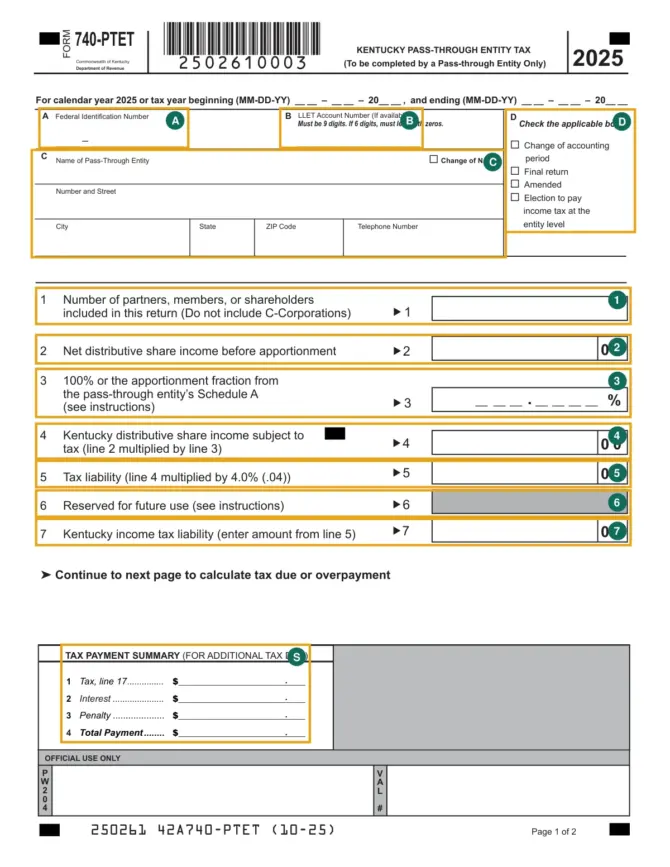
| Item or line | Printed label | What to enter |
|---|---|---|
| Tax year | For calendar year 2025 or tax year beginning, ending | The printed year covers calendar year 2025; the date fields are for an entity whose tax year begins on another date (MM-DD-YY). |
| A | Federal Identification Number | The entity’s FEIN. The instructions warn that a missing FEIN may delay processing and any refund. |
| B | LLET Account Number | The entity’s Kentucky Limited Liability Entity Tax account number, when it has one. The note under the box: nine digits, and a six-digit number gets leading zeros. |
| C | Name, number and street, city, state, ZIP code, telephone | The entity’s name and address. Check “Change of Name” when the name has changed. |
| D | Check the applicable boxes | Change of accounting period, final return, amended, or election to pay income tax at the entity level. |
| 1 | Number of partners, members, or shareholders | The owners included in the return, leaving out C corporations and tax-exempt entities. |
| 2 | Net distributive share income before apportionment | Every item reported on the Kentucky Schedule K-1 as distributable share income, including interest, dividends, capital gains, guaranteed payments and rents. |
| 3 | 100% or the apportionment fraction | The fraction from the entity’s Schedule A, or 100%. A zero fraction must be entered as zero. |
| 4 | Kentucky distributive share income subject to tax | Line 2 multiplied by line 3. |
| 5 | Tax liability | Line 4 multiplied by 4.0% (.04). |
| 6 | Reserved for future use | Nothing. The box is shaded. |
| 7 | Kentucky income tax liability | The amount from line 5. |
| S | Tax Payment Summary (for additional tax due) | Tax from line 17, interest, penalty and the total payment. |
Item D(a) applies when the entity changed its accounting period since its prior Kentucky return; if the IRS approved the change of taxable year in writing, attach a copy of that letter. Item D(c) is for a second return covering a period already filed, and it switches on lines 12 and 14 on page 2.
Line 3 has room for three digits before the decimal point and four after, followed by a printed percent sign, so a fraction from Schedule A goes in as a percentage. Line 7 has its own check: the instructions require the tax on line 7 to equal the total of line 9 on all the PTET-CRs attached to the return. Each PTET-CR multiplies that owner’s Kentucky distributive share income by the same 4.0% on its line 7, and line 9 carries the tax the entity paid for that owner.
Page 2: payments, penalty and refund
Page 2 starts from the line 7 tax and nets out what has already been paid.
| Line | What goes on it |
|---|---|
| 8 | Tax credit received on a 740-PTET-CR issued to this entity by another electing entity. |
| 9 | Estimated tax payments made with Form PTET-ES vouchers for the year, without the credit carried from the prior year. |
| 10 | Extension payment made for PTET. |
| 11 | Prior year’s tax credit. |
| 12 | Tax paid on the original return; amended returns only. |
| 13 | Total of lines 8 through 12. |
| 14 | Overpayment on the original return; amended returns only. |
| 15 | Reserved for future use. |
| 16 | Estimated tax penalty from Form PTET-P. |
| 17 | Tax and penalty due: lines 7, 14 and 16 less line 13. |
| 18 | Overpayment: line 13 less lines 7, 14 and 16, when positive. |
| 19 to 21 | Parts of the overpayment credited to 2025 interest, to the 2025 late file/pay penalty, and to 2026 PTET. |
| 22 | Amount refunded: line 18 less lines 19 through 21. |
A member signs the return and prints a name and title. A paid preparer signs below with an ID number and contact details, and the YES or NO box answers whether the Department may discuss the return with that preparer.
The 2025 Form PTET-P, 40A201PTET-P (10-25), is where line 16 comes from, and two of its instructions do not match the 740-PTET. Its Line 23 says to put the penalty on Form 740-PTET line 16 when there is tax due “on line 15” and to add it to line 20 when line 18 shows an overpayment; on the 2025 return, line 15 is reserved, line 16 is the penalty line and line 20 is the late file/pay penalty credit. Its Line 4 also dates the fourth installment on the 15th day of the 12th month of the tax year, while the PTET instructions put it on January 15 after year end. The Pass-Through Entity Branch (502-564-8139, DORWEBRESPONSEPASSTHROUGHENTITY@ky.gov) is the contact for which reading applies to your return.
What changed on the 2025 form
The “Kentucky Form Changes” list in the 2025 Form PTE instructions names these PTET changes:
- Form 740-PTET: lines 6 and 15 are now reserved for future use, and line 5 is renamed from “Tax before credit” to “Tax Liability”.
- Form PTET-CR: line 7 is renamed the same way and line 8 is reserved.
- Form PTET-P: Part I gains lines (a) and (b), comparing the 2024 740-PTET liability with the current year’s estimated payments.
The Pass-Through Entities page gives the reason for the reserved lines: business tax credits are no longer claimed on the 740-PTET. They pass to owners through Form PTE, Schedule K/K-1, line 13, and are claimed on the owner’s own return. Amended returns are not needed for this change, and an entity assessed an underpayment penalty because it counted its owners’ credits when computing estimates may ask for a waiver in writing through the Department’s Contact Us page.
When Form 740-PTET and the tax are due
The Department’s Corporation, LLC and Pass-Through Tax FAQs put pass-through entity returns on the 15th day of the fourth month after the taxable year ends, moved to the next business day when that date is a weekend or legal holiday. For calendar year 2025 that is April 15, 2026. The PTET instructions add that the tax is due on that same date “without regard to extensions”.
An extension gives six more months to file, not to pay. The instructions point first to electronic extension payments at epayment.ky.gov/EPAY; when that is not possible, any of these works:
- Form 740-PTET-EXT for the current year, filed before the due date in KRS 141.160. The 2025 version is mailed to Kentucky Department of Revenue, Frankfort, Kentucky 40620-0021.
- A copy of an approved Kentucky extension, either the corporation/LLET extension (Form 720-EXT) or Form 40A102, attached to the 740-PTET filed by the extended due date.
- A copy of federal Form 7004 attached the same way.
For a calendar-year 2025 entity, the original date and the extended date of October 15, 2026 have both passed at the check date of this guide. A fiscal year that began in 2025 ends in 2026, and its due date follows the same fourth-month rule.
Interest under KRS 131.183: the instructions put the 2026 tax interest rate at 7% and say the rate the Department charges on unpaid taxes is 9%. The Tax Payment Summary on page 1 has its own interest and penalty lines for a payment sent with the return.
For years beginning on or after January 1, 2024, an electing entity makes estimated payments when its estimated tax for an individual owner can reasonably be expected to exceed $500. The PTET instructions list April 15, June 15, September 15 and January 15, 25% each, and the matching months for fiscal years. PTET-P (a) and (b) say no penalty applies when the current year’s estimated payments equal or exceed the 2024 740-PTET liability.
Where to get the 2025 form and where to send it
The fillable 2025 PDF is in the Department of Revenue’s online forms library, tagged for the pass-through entity tax and tax year 2025 next to the PTET instructions, PTET-P, KPTET-V and 740-PTET-EXT. The Department has no e-filing of business entity returns on its own website; the 740-PTET and PTET-CRs are e-filed through third-party software on its Business Income Tax Software Approval List.
Paying is a separate step. For tax years beginning on or after October 1, 2021, the instructions require pass-through entities to pay electronically, at epayment.ky.gov/EPAY, from a bank account or by credit card, where the provider may charge a fee.
| Situation | What to send | Address |
|---|---|---|
| Paper return, refund or no payment | Form 740-PTET with a PTET-CR for each owner | Kentucky Department of Revenue, Frankfort, KY 40619-0006 |
| Paper return with a check | Return, PTET-CRs and the check; no KPTET-V needed | Kentucky Department of Revenue, Frankfort, Kentucky 40619-0006 |
| E-filed return, electronic payment not possible | Form KPTET-V with the check | Kentucky Department of Revenue, Frankfort, Kentucky 40619-0006 |
| Paper extension | Form 740-PTET-EXT | Kentucky Department of Revenue, Frankfort, Kentucky 40620-0021 |
Checks are payable to the Kentucky State Treasurer, as printed in the payment block of the return.
Official PDF: 740-PTET — Official PDF (revenue.ky.gov)
What delays or changes a 740-PTET
- Item A left empty. The instructions say a missing FEIN may delay processing of the return and any refund.
- Line 7 not matching the PTET-CRs. The tax on line 7 must equal the sum of line 9 on every PTET-CR attached.
- A business tax credit taken on line 6. The line is reserved in 2025; credits belong on Schedule TCS or Schedule ITC with the owner’s own return.
- Line 3 left blank when the Schedule A fraction is zero. The instructions require the zero.
- Prior-year credit counted twice. Line 9 holds only the PTET-ES payments; the credit carried from the prior year goes on line 11.
Questions about Form 740-PTET
Can a single-member LLC file Form 740-PTET?
The Department’s April 2023 election FAQs answer yes, including for a single-member LLC disregarded for federal purposes. The 2025 PTET instructions do not repeat the point.
Do the owners still pay Kentucky income tax on this income?
Individual owners who file a Kentucky individual return reporting tax under KRS 141.020 are allowed the refundable pass-through entity tax credit shown on their PTET-CR, claimed on Form 740 or 740NP, line 31(g).
Does an electing entity still file Form 740NP-WH for nonresident owners?
The April 2023 FAQs say nonresident withholding is not required once the entity makes the election.
Can the election be undone after the return is filed?
The election is irrevocable for the taxable year it covers and binding on all owners, according to the 2025 instructions and the ELECT form. Each year is a new election.
Sources
- Form 740-PTET, Kentucky Pass-Through Entity Tax, 2025, 42A740-PTET (10-25)
- Instructions for Kentucky Pass-through Entity Tax, 2025, 42A740-PTET(I) (10-25)
- Form PTET-P, Pass-Through Entity Tax Underpayment Penalty Calculations, 2025, 40A201PTET-P (10-25)
- Form 740-PTET-ELECT, 2025, 42A740-PTET-ELECT (10-24)
- Form 740-PTET-ELECT, 2026, 42A740-PTET-ELECT (2-25)
- Form 740-PTET-EXT, 2025, 42A740-PTET-EXT0003
- Form KPTET-V, Kentucky Pass Through Entity Tax Payment Voucher, 2025
- Kentucky Pass-Through Entity Income and LLET Return Instructions, 2025 (Kentucky Form Changes)
- Kentucky Department of Revenue, Pass-Through Entities
- Corporation, LLC, and Pass-Through Tax Frequently Asked Questions
- Pass-Through Entity Election FAQs (April 2023)
- E-file and Payment Options