Kentucky Schedule ITC, the Kentucky Individual Tax Credit Schedule, is where a Form 740 or 740-NP filer claims the state’s nonrefundable business credits, the personal credits for age 65, blindness and Kentucky National Guard service, and the family size tax credit. The schedule is also enclosed with Form 741, the fiduciary return, which takes the Section A total. The version for tax year 2025 is 42A740ITC (10-25): two pages of form followed by six pages of instructions in one PDF.
Who has to file Schedule ITC
The instructions name three situations. You file the schedule if you have nonrefundable business incentive credits, if you claim a personal tax credit (65 or over, blind, or in the Kentucky National Guard), or if you have qualifying dependent children and claim the family size tax credit. A single filer with no qualifying children, no business credits and no age, blindness or Guard credit is outside all three, although the family size table printed on the schedule still sets the percentage for a family of one.
Some credits on Form 740 bypass the schedule entirely. The refundable pass-through entity tax credit from Form PTET-CR goes straight to Form 740 or 740-NP, line 31(g). The education tuition tax credit is claimed on Form 8863-K, and the child and dependent care credit is computed on Form 740, line 24 from federal Form 2441.
What is new on the 2025 schedule
The What’s New page of the 2025 Form 740 instruction packet lists two changes that show up on Schedule ITC:
- The family size thresholds rose to $15,650 for a family of one, $21,150 for two, $26,650 for three and $32,150 for four or more. These are the top figures in the 100 percent row of the Section C table.
- Line 24, the Qualified Broadband Investment Tax Credit, is new. It applies to taxable years beginning on or after January 1, 2025 and before January 1, 2029, the application is due to the Department of Revenue by December 31, and the credit is capped at $5 million annually.
A Reminders item in the same packet introduces Worksheet INV for inventory tax credits passed through on a Schedule K-1, and that item refers to “Section A, line 23.” On the 2025 Schedule ITC (10-25), inventory is line 22 and line 23 is Renewable Chemical Production. The Schedule ITC instructions themselves place Worksheet INV under line 22. If your inventory credit amount does not obviously belong on line 22, ask the Department of Revenue at (502) 564-4581 before filing.
How to fill out Section A, lines 1 to 25
Section A is a single table. Column A is the line number, column B says whether the credit needs approval before you claim it, column C names the credit and column D names the document you enclose. You write amounts in column E for your spouse and column F for yourself.
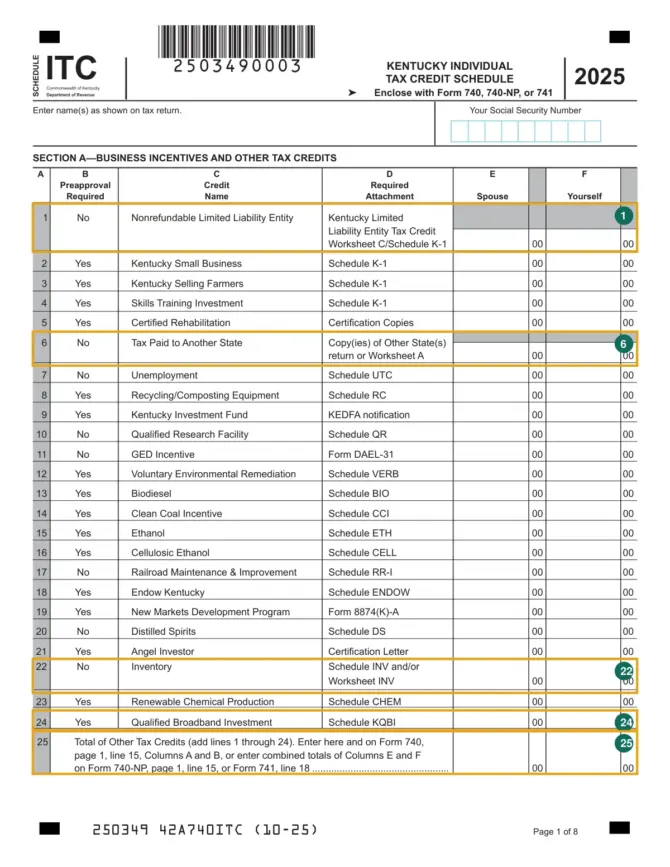
| Line | Credit | Preapproval | Enclose | What the instructions add |
|---|---|---|---|---|
| 1 | Nonrefundable limited liability entity tax (LLET) | No | Worksheet C, Schedule K-1 or Form 725 | The lesser of your tax savings and the LLET credit on the K-1; the rest is lost, no carryforward |
| 2 | Kentucky Small Business | Yes | Schedule K-1 | Approved by the Kentucky Economic Development Finance Authority (KEDFA); up to $25,000 per business per year; carry forward 5 years |
| 3 | Kentucky Selling Farmers | Yes | Schedule K-1 | Up to $25,000 a year and $100,000 over the life of the credit; carry forward 5 years |
| 4 | Skills Training Investment | Yes | Schedule K-1 | Amount certified by the Bluegrass State Skills Corporation; carry forward 3 years |
| 5 | Certified Rehabilitation | Yes | Certification copies | 30% for owner-occupied homes (up to $60,000 a project), 20% for commercial property; at least $20,000 spent; carry forward 7 years |
| 6 | Tax paid to another state | No | Other state’s return or Worksheet A | The lesser of the Kentucky tax savings and the tax paid to the other state |
| 7 | Unemployment | No | Schedule UTC | $100 for each qualified person hired in the last six months of 2024 or during 2025 |
| 8 | Recycling/composting equipment | Yes | Schedule RC | 50% of the installed cost of equipment used only in Kentucky |
| 9 | Kentucky Investment Fund | Yes | KEDFA notification | 40% of the certified cash contribution; no credit beyond 15 years from certification |
| 10 | Qualified Research Facility | No | Schedule QR | 5% of the cost of building or equipping a research facility; carry forward 10 years |
| 11 | GED Incentive | No | Form DAEL-31 | Employer completes the lower portion of the final report |
| 12 | Voluntary Environmental Remediation | Yes | Schedule VERB | At most 25% of the approved credit in one year |
| 13 | Biodiesel | Yes | Schedule BIO | Claim filed by January 15; certification issued by April 15 |
| 14 | Clean Coal Incentive | Yes | Schedule CCI | $2 per ton of eligible coal used at a certified facility |
| 15 | Ethanol | Yes | Schedule ETH | $1 per gallon unless the annual cap applies; no carryforward |
| 16 | Cellulosic Ethanol | Yes | Schedule CELL | $1 per gallon unless the annual cap applies; no carryforward |
| 17 | Railroad Maintenance and Improvement | No | Schedule RR-I | Used only in the year of the expenditures |
| 18 | Endow Kentucky | Yes | Schedule ENDOW | 20% of the endowment gift, up to $10,000; carry forward 5 years |
| 19 | New Markets Development Program | Yes | Form 8874(K)-A | Subject to a $10 million credit cap each fiscal year |
| 20 | Distilled Spirits | No | Schedule DS | 100% of the distilled spirits property tax paid on time |
| 21 | Angel Investor | Yes | Certification letter | Minimum $10,000 investment; at most 50% of the award used per year; 15 years |
| 22 | Inventory | No | Schedule INV and/or Worksheet INV | Property tax paid on time on inventory |
| 23 | Renewable Chemical Production | Yes | Schedule CHEM | Carry forward 3 years |
| 24 | Qualified Broadband Investment | Yes | Schedule KQBI | New for 2025; application by December 31 |
| 25 | Total of other tax credits | Add lines 1 through 24 |
Lines 1, 6, 22, 24 and 25 are the ones the instructions say the most about, and they are marked on the image below.
Line 1. Owners of a limited liability pass-through entity complete Worksheet C for each entity and keep it. The worksheet compares the Kentucky tax on your full taxable income (Form 740, line 11 or 740-NP, line 13) with the tax on that income minus the entity’s income from the K-1 or Form 725. The difference is the tax savings, and the credit is the smaller of that figure and the LLET credit reported to you. Copies of the K-1s or Forms 725 go in with the return.
Line 6. Worksheet A works the same way for another state’s tax, one worksheet per state, and it is for residents and part-year residents only. Gambling losses claimed on Schedule A enter the calculation and can reduce or eliminate the credit. You need to have filed and paid tax in the other state on income Kentucky also taxes, and a copy of that state’s return with a schedule of income sources goes with your Kentucky return. Tax that was only withheld by another state does not count. Wages earned in a reciprocal state also do not qualify: Illinois and West Virginia (wages and salaries), Indiana (wages, salaries and commissions), Michigan and Wisconsin (personal services income), Ohio (wages and salaries, with an exception for 20 percent S corporation shareholder-employees) and Virginia (daily commuters). If one of those states withheld tax, you ask that state for the refund.
Line 22. For an inventory credit that comes through a Schedule K-1, complete one Worksheet INV per entity with its name, FEIN, your ownership percentage and your share of the credit. Worksheet INV is not needed when Schedule INV is attached, and the two are never submitted for the same entity.
Line 23. The line 23 instructions describe the renewable chemical credit for taxable years beginning on or after January 1, 2021 and ending on or before December 31, 2024, yet the line is printed on the 2025 schedule with a three-year carryforward. The instructions do not say whether line 23 is only for amounts carried forward. A taxpayer with a 2025 Schedule CHEM should confirm with the Department at (502) 564-4581.
Line 25. On Form 740, column E goes to line 15, column A, and column F goes to line 15, column B. On Form 740-NP you add columns E and F together and enter one figure on line 15. Fiduciaries carry the total to Form 741, line 18.
Section B: credits for age 65, blindness and the National Guard
Section B is on page 2. Complete it only if you or your spouse were 65 or older on or before December 31, 2025, legally blind on that date, or a member of the Kentucky National Guard on that date. Enter your date of birth, then 40 on line 1 for age, 40 on line 2 for blindness and 20 on line 3 for Guard membership; line 4 is the total. Lines 5 to 8 repeat this for a spouse, but only on a joint return or a married filing separately on a combined return.
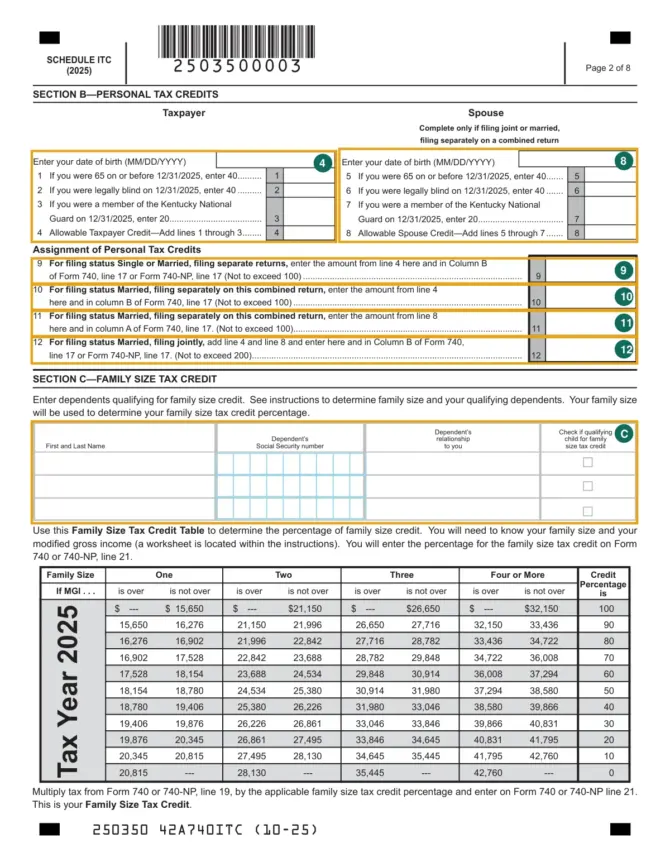
| Line | Filing status | Amount | Where it goes |
|---|---|---|---|
| 9 | Single, or married filing separate returns | Line 4, not over 100 | Form 740 or 740-NP, line 17, column B |
| 10 | Married filing separately on a combined return (you) | Line 4, not over 100 | Form 740, line 17, column B |
| 11 | Married filing separately on a combined return (spouse) | Line 8, not over 100 | Form 740, line 17, column A |
| 12 | Married filing jointly | Lines 4 and 8 added, not over 200 | Form 740 or 740-NP, line 17, column B |
Nonresidents and part-year residents get a reduced amount. The Form 740-NP instructions have you multiply line 17 by the percentage on line 7 (carried from page 4, line 34) and enter the result on line 18.
Section C and the family size tax credit
Section C lists the dependents that make up your family size: first and last name, Social Security number, relationship, and a checkbox for each qualifying child. Family size is you, your spouse if married and living in the same household, and your qualifying children, with four as the maximum. A single person, or a married person living apart from the spouse for the entire year, is family size 1, and can qualify even if claimed as a dependent on a parent’s return.
A qualifying child follows Internal Revenue Code section 152(c). The instructions summarize four tests: the relationship test (child or stepchild by blood or adoption, sibling, stepsibling or a descendant of one of them, among the categories the instructions list), more than half the year in your home, under 19 at year end or under 24 if a full-time student for at least five months, or permanently and totally disabled, and not providing more than half of their own support. A child who lives with you but cannot be claimed because of section 152(e)(2) or (e)(4) still counts.
Modified gross income (MGI) comes from a worksheet on page 8 of the schedule. Lines (a) to (e) add federal adjusted gross income from Form 740, line 5 (740-NP, line 8), a spouse’s federal AGI if you file separate returns and live together, non-Kentucky municipal bond interest and lump-sum distributions from federal Form 4972. Lines (f) to (i) do the same with Kentucky AGI from line 9 and Form 4972-K. Line (j), the greater of (e) and (i), is your MGI. Form 740’s instructions put the ceiling at $42,760: above that, no family size credit.
Find your family size column and MGI row in the table on page 2, write the percentage as a decimal on Form 740 or 740-NP, line 21 (family size goes on line 20), and multiply it by the tax on line 19. Suppose a single parent with two qualifying children has MGI of $28,000. That is family size 3, and $28,000 falls in the row over $27,716 and not over $28,782, so the percentage is 80. With $900 of tax on line 19, the family size tax credit is $720.
Where Schedule ITC goes and when it is due
Schedule ITC is not filed alone. It is enclosed with the Form 740, 740-NP or 741 it supports, together with the attachments listed in column D; it has no signature line of its own. For calendar year 2025, Forms 740 and 740-NP must be postmarked or filed electronically by April 15, 2026. Paper returns go to one of two addresses:
| Return | Mail to |
|---|---|
| Refund or no payment | Kentucky Department of Revenue, Frankfort, KY 40618-0006 |
| Payment enclosed | Kentucky Department of Revenue, Frankfort, KY 40619-0008 |
Besides commercial software, the Department offers KY File, a free site that works like the paper forms with basic math and error checks. Download the Schedule ITC (2025) PDF from the Department’s forms list, where it is the version marked Current. Questions go to Taxpayer Assistance at (502) 564-4581. This page explains the form and is not tax advice for your return.
Another state’s business credit schedule works differently. Arkansas corporations, for example, claim incentive credits on Arkansas Form AR1100BIC.
Points the instructions warn about
- Claiming tax withheld by another state on line 6, or tax paid to a reciprocal state on wages that the agreement exempts.
- Leaving out the other state’s return and income schedule that line 6 requires.
- Submitting both Schedule INV and Worksheet INV for the same entity on line 22.
- Claiming an Endow Kentucky credit on line 18 without reducing a Schedule A charitable deduction for the same gift, where the instructions say a reduction may be needed.
- Expecting LLET, ethanol, cellulosic ethanol or railroad credits to carry over. The instructions say unused amounts on lines 1, 15, 16 and 17 do not carry forward.
Questions about Kentucky Schedule ITC
Do I need Schedule ITC to claim the family size tax credit?
The schedule has to be filed when you have qualifying dependent children and claim the credit, because Section C is where those children are listed. Without qualifying children you skip Section C, but the percentage still comes from the table on page 2 of the schedule, which Form 740, lines 20 and 21 refer you to.
Can I claim the credit for tax paid to another state as a nonresident?
Worksheet A says it is for Kentucky residents and part-year residents only, and the credit is the smaller of the Kentucky tax savings and the other state’s tax.
Where does the Section A total go on Form 740-NP?
Add columns E and F of line 25 and enter the combined total on Form 740-NP, page 1, line 15.
Official sources
- Kentucky Department of Revenue, Schedule ITC (2025), Kentucky Individual Tax Credit Schedule, 42A740ITC (10-25), with instructions
- Kentucky Department of Revenue, 2025 Kentucky Individual Income Tax Forms instruction packet, 42A740(PKT) (10-25)
- Kentucky Department of Revenue, 2025 Form 740-NP instruction packet
- Kentucky Department of Revenue, Forms