Arkansas gives individuals two routes to more time for a 2025 income tax return. If the IRS accepted your automatic federal extension on Form 4868, that already counts for Arkansas and nothing else is sent to the state. Form AR1055-IT is the state-only request for people without a federal extension: it moves the filing date to November 15 for calendar-year filers, and fiscal-year filers get 210 days from their return due date.
This guide follows the 2025 form, AR1055-IT (R 4/25/2025), and its one-page instruction sheet, revised August 25, 2025. Both are posted on the Department of Finance and Administration (DFA) individual income tax forms page.
Do you need AR1055-IT if you filed federal Form 4868?
You do not. The DFA deadlines page says the state honors an accepted federal extension and sets your Arkansas due date one month after the federal extended due date, which it describes as usually November 15. The Department stopped asking for a copy of Form 4868 with the state return, and the same page points out that the IRS sends no approved copy back to you.
AR1055-IT is for the opposite case, when no federal extension was filed. It covers the individual returns: Form AR1000F for full-year residents and Form AR1000NR for nonresidents and part-year residents. The 2025 return booklet adds two limits. The most an individual can get on AR1055-IT is 210 days, and being unable to pay the tax is not a valid reason to ask for one.
Other filers have their own forms. Corporations request time on Form AR1155, and estates and trusts use the fiduciary version, AR1055-FE.
Filling in AR1055-IT, part by part
The fillable PDF has the request at the top and a payment voucher under a “cut here” line. In the image, frames 1 to 3 mark the request and frames 4 and 5 the voucher. The form has no signature line and no tax calculation of its own.
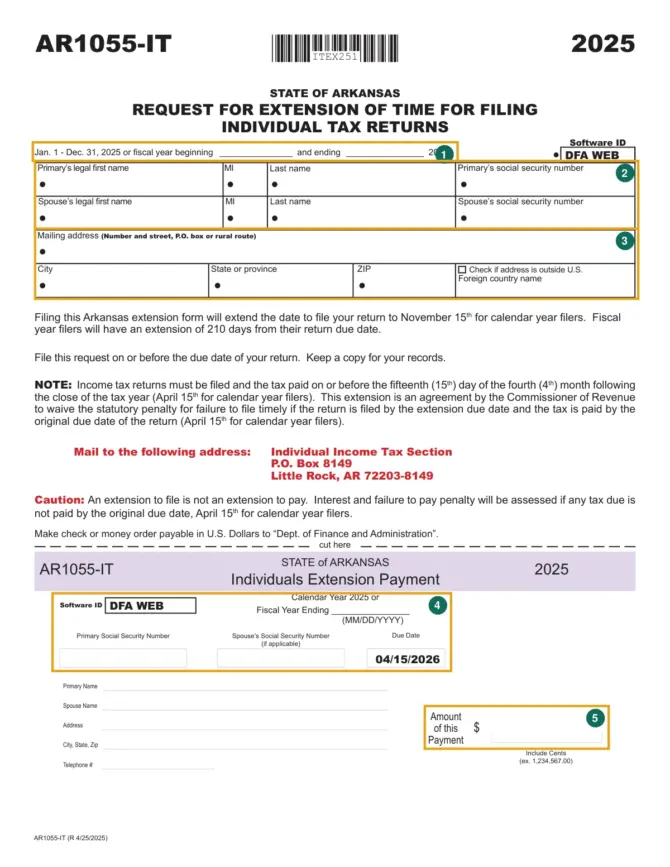
| Frame | Part of the form | What to enter |
|---|---|---|
| 1 | Tax period line | “Jan. 1 – Dec. 31, 2025” is printed for calendar-year filers. A fiscal-year filer writes the beginning and ending dates of the tax year. |
| 2 | Names and Social Security numbers | Primary’s legal first name, middle initial, last name and SSN in the first row; the spouse’s names and SSN in the second. |
| 3 | Mailing address | Number and street, P.O. box or rural route, then city, state or province, and ZIP. For an address outside the U.S., tick the box and add the foreign country name. |
| 4 | Voucher identification | Fiscal year ending date in MM/DD/YYYY form (the fillable copy shows 12/31/2025), primary SSN, and the spouse’s SSN, labeled “if applicable”. The due date 04/15/2026 is preprinted. |
| 5 | Amount of this payment | The dollar amount enclosed, with cents, written like the form’s example 1,234,567.00. |
Below frame 4 the voucher repeats the primary and spouse names, the address with city, state and ZIP, and adds a telephone line. In the fillable PDF, the voucher’s name, address and SSN fields share field names with the request above, so they fill in from frames 2 and 3; only the telephone and the amount are typed separately. The “Software ID” box reads DFA WEB on the copy downloaded from the DFA site. The form asks you to keep a copy of the completed request.
When AR1055-IT is due and how long the extension lasts
The request goes in on or before the due date of your return. For a calendar-year 2025 return that was April 15, 2026, and the deadlines page says a paper AR1055 must be postmarked on or before April 15. A fiscal-year return is due on the fifteenth day of the fourth month after the tax year closes, so a fiscal-year request has that date as its limit.
Once the request is in, a calendar-year 2025 return can be filed until November 15, 2026. The 2025 booklet gives November 15 for both routes, the federal Form 4868 and AR1055-IT, while the fiscal-year rule on the form is 210 days from the return’s due date. For 2025 calendar-year returns, that April 15, 2026 request date had already passed when this guide was last checked.
Paying tax with the extension request
The form’s caution reads that an extension to file is not an extension to pay. Tax still unpaid after the original due date, April 15 for calendar-year filers, is charged interest and the failure-to-pay penalty. The note above the mailing address describes the extension as the Commissioner of Revenue’s agreement to waive the failure-to-file penalty, provided the return is filed by the extended date and the tax was paid by the original due date.
The penalties and interest section of the 2025 booklet gives the rates: 1% per month for failure to pay and 5% per month for failure to file, up to a maximum of 35% of the tax due on an original return, plus interest of 10% per year counted from the original due date until the tax is paid.
With a paper request, enclose a check or money order for your estimate of the tax due, payable in U.S. dollars to “Dept. of Finance and Administration”, together with the voucher. The booklet says payments made on extension should use the voucher attached to AR1055-IT. Online filers can instead have all or part of the estimated tax debited from a checking or savings account. When you later file the return, the amount paid with the request goes on line 41, “Payment made with extension”, of Form AR1000F or AR1000NR.
What can cost you the extension
- Leaving the extension box empty on the front of the return. AR1000F and AR1000NR carry a box for filers who have “filed a state extension or an automatic federal extension”; the booklet says that if it is not checked, you will not receive credit for either extension.
- Mailing a paper AR1055-IT after filing it electronically. The instruction sheet says to keep the electronic acknowledgment and not to mail the form.
- A paper request postmarked after April 15. The deadlines page sets the postmark limit for calendar-year filers.
- Asking for time because the tax cannot be paid. The booklet rules out inability to pay as a reason, and the unpaid tax draws interest and penalty from April 15 either way.
Filing AR1055-IT online or by mail
The 2025 form and the instruction sheet are both on the DFA individual income tax forms page, each listed with the date 01/07/2026.
You can file AR1055-IT online yourself or through a tax professional. Keep your prior-year tax return at hand, because the process asks for information from it to verify who you are. You get an electronic acknowledgment when the transaction is complete. The instruction sheet also says several companies offer free e-filing of AR1055-IT through the Free File program.
On paper, complete the form, enclose the payment of your estimated tax due and mail both to:
Individual Income Tax Section
P.O. Box 8149
Little Rock, AR 72203-8149
That is the address printed on the 2025 form. The return booklet adds an “ATTN: Extension” line above the box number.
Official PDF: Form AR1055-IT — Official PDF (dfa.arkansas.gov)
Questions about AR1055-IT
Do I get a confirmation after filing AR1055-IT?
An electronic request returns an electronic acknowledgment, which the instructions tell you to keep with your records. For a federal Form 4868, DFA notes that the IRS does not send an approved copy, and the deadlines page tells you to check the extension box on the front of your Arkansas return when you file.
Can a part-year resident use AR1055-IT?
The form covers individual tax returns, and part-year residents file Form AR1000NR, so the same request applies to them, with November 15 as the extended date for a calendar-year return.
Where does the extension payment show up on my return?
On line 41 of Form AR1000F or AR1000NR, “Payment made with extension”. The booklet tells you to enter the amount you paid with the Arkansas request there.