Form AR1002NR is the Arkansas income tax return for a nonresident estate or trust. It differs from the resident version, Form AR1002F, in one calculation: the fiduciary figures tax on all of the estate’s or trust’s income, then keeps only the share that matches the Arkansas income. That share comes from column B divided by column A on line 19, written as a six-place decimal on line 26C.
The 2025 return has three pages. Page 1 carries the identification block and income and deductions in two columns, page 2 the tax, apportionment, payments and signatures, and page 3 Schedule A (capital gains) and Schedule B (income distributed to beneficiaries). The page footers show revisions of 9/26/2025, 4/28/2025 and 2/12/2025. DFA’s forms page lists it as the “AR1002NR Non-Resident Fiduciary Income Tax Return”.
Who files the AR1002NR instead of the AR1002F
The fiduciary instructions, which cover both returns, say every fiduciary, or at least one of the joint fiduciaries, must file for the estate or trust when any one of four conditions applies:
- any income is currently distributable;
- the tax is payable by the beneficiaries or by the grantor;
- the net income is $3,000 or over;
- any beneficiary is a nonresident.
DFA’s 2025 tax table booklet labels the two returns “Fiduciary Income Tax – Resident Trusts” (AR1002F) and “Fiduciary Income Tax – Nonresident Trusts” (AR1002NR). The 2025 instructions do not give a residency test for an estate or trust. DFA’s income tax Regulation 1997-4, rule 1.26-51-803, treats an estate’s or trust’s income as attributable to Arkansas when its trustee, administrator, executor or personal representative is an Arkansas resident, or when the estate or trust is physically located in Arkansas. It applies the same four filing conditions to resident (AR1002) and nonresident (AR1002NR) fiduciaries. If the residence of the fiduciary or the location of the estate is unclear, ask the Individual Income Tax hotline, (501) 682-1100 or (800) 882-9275, or a tax adviser before choosing the form.
Beneficiaries have their own filing duty. A nonresident beneficiary who receives distributions from an Arkansas estate or trust must file Form AR1000NR reporting Arkansas-source income, whatever the amount of the distribution. A resident beneficiary includes the distributions in total Arkansas income to decide whether an AR1000F is required.
When the 2025 return is due and how to get more time
A calendar-year estate or trust files by April 15, so the 2025 return is due April 15, 2026. A fiscal-year filer files by the 15th day of the fourth month after the fiscal year closes, and writes the fiscal year dates in the “For 2025 or fiscal year beginning … and ending” line at the top of page 1. For a decedent’s estate, the instructions say the moment of death ends the decedent’s tax year and starts the estate’s.
There are two ways to extend:
- A federal extension for the fiduciary return on federal Form 7004 gives the same extension in Arkansas plus one month.
- Without a federal extension, Form AR1055-FE requests a 210-day Arkansas extension. It must be filed before the April 15 due date (calendar-year filers) and goes to Individual Income Tax Section, ATTN: Extension, P.O. Box 8149, Little Rock, AR 72203-8149.
Either way, check the shaded box on page 1 that says you filed a state extension or an automatic federal extension. The instructions say the extension is credited only if that box is checked. An extension moves the filing date, not the payment date: interest is charged on tax not paid by the due date, and the law also provides a late filing penalty and a failure to pay penalty.
Filling in the header on page 1
Enter the exact name of the estate or trust, not a person’s name, then the name and title of the fiduciary or trustee, the mailing address, telephone, email and the date the trust was created. A foreign address uses the “Check if address is outside U.S.” box and the foreign country line.
The federal identification number (FEIN) box needs the complete number. The instructions warn that an FEIN with asterisks or X’s in place of digits may delay processing or cause rejection, that each estate or trust needs its own FEIN, and that a Social Security number cannot be used.
Type of entity has eight boxes: decedent’s estate, simple trust, complex trust, ESBT, grantor trust, charitable trust, bankruptcy estate and pooled income fund. Below the email line, mark initial, amended or final return. A final return tells DFA to close the entity’s account permanently.
How to fill out lines 1 to 21 in columns A and B
Column A is headed “All income” and column B “Arkansas income”. Lines 1 through 19 take an amount in each column; line 21 is figured from column A only on this return (the resident AR1002F uses column B). If the trust has an ESBT portion, its income and deductions stay off lines 1 through 19 and go on a separate attached schedule.
| Line | Printed label | What goes there and what to attach |
|---|---|---|
| 1 | Interest income | All taxable interest received or credited to the account. Attach Form AR4-FID showing all interest and identifying any nontaxable interest. |
| 2 | Ordinary dividends | All taxable dividends. Attach AR4-FID. |
| 3 | Net profit from trade or business | Net profit or loss. Attach the federal schedule. |
| 4 | Capital gains | Total from Schedule A, line 12, on page 3. Attach federal Schedule D. |
| 5 | Rents, royalties, partnerships, other estates and trusts | Net rent and royalties, the share of partnership profits and income from another estate or trust, received or not. Pass-through entity income does not go here. Attach federal Schedule E. |
| 6 | Farm income | Net farm profit or loss. Attach federal Schedule F. |
| 7 | Pass-through income | All pass-through entity income received by the trust. Attach the K-1s. |
| 8 | Other income | Taxable income not reported elsewhere, with a statement identifying the source. |
| 9 | Total income | Lines 1 through 8. |
| 10 | Taxes | Taxes paid in the year and not deducted elsewhere, with a schedule. Federal and Arkansas taxes and local benefit assessments that raise the property’s value are excluded. |
| 11 | Interest | Interest paid and not deducted elsewhere, but not interest on capital the estate or trust put into a business. |
| 12 | Charitable contributions | Amounts paid or permanently set aside for charitable organizations. Arkansas has adopted IRC 664(c) for charitable remainder trusts. |
| 13 | Fiduciary fees | Deductible attorney, accountant, return preparer or fiduciary fees for administering the estate or trust during the year. |
| 14 | Pass-through income adjustment | Pass-through entity income taken back out (see the next paragraph). Attach the K-1s. |
| 15 | Other deductions | Other deductions allowed by Arkansas law, such as bad debts, casualty losses and involuntary conversion of property not used in a trade or business, with a detailed schedule by type and amount. |
| 16 to 19 | Totals and distributions | Line 16 adds lines 10 to 15; line 17 is line 9 minus line 16; line 18 is income or loss to be distributed to all beneficiaries in the year; line 19 is line 17 minus line 18. |
| 20 | Standard deduction | Printed as $2,470. The instructions say not to adjust it. |
| 21 | Net taxable income | Line 19, column A, minus line 20. |
Lines 7 and 14 work as a pair for a trust that owns part of a business subject to a pass-through entity (PET) tax in Arkansas or another state. The entity’s income is reported on line 7, and the income subject to that PET tax is removed on line 14, unless guaranteed payments from a partnership are included in the income from the entity. An entity paying Arkansas PET tax by check with its paper return uses Form AR1100PTV; that payment is separate from this return.
Apportioning the tax on lines 22 to 26F
This is the part of page 2 that only the nonresident return has. The marked frames follow the order of the calculation: 1 is line 22, 2 and 3 are lines 26A and 26B, 4 is the line 26C decimal, 5 and 6 are lines 26D and 26F, 7 is line 37 and 8 is line 38C.
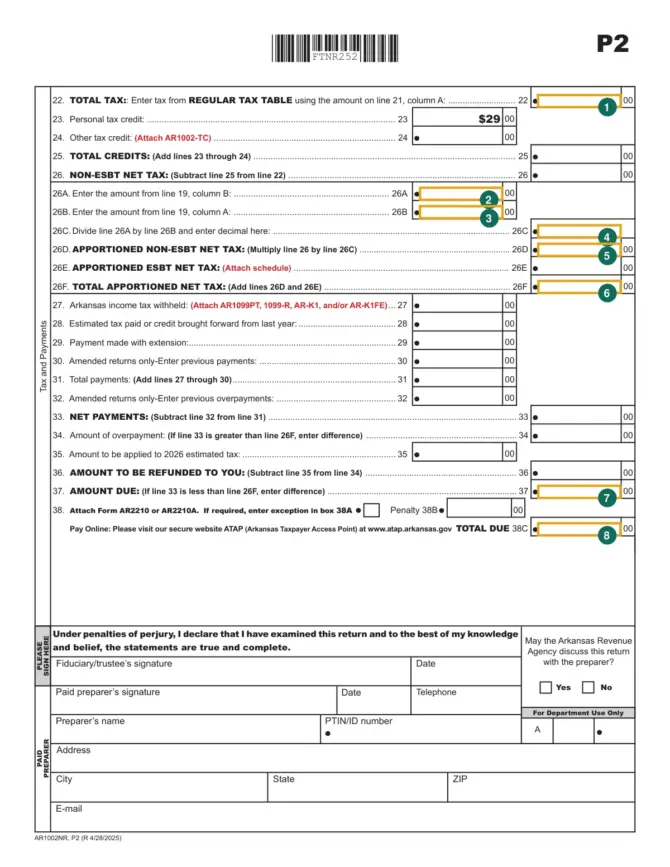
| Frame | Line | What to enter |
|---|---|---|
| 1 | 22 Total tax | Tax from the Regular Tax Table on line 21, column A. Enter zero if less than zero. |
| 23 Personal tax credit | Printed as $29; not adjusted. | |
| 24 Other tax credit | Total allowable credits from line 3 of Form AR1002-TC, attached with its supporting documents. | |
| 25 and 26 | Line 25 adds lines 23 and 24 (never negative); line 26, non-ESBT net tax, is line 22 minus line 25. | |
| 2 | 26A | Line 19, column B. |
| 3 | 26B | Line 19, column A. |
| 4 | 26C | Line 26A divided by line 26B, rounded to six decimal places and not more than 100%. |
| 5 | 26D | Line 26 multiplied by line 26C: the apportioned non-ESBT net tax. |
| 26E | Apportioned net tax from the S portion of an ESBT, with a schedule showing the ESBT computation and its apportionment. | |
| 6 | 26F | Line 26D plus line 26E: total apportioned net tax. |
The 2025 Regular Tax Table is the fiduciary table for both returns. For income of $100,001 and over it gives the tax as $3,809 plus 3.9% of the excess over $100,000. A made-up example: a trust with $160,000 on line 19, column A, and $40,000 on line 19, column B. Line 21 is $157,530 ($160,000 minus $2,470), so the formula gives about $6,053 on line 22. After the $29 credit, line 26 is about $6,024. Line 26C is 40,000 ÷ 160,000 = 0.250000, and line 26D is about $1,506. Use the printed table for the actual figure.
Payments, refund and amount due (lines 27 to 38C)
| Line | Entry |
|---|---|
| 27 | Arkansas income tax withheld. The form asks for AR1099PT, 1099-R, AR-K1 and/or AR-K1FE to be attached. |
| 28 | Estimated tax paid, or credit brought forward from last year. |
| 29 | Amount paid with an extension. |
| 30 and 32 | Amended returns only: payments made with or after the original return (30) and overpayments, refunds or carryforwards already received (32). |
| 31 and 33 | Line 31 adds lines 27 to 30; line 33, net payments, is line 31 minus line 32. |
| 34 to 36 | If line 33 is greater than line 26F, the difference is the overpayment (34). Line 35 is the part carried to the 2026 estimated account; line 36, the refund, is line 34 minus line 35. |
| 37 | Amount due when line 26F is larger than line 33 (frame 7). |
| 38A and 38B | From Form AR2210: the exception number from Part 1 in 38A, or the penalty from line 17 in 38B. From Form AR2210A: “6” in 38A and the amount from line 46 in 38B. Attach the form used. |
| 38C | Total due: line 37 plus line 38B (frame 8). |
The underpayment penalty can apply when net tax on line 26F is more than $1,000 and the estate or trust did not file the estimated tax declaration Arkansas requires or did not pay adequate installments.
Page 2 ends with the fiduciary or trustee’s signature and date under the penalties-of-perjury statement, a Yes/No box on whether DFA may discuss the return with the preparer, and the paid preparer block (signature, name, PTIN or ID number, address, telephone and email).
Schedule A capital gains and Schedule B distributions
Schedule A on page 3 has three money columns: federal Schedule D, (A) all income and (B) Arkansas only. Line 1 takes the federal long-term gain or loss from line 16 of federal Schedule D (Form 1041), and lines 4 and 9 take the short-term loss or gain from line 7. Arkansas did not adopt federal bonus depreciation, so the schedule has adjustment lines for depreciation differences.
- Only 50% of net long-term capital gain is taxed (line 8); short-term gain is taxed at 100%.
- Under Act 1488 of 2013, net capital gain over $10,000,000 from a gain realized on or after January 1, 2014 is exempt, so line 7b is capped at $10,000,000.
- Capital loss deductible after offsetting gains is limited to $3,000 (line 12).
- Line 12 carries to page 1, line 4.
The form labels lines 2, 5 and 10 as the depreciation adjustment lines. The line 4 note in the instruction booklet lists lines 2, 5 and 11; on the 2025 form, line 11 is the Arkansas short-term capital gain. Follow the printed labels on the form.
Schedule B lists each beneficiary’s share of income: name (or name of the estate or trust), SSN or FEIN, address, state, ZIP and amount, plus the total share and the number of beneficiaries who received distributions. There are five rows; attach a separate schedule if you need more. A completed AR K-1FE for each beneficiary must be attached to the return.
Attachments that go with the return
- Form AR4-FID for interest (line 1) and dividends (line 2)
- Federal schedules for lines 3, 5 and 6, and federal Schedule D for Schedule A
- K-1s for pass-through income (lines 7 and 14)
- A statement for line 8 and schedules for lines 10 and 15
- The ESBT computation schedule when line 26E is used
- Form AR1002-TC with supporting documents for line 24
- Withholding statements for line 27
- Form AR2210 or AR2210A when lines 38A and 38B apply
- An AR K-1FE for every beneficiary
Where to mail the AR1002NR and how to pay
The 2025 form and instructions are on DFA’s Fiduciary and Estate Income Tax Forms page. The instructions give different post-office boxes depending on the result of the return:
| Return result | Mailing address |
|---|---|
| Tax due | Arkansas State Income Tax, P.O. Box 2144, Little Rock, AR 72203-2144 |
| Refund | Arkansas State Income Tax, P.O. Box 1000, Little Rock, AR 72203-1000 |
| No tax due or refund | Arkansas State Income Tax, P.O. Box 2144, Little Rock, AR 72203-2144 |
The physical address is Arkansas State Income Tax, 1816 W 7th Street, Room 2300, Little Rock, AR 72201. DFA notes that a return with insufficient postage will not be delivered by the U.S. Postal Service.
A balance can be paid three ways. ATAP (Arkansas Taxpayer Access Point, www.atap.arkansas.gov) takes payments without registration. Credit card payments go through ACI Payments Inc at 1-800-272-9829 or acipayonline.com, which charges a convenience fee that the state does not receive. By mail, enclose a check or money order with a completed Form AR1002V in the return envelope, payable in U.S. dollars to the Department of Finance and Administration, with the FEIN written on it, and mail on or before the due date. For an amended return payment, mark Yes on the AR1002V amended-return question.
Official PDF: Form AR1002NR — Official PDF (dfa.arkansas.gov)
What delays the return or loses a credit
- A partial FEIN, with asterisks or X’s, may delay processing or lead to rejection; a Social Security number cannot replace it.
- The return must carry the name of the estate or trust, not a person’s name.
- Without the extension box checked on page 1, the federal or state extension is not credited.
- Line 26C must be rounded to six decimals and cannot exceed 100%.
- Each beneficiary needs an AR K-1FE attached.
- Insufficient postage means the Postal Service will not deliver the return.
Questions about the AR1002NR
Does a nonresident trust pay Arkansas tax on all of its income?
Tax is first computed on line 21, column A, which covers all income, then multiplied on line 26D by the line 26C ratio of Arkansas income to all income. Only the apportioned amount on line 26F is compared with payments.
Where does a refund from the AR1002NR go if part of it is kept for 2026?
Line 35 sends that part to the 2026 estimated tax account, and line 36 is the remainder refunded. A refund return is mailed to P.O. Box 1000.
Do beneficiaries in other states have to file in Arkansas?
The instructions say a nonresident beneficiary with distributions from an Arkansas estate or trust must file Form AR1000NR reporting Arkansas-source income, regardless of the amount distributed.
Official documents and review date
- 2025 AR1002NR Arkansas Fiduciary Nonresident Income Tax Return
- Arkansas Fiduciary Income Tax Instructions, AR1002F and AR1002NR (2025)
- 2025 Tax Tables (Regular Tax Table used for fiduciary returns)
- Comprehensive Individual Income Tax Regulations, Regulation 1997-4 (rule 1.26-51-803)
- Fiduciary and Estate Income Tax Forms, Arkansas Department of Finance and Administration
- AR1100PTV Pass-Through Entity Tax Return Payment Voucher (2025)