Form AR1000ADJ is the one-page Arkansas schedule that lists the 18 adjustments allowed against total income on an individual return, from the Texarkana border city exemption to ABLE account contributions. Its line 19 total becomes line 24 of Form AR1000F (full-year residents) or Form AR1000NR (part-year residents and nonresidents), and line 25 of the return is line 23 minus that figure: your Arkansas adjusted gross income. The current version is the 2025 schedule, AR1000ADJ (R 4/25/2025), with separate two-page instructions revised 6/17/2025.
Who attaches AR1000ADJ, and by what date
The booklet for AR1000F and AR1000NR says that anyone claiming an adjustment from the list on line 24 uses AR1000ADJ, puts the total on that line and attaches the schedule. Without any of the 18 adjustments, the schedule is not needed. The schedule has no signature line of its own; it travels with the signed return.
For tax year 2025, a calendar-year return is due no later than April 15, 2026. A federal extension on Form 4868 carries over to Arkansas and moves the filing date to November 15; you check the box on the return instead of attaching the 4868. Without a federal extension, you can request an Arkansas extension on Form AR1055-IT before April 15; DFA states that inability to pay is not a valid reason for an Arkansas extension. The postmark date counts as the filing date.
Arkansas takes the return and its schedules through the Federal/State e-file program, which DFA says is available to most full-year residents and to some nonresidents and part-year residents. On paper, the address depends on the result of the return:
- Refund: Arkansas State Income Tax, P.O. Box 1000, Little Rock, AR 72203-1000
- Tax due, or no tax due and no refund: Arkansas State Income Tax, P.O. Box 2144, Little Rock, AR 72203-2144
Columns A, B and C on the schedule
Each line has three entry columns, matching the columns of the return. Column A (Primary/Joint) is used by everyone. Column B is only for filing status 4, married filing separately on the same return, where the spouse’s adjustments go. Every other filing status uses column A alone, including married filing jointly (status 2).
Column C, “Arkansas Adjustments Only”, belongs to AR1000NR filers. A part-year resident enters there only the part of each adjustment attributable to Arkansas. A full-year nonresident who puts any amount in column C must attach an explanation. The column matters because AR1000NR divides line 25, column C, by the total of columns A and B on line 25 to get the Arkansas percentage that apportions the tax (lines 38A to 38D). Full-year residents on AR1000F leave column C alone.
How to fill out AR1000ADJ line by line
The schedule prints a warning under line 19: do not enter amounts from categories that are not printed on the form. The table follows the 2025 schedule and its instructions; the page numbers point to the 2025 AR1000F/AR1000NR booklet.
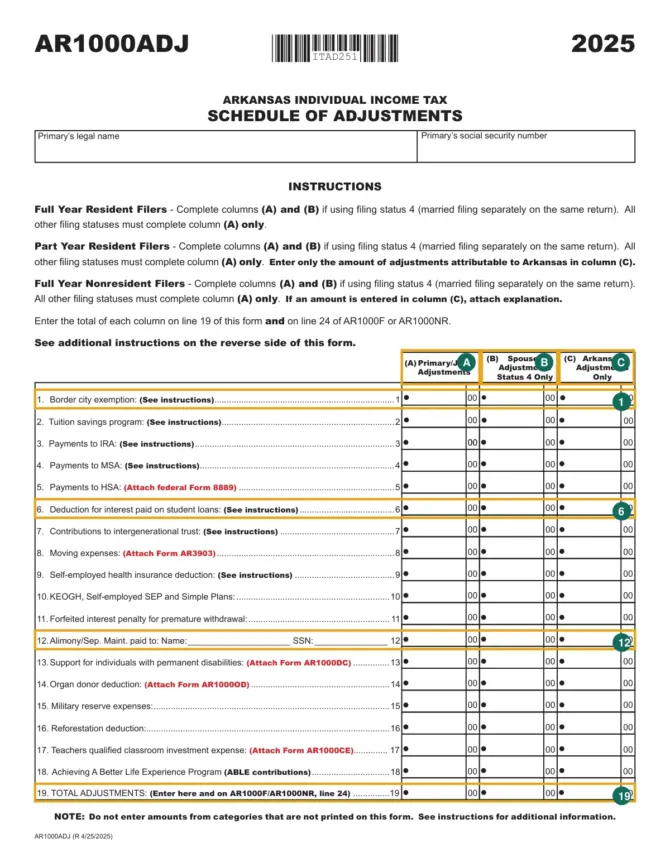
| Line | Adjustment | Where the figure comes from | Limit or condition DFA states |
|---|---|---|---|
| 1 | Border city exemption | Income covered by the Texarkana exemption; attach Form AR-TX from your employer for wages | Full exemption for residents of Texarkana, Arkansas; residents of Texarkana, Texas deduct only income earned inside Texarkana, Arkansas city limits |
| 2 | Tuition savings program | Contributions to an Arkansas Tax Deferred Tuition Savings Program account, or another state’s program | $5,000 per taxpayer, excess carried forward up to 4 years; $7,500 for a rollover from another state’s plan; $3,000 for another state’s plan not deducted there |
| 3 | Payments to IRA | Contributions to your own traditional IRA | $7,000 each if neither spouse had an employer plan, plus up to $1,000 if 50 or older; phase-out chart on booklet page 19 otherwise |
| 4 | Payments to MSA | Contributions to an existing Archer MSA | Monthly limit of 1/12 of 65% (self-only) or 75% (family) of the HDHP annual deductible |
| 5 | Payments to HSA | Contributions shown on federal Form 8889, which must be attached | $4,300, or $8,550 for family coverage, plus $1,000 at age 55; reduced by Archer MSA contributions |
| 6 | Interest paid on student loans | Student Loan Interest Worksheet, booklet page 19 | No more than $2,500; not for status 5 or anyone claimed as a dependent |
| 7 | Contributions to intergenerational trust | Contributions to a long-term trust for a person under 18 | $4,000 per year |
| 8 | Moving expenses | Form AR3903, a completed copy attached | Move for a job or business that adds at least 50 miles to the old commute |
| 9 | Self-employed health insurance | Self-Employed Health Insurance Deduction Worksheet, booklet page 20 | Smaller of premiums paid or net profit from the business, less line 10 |
| 10 | Keogh, SEP and SIMPLE plans | Your total contributions as a self-employed person | Depends on the plan; DFA refers to IRS Publication 560 |
| 11 | Forfeited interest penalty | Penalties paid for early withdrawal of certificates of deposit | Total paid |
| 12 | Alimony or separate maintenance paid | Payments made under a court order; write the recipient’s name and SSN on the line | Total paid |
| 13 | Support for individuals with permanent disabilities | Form AR1000DC, one for each individual | $500 per individual |
| 14 | Organ donor deduction | Form AR1000-OD, line 7 | Up to $10,000 |
| 15 | Military reserve expenses | Your military reserve expenses | Total amount |
| 16 | Reforestation deduction | Your reforestation deductions | Total amount |
| 17 | Teachers’ classroom investment expense | Form AR1000CE, line 7, one form for each taxpayer claiming | $1,000 per taxpayer, $2,000 on a joint return if each spouse is a teacher |
| 18 | ABLE contributions | Contributions to an Achieving A Better Life Experience Program account | $5,000 per taxpayer, excess carried forward up to 4 years |
| 19 | Total adjustments | Lines 1 through 18, column by column | Goes to AR1000F or AR1000NR, line 24 |
Line 1: Texarkana
The border city exemption has two versions. If you lived within the city limits of Texarkana, Arkansas, your income is fully exempt from Arkansas income tax; a part-year Texarkana resident claims it only on income earned while living there. If you lived within the city limits of Texarkana, Texas, you deduct the income you earned inside the city limits of Texarkana, Arkansas, and all your other Arkansas income stays taxable.
Either way, you still file a return that reports all Arkansas income for the year, and you must use your street address in Texarkana, Arkansas or Texarkana, Texas on it. A physical address is required. Wages need Form AR-TX, which your employer supplies. Interest, dividends, Schedule C, Schedule E, Schedule F and retirement income do not need an AR-TX, though DFA says it may ask for more information when you adjust for them.
Lines 2 and 18: tuition savings and ABLE accounts
Both lines work the same way for Arkansas accounts: up to $5,000 per taxpayer for the year, and anything above $5,000 carries forward to the next 4 tax years. Line 2 has two more limits. Money rolled into an Arkansas plan from another state’s tuition savings plan can be deducted up to $7,500 per taxpayer in the year of the rollover, as long as it was never deducted in an earlier Arkansas return. Contributions to another state’s plan are deductible up to $3,000 when they are not deducted on that state’s income tax. Qualified withdrawals from either kind of plan are exempt from Arkansas income tax for the beneficiary.
Lines 3 to 5: IRA, MSA and HSA
For line 3, if neither you nor your spouse was covered by an employer retirement plan, the whole traditional IRA contribution is deductible up to $7,000 each, whatever the filing status, and someone who turned 50 before the end of the tax year may add up to $1,000. If either of you was covered, the IRA Phase-Out Chart on page 19 of the booklet works from Arkansas AGI:
| Filing status | Phase-out starts above | Deduction is zero at |
|---|---|---|
| Single, head of household | $79,000 | $89,000 |
| Married on the same return (status 2 or 4), or surviving spouse | $126,000 | $146,000 |
| Married filing on separate returns (status 5) | $0 | $10,000 |
| Nonactive spouse (income computed jointly) | $236,000 | $246,000 |
Inside a phase-out range, the chart sends you to IRS Publication 590 to figure the allowable amount.
Lines 4 and 5 both require coverage under a high deductible health plan (HDHP) only. New Archer MSAs could not be opened after 2007, but contributions to existing ones still go on line 4. For line 5, the instructions give HSA contribution limits of $4,300, or $8,550 for families, with an extra $1,000 for 2025 for people who reached 55 by year end. Archer MSA contributions reduce the HSA maximum. Federal Form 8889 is required with line 5.
Line 6: the student loan interest worksheet
You qualify only if all four conditions in the instructions are met: you paid interest in 2025 on a qualified student loan, your filing status is not 5, you are not claimed as a dependent on someone else’s 2025 return, and your AGI is under $100,000 (status 1, 3 or 6) or $200,000 (status 2 or 4; for status 4 this is the couple’s combined income). The worksheet on booklet page 19 starts from line 23 of the return, subtracts the other adjustments on line 24 (not line 6 itself), and reduces the deduction between $85,000 and $100,000, or $170,000 and $200,000 for status 2 or 4.
A hypothetical single filer paid $1,800 of student loan interest. Total income on line 23 is $93,000 and the other AR1000ADJ lines add up to $2,000, so modified AGI is $91,000. That is $6,000 over the $85,000 threshold; $6,000 divided by $15,000 gives 0.400, and 0.400 times $1,800 is $720. The allowable deduction is $1,800 minus $720, or $1,080, written on line 6, column A. Status 4 filers then split the deduction on worksheet lines 11 to 15 in proportion to the interest each spouse paid, with line 14 going to column A and line 15 to column B.
Lines 8 to 10: moving and self-employment
Line 8 is open to employees and self-employed people who moved in 2025 for a job or business, if the move added at least 50 miles to the distance from the old home to the old workplace; with no former workplace, the new workplace must be at least 50 miles from the old home. A completed Form AR3903 goes with the return. Moving reimbursements included on your W-2 are reported as income on line 8 of AR1000F or AR1000NR. The booklet’s mileage table lists 21 cents a mile for medical and moving travel in 2025.
Line 10 comes before line 9 in the arithmetic. The self-employed health insurance worksheet on booklet page 20 takes the premiums paid for coverage set up under your business for you, your spouse and dependents, compares them with your net profit and other earned income from that business less the line 10 deduction, and puts the smaller figure on line 9. The same premiums cannot be used again as medical expenses on Form AR3.
Lines 13, 14 and 17: certificates and supporting forms
Line 13 is $500 for each qualifying individual with disabilities, with a separate Form AR1000DC for each. The certificate is good for one year, must be completed in full and is signed under penalties of perjury. The person must be your natural or adopted child or your dependent, cared for in your home, and diagnosed by a physician as totally and permanently disabled; the person cannot be you or your spouse.
Line 14 covers unreimbursed travel, lodging, medical costs and lost wages from a living donation of all or part of a liver, pancreas, kidney, intestine, lung or bone marrow by you or your dependent. AR1000-OD caps it at $10,000, allows it only for the year of the transplant and only once in a lifetime. Organs from a deceased donor do not qualify.
Line 17 takes the total from Form AR1000CE. The deduction is for preK-12 teachers, instructors, counselors, principals and aides employed at least 900 hours in the year at a state-certified public school. The form groups expenses into books, school supplies, computer equipment and software, athletic equipment, and food and clothing for the teacher’s students, and the teacher must keep the receipts.
Line 19 and line 24 of the return
Add lines 1 through 18 in each column and write the totals on line 19. Each column total then goes to the same column of line 24 on AR1000F or AR1000NR. Line 25, adjusted gross income, is line 23 (total income) minus line 24. On AR1000NR, the column C figure on line 25 feeds the Arkansas income percentage on line 38C, so a column C total on AR1000ADJ changes the apportioned tax as well as AGI.
Before the schedule goes in with the return
- Each column of line 19 equals the same column on line 24 of AR1000F or AR1000NR.
- Column B is used only with filing status 4.
- A full-year nonresident with an amount in column C has attached an explanation.
- Form AR-TX is attached for Texarkana wages on line 1.
- Federal Form 8889 is attached for line 5.
- Form AR3903 is attached for line 8.
- The recipient’s name and SSN are written on line 12.
- One Form AR1000DC per individual for line 13, Form AR1000-OD for line 14, and one Form AR1000CE per claiming taxpayer for line 17.
- Nonresidents and part-year residents have attached pages 1 and 2 of the federal Form 1040, without which DFA says the Arkansas return will not be processed.
Where to get the 2025 AR1000ADJ PDF and its instructions
DFA lists the schedule on its 2025 Tax Forms page as “AR1000ADJ Adjustments Schedule”, a fillable one-page PDF, with the line instructions as a separate file. The form says to see the instructions on its reverse side; in the download they are that second PDF, not page 2. The cover of the 2025 AR1000F/AR1000NR booklet gives (501) 682-1100, (800) 882-9275 and individual.income@dfa.arkansas.gov for help.
Official PDF: Form AR1000ADJ — Official PDF (dfa.arkansas.gov)
Questions about AR1000ADJ
Can I enter an adjustment that is on my federal return but not on AR1000ADJ?
The schedule says not to enter amounts from categories that are not printed on the form. Only the 18 listed adjustments reduce Arkansas total income on line 24.
We file jointly in Arkansas. Do we use column B?
Column B is only for filing status 4, married filing separately on the same return. A joint return (status 2) puts both spouses’ adjustments in column A.
I put $8,000 into an Arkansas tuition savings account in 2025. What happens to the rest?
Line 2 takes $5,000 for 2025. Under the instructions, the $3,000 above the limit carries forward to the next 4 tax years.
Official sources
- Arkansas Department of Finance and Administration, AR1000ADJ, Arkansas Individual Income Tax Schedule of Adjustments, 2025 (R 4/25/2025)
- Arkansas Department of Finance and Administration, Instructions for Form AR1000ADJ, 2025 (R 6/17/2025)
- Arkansas Department of Finance and Administration, Arkansas 2025 Individual Income Tax Forms and Instructions (AR1000F and AR1000NR booklet)
- Arkansas Department of Finance and Administration, Form AR1000F, 2025
- Arkansas Department of Finance and Administration, Form AR1000NR, 2025
- Arkansas Department of Finance and Administration, Form AR1000DC, Certificate for Individuals with Disabilities, 2025
- Arkansas Department of Finance and Administration, Form AR1000-OD, Organ Donor Deduction, 2025
- Arkansas Department of Finance and Administration, Form AR1000CE, Teachers Qualified Classroom Investment Expense, 2025
- Arkansas Department of Finance and Administration, Form AR3903, Moving Expenses, 2025
- Arkansas Department of Finance and Administration, 2025 Tax Forms