AR1000ES is the Arkansas packet an individual uses to declare and pay estimated income tax for 2026: a worksheet that works out the year’s estimate, then four vouchers dated April 15, June 15 and September 15, 2026, and January 15, 2027. Arkansas tax withheld from pay is subtracted on worksheet line 7, so the vouchers carry only the part of the tax that withholding does not cover.

Who has to file the declaration
The test is the line 8 result of the 2026 worksheet: tax on the expected income, less the personal tax credits and less the Arkansas tax expected to be withheld during 2026. The worksheet says to file the declaration voucher if line 8 is $1,000 or more; below $1,000 no voucher is required.
The instruction page of the same packet words the test as an estimate of more than $1,000. The 2025 AR2210 instructions, the latest on DFA’s forms page, state the rule as $1,000 or more where withholding for the year does not equal 90% of the estimated tax. The difference only touches an estimate of exactly $1,000; DFA at (501) 682-1100 can confirm how such a case is treated.
Two groups follow different timing. A taxpayer whose farming income can reasonably be expected to reach at least two thirds of gross income from all sources may file the declaration and pay by the 15th day of the second month after the income year closes, or skip the declaration and file the return with full payment by the 15th day of the third month. Fiscal year filers file the declaration by the 15th day of the fourth month of their income year and pay the rest quarterly.
Married couples work the worksheet in two columns, Primary and Spouse, for lines 1 to 4. The vouchers carry a second name line and a spouse Social Security number for a joint declaration. The 2025 AR1000F and AR1000NR instructions say that if spouses who made a joint declaration later file on separate forms, the estimated payments are credited to the primary filer.
How to complete the 2026 estimated tax worksheet
The worksheet on page 2 is marked “for your records only”. DFA’s instructions suggest last year’s income and deductions as a starting point, adjusted for 2026.
| Worksheet line | What goes there | Where the figure comes from |
|---|---|---|
| 1 | Adjusted gross income expected in 2026, per column. | Your expected 2026 income; last year’s return is the suggested starting point. |
| 2 | Estimated itemized deductions, or the standard deduction of $2,470 per taxpayer. | Form AR3, the Arkansas itemized deduction schedule, if you itemize. |
| 3 | Net taxable income: line 1 minus line 2. | Lines 1 and 2. |
| 4 | Tax on line 3. | The tax rate schedule on page 2; incomes from $94,701.00 to $97,600.99 use the separate table on page 3. |
| 5 | Total tax: the line 4 entries added together. | Both columns of line 4. |
| 6 | Tax credits. | The credit list below the worksheet. |
| 7 | Arkansas income tax expected to be withheld during 2026 from salaries, wages, commissions and similar pay. | Arkansas withholding on your 2026 pay. |
| 8 | Estimated tax: line 5 minus lines 6 and 7. | The amount that decides whether vouchers are needed. |
The credits listed for line 6 are $29 for single filers or married couples filing separate forms; $58 for a joint return, head of household, married filing separately on the same return, or qualifying widow(er) with dependent child; $29 for each dependent; and $29 each for blind, deaf, over 65 and 65 special.
The schedule taxes net taxable income below $5,599 at zero. At the top, net taxable income of $100,000 and over is taxed at $3,618.00 plus 3.7% of the excess over $99,999.99.
A worked example: a single filer expects $60,000 of AGI, takes the $2,470 standard deduction and expects $500 of Arkansas withholding. Line 3 is $57,530. That falls in the $50,000.00 to $59,999.99 band, so line 4 is $1,481.00 plus 3.7% of $7,530.01, or $1,759.61. After the $29 credit and the $500 withholding, line 8 is $1,230.61, above the voucher threshold. One quarter of that is $307.65, entered on the voucher as $308.00.
2026 voucher due dates and late starts
How much goes on each voucher depends on the date you first become liable to file a declaration. Once that date has passed, the remaining vouchers split line 8 among themselves.
| Voucher | Due date printed on it | If you first become liable on this date, enter |
|---|---|---|
| 1 | 04/15/2026 | One fourth of line 8 (four installments) |
| 2 | 06/15/2026 | One third of line 8 (three installments) |
| 3 | 09/15/2026 | One half of line 8 (two installments) |
| 4 | 01/15/2027 | All of line 8 (paid in full) |
When a due date falls on a Saturday, Sunday or legal holiday, a payment postmarked on the next business day that is not a weekend day or legal holiday counts as timely. The 2025 AR2210 instructions also list an exception for the fourth installment: in place of that voucher, the taxpayer may file the income tax return and pay the tax by January 31, or the last day of the first month after the income year closes.
Filling in each voucher
All four vouchers have the same fields; only the voucher number and the preprinted due date change. The illustration shows voucher 1 from page 3 of the PDF with the fields numbered in the order of this table.
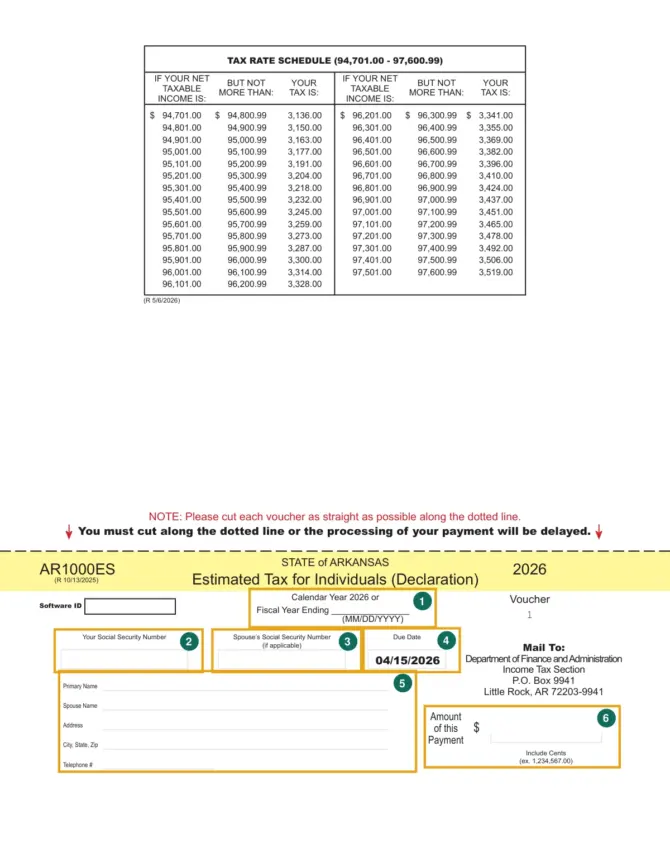
| Field | What to enter |
|---|---|
| 1. Calendar Year 2026 or Fiscal Year Ending | The voucher is printed for calendar year 2026; a fiscal year filer writes the year-end date as MM/DD/YYYY. |
| 2. Your Social Security Number | The primary taxpayer’s number. A 2025 overpayment you asked to carry forward is credited to the primary SSN on that AR1000F or AR1000NR. |
| 3. Spouse’s Social Security Number | Marked “if applicable”; it goes with the Spouse Name line on a joint declaration. |
| 4. Due Date | Already printed: 04/15/2026, 06/15/2026, 09/15/2026 or 01/15/2027. |
| 5. Primary Name, Spouse Name, Address, City, State, Zip, Telephone # | Your name, mailing address and telephone number. |
| 6. Amount of this Payment | The installment from the worksheet, rounded to the nearest whole dollar and written with cents, such as $794.00 for $793.74. |
The fillable PDF shows “DFA WEB” in the Software ID box; the instructions give no entry for it. A record grid on page 2 has rows for date, amount, overpayment, total due and date paid under each of the four vouchers, with a total column. In the 2025 AR1000F and AR1000NR instructions, line 40 takes the total paid on that year’s declaration, including the January installment and any credit brought forward, without penalties or interest.
What the underestimate penalty is based on
The estimate has to come to at least 90% of the tax actually due. If that much is not declared and paid by each quarterly due date, a penalty of 10% per year is added to the underestimate, assessed quarterly. The penalty is computed on the lesser of the current year’s or the previous year’s tax liability, and someone with uneven income may annualize it. The 2025 AR2210 instructions compute it per quarter as the days from the due date to the payment date, divided by 365, times 10%, times the underpayment.
DFA’s forms page lists Form AR2210 for the penalty and Form AR2210A for the annualized method. In the 2025 AR2210 instructions, no penalty applies when the tax shown on the return is under $1,000, or when the original estimate equals the tax due on the return for the preceding 12-month year that showed a liability. It also does not apply when the preceding year was a 12-month year with no tax liability and the taxpayer was an Arkansas resident throughout that year. The Commissioner can also waive it for casualty, disaster or other unusual circumstances, and for a taxpayer who retired after reaching age 62, or became disabled in that tax year or the year before, where the underpayment had reasonable cause and was not willful neglect. The exception number goes in box 52A of AR1000F or AR1000NR with the form attached.
Where to send AR1000ES or pay online
Download the 2026 AR1000ES packet from DFA; the forms page shows it posted June 2, 2026. Payments can be made online through the Arkansas Taxpayer Access Point at www.atap.arkansas.gov, which the packet says is available 24 hours.
For a paper payment, mail the voucher with a check or money order payable to the Department of Finance and Administration to:
Department of Finance and Administration
Income Tax Section
P.O. Box 9941
Little Rock, AR 72203-9941
Write your Social Security number on the check or money order. Questions go to (501) 682-1100, to the office in Room 2300 of the Joel Y. Ledbetter Building at 7th and Wolfe in Little Rock, or in writing to P.O. Box 3628, Little Rock, AR 72203-3628. Corporations pay their estimates on the separate AR1100ESCT vouchers.
Payment and credit problems DFA names
- Each voucher has to be cut along the dotted line; the packet says processing of the payment is delayed otherwise, and asks for a straight cut.
- A carryforward from last year is credited only to the primary filer and cannot be divided between spouses. Where the previous primary filer has died, the 2025 AR1000F and AR1000NR instructions call for a letter before filing asking that the carryforward go to the spouse; without it, processing of the return can be delayed.
- A refund or overpayment from a prior-year return filed after its due date cannot be carried forward as estimated tax.
This guide covers the 2026 packet and the penalty rules DFA publishes with it. For a fiscal year, farm income or a joint-to-separate change, a tax adviser or DFA can confirm the amounts that apply to you.