Form AMFT-22 (I) is the Gasoline Importer Report that a licensed Arkansas motor fuel distributor files every month with the Motor Fuel Tax Section of the Department of Finance and Administration (DFA). It accounts for every gallon of gasoline the distributor received in the previous month, takes out the gallons that are exempt or taxed somewhere else, and turns the rest into Arkansas motor fuel excise tax, wholesale tax and border zone tax. DFA’s Motor Fuel Tax Forms page lists it as “Gasoline Importer AMFT-22(I) and Instructions”, posted August 19, 2025. The PDF has two pages, the report and its instructions, and prints no revision date.
Who files Form AMFT-22 (I) and how the report reaches DFA
The instructions are addressed to every licensed distributor: on or before the 25th day of each month, file a report accounting for all motor fuels handled during the preceding month, even when the account had no activity. Arkansas’s Motor Fuel Tax Law, which DFA posts on the same forms page, says the same in § 26-55-229(b): once a distributor has to file monthly reports, it keeps filing them even when no tax is due, until it notifies the Secretary in writing that it is no longer liable.
Arkansas uses separate versions of the monthly distributor report. Gasoline importers file AMFT-22 (I); the forms page also lists a Gasoline First Receiver report, AMFT-22 (F), and the diesel pair AMFT-13 (I) and AMFT-13 (F). Neither gasoline form explains how a licensee is classed as an importer or a first receiver; the Motor Fuel Tax Section answers that at (501) 682-4800.
The PDF is not the filing route. Its general information paragraph says that all original and amended returns must be submitted electronically and that all original payments must be made by electronic funds transfer (EFT). Electronic filing happens in the Arkansas Taxpayer Access Point (ATAP). DFA’s XML upload instructions for motor fuel returns describe the monthly steps:
- Log on to ATAP and, on the Summary tab, open “View Returns” for the MFT account.
- Click “File” for the period being reported.
- On the Motor Fuel Schedule of Receipts page, click “Import From XML”, choose the saved .xml file and click OK. “Table View” shows the imported data as a table.
- Correct any errors, click Next through the remaining filing steps, and click Submit.
Before importing, the file can be checked with “XML Return File Validation” in the Inquiries section of the ATAP home page. The same instructions say importers and first receivers both use the Distributor Schedule in the XML file, that a licensee filing a gasoline return and a distillate return should put all return types in one XML file, and that the state license number field takes the state-issued account number in the format 11111111-MFT. The paper form, by contrast, asks for a five-digit license number. The PDF shows the 26 lines and the schedule types each line is built from.
A reporting firm or accountant that files for the distributor needs authorization. The Motor Fuel Tax page links “Reporting Firm Authorization / Power of Attorney” to DFA’s general power of attorney form, explained in our guide to the Arkansas DFA Power of Attorney. DFA’s ACH credit instructions add that a power of attorney must be on file for each taxpayer represented by an accounting firm, payroll service, CPA or other third party.
Monthly due dates for the 2026 reports
The report and the EFT payment are due by the 25th of the month after the report month. Any report timestamped after the 25th, or any EFT payment made after the EFT due date, is treated as delinquent, and the instructions say applicable penalties and interest will be assessed. When the 25th falls on a weekend or holiday, DFA’s “Distributor/Supplier EFT and XML Due Dates for 2026” moves the date:
| Report month (2026) | EFT and XML due date |
|---|---|
| January | February 25, 2026 |
| February | March 25, 2026 |
| March | April 27, 2026 |
| April | May 26, 2026 |
| May | June 25, 2026 |
| June | July 27, 2026 |
| July | August 25, 2026 |
| August | September 25, 2026 |
| September | October 26, 2026 |
| October | November 25, 2026 |
| November | December 28, 2026 |
| December | January 25, 2027 |
Schedules R, D and M behind the report
Lines 1 to 11 of AMFT-22 (I) each point to a supporting schedule, and the instructions require each schedule to carry detailed information for every line and column. Supporting schedules are not required with a no-activity report. The blank schedules are on the Motor Fuel Tax Forms page:
- Form R, Motor Fuel Tax Schedule of Receipts. One schedule type per form: 1 for gallons received tax paid, 2 for gallons received in Arkansas tax unpaid, 3 for gallons imported from another state. Each receipt is a row with carrier name, mode, point of origin and destination, the seller it was acquired from and the seller’s FEIN or SSN, date received, document number and net gallons. Columns 2, 10 and 11 are not used in Arkansas.
- Form D, Motor Fuel Tax Schedule of Disbursements. Schedule types 5I to 5N are gallons sold at the Missouri, Oklahoma, Texas, Louisiana, Mississippi and Tennessee border zone rates; 6 is gallons delivered to a licensed distributor with tax not collected; 7 is gallons exported to another state; 8 is gallons delivered to the U.S. government; 10B is gallons sold for aviation purposes; 10H is casualty losses. Each row has the purchaser and the purchaser’s FEIN or SSN in place of the seller.
- Form M, Motor Fuel Tax Report of Loss. It asks for the product type, the reason for the loss (mixed product, fire, theft, transport accident or other), the date, city, state and county of the incident, the agency investigating it, whether it was reported to the Arkansas Pollution Control and Ecology Department, the total gallons lost, an explanation, and a signed declaration.
Both Form R and Form D ask you to foot each page separately and carry the total to the last page of the schedule. One detail differs between them: Form D lists product code 124 as gasohol, while Form R prints “gasoline” next to 124 as well as next to 65. If you are unsure which code a gasohol receipt takes, ask the Motor Fuel Tax Section before you file.
How to fill out Form AMFT-22 (I), line by line
The markers on the image group the 26 lines into the blocks you fill in order; the line numbers in the second column are the form’s own.
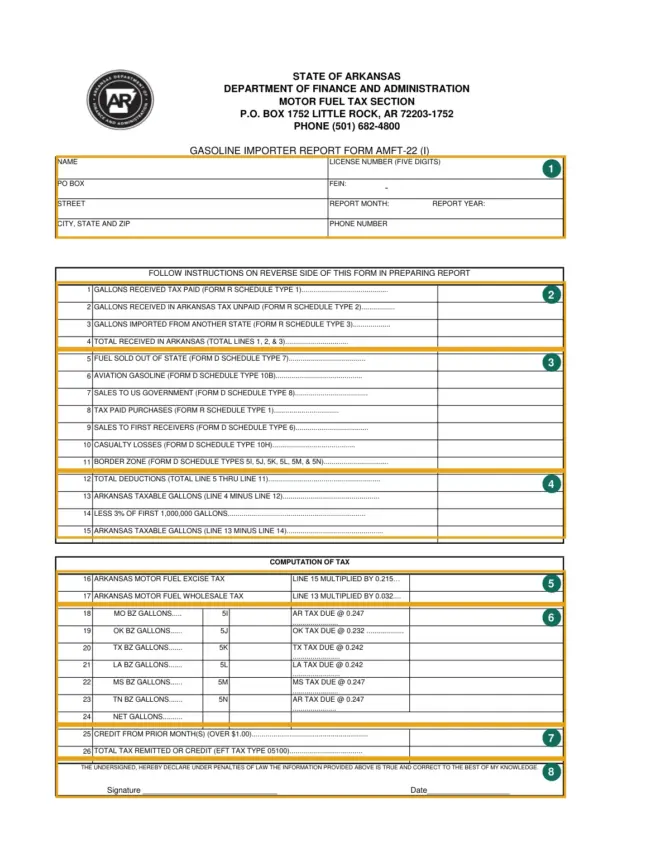
| Marker | Lines | What goes there |
|---|---|---|
| 1 | Header | Name, PO box, street, city, state and ZIP, the five-digit license number, FEIN, report month and year, and phone number. |
| 2 | 1 to 4 | 1: gallons received tax paid (Form R, schedule type 1). 2: gallons received in Arkansas tax unpaid (Form R, type 2). 3: gallons imported from another state (Form R, type 3). 4: total received in Arkansas, lines 1 + 2 + 3. |
| 3 | 5 to 11 | Deductions. 5: fuel sold out of state (Form D, type 7). 6: aviation gasoline (Form D, type 10B). 7: sales to the U.S. government (Form D, type 8). 8: tax-paid purchases (Form R, type 1). 9: sales to first receivers (Form D, type 6). 10: casualty losses (Form D, type 10H, supported by Form M). 11: border zone gallons (Form D, types 5I to 5N). |
| 4 | 12 to 15 | 12: total deductions, lines 5 through 11. 13: Arkansas taxable gallons, line 4 minus line 12. 14: 3% of the first 1,000,000 gallons on line 13. 15: Arkansas taxable gallons, line 13 minus line 14. |
| 5 | 16 and 17 | 16: excise tax, line 15 times 0.215. 17: wholesale tax, line 13 times 0.032. |
| 6 | 18 to 24 | Border zone gallons by state, each multiplied by the rate printed on its row, and net gallons on line 24. |
| 7 | 25 and 26 | 25: credit from prior months, if over $1.00. 26: total tax remitted or credit, paid under EFT tax type 05100. |
| 8 | Declaration | Signature and date under penalties of law. |
Tax-paid gallons appear twice. Line 1 adds them to the gallons received and line 8 deducts them again, both from Form R schedule type 1, so they do not reach line 13. That matches § 26-55-230(a)(1) of the Motor Fuel Tax Law, which starts the computation from gallons received reduced by the gallons on which tax has already been paid. The law also requires all volumes to be adjusted to 60 degrees Fahrenheit (§ 26-55-230(b)).
Line 9 is what separates this report from the first receiver version. AMFT-22 (F) has no “sales to first receivers” line, so its lines run one number lower (its excise tax is on line 14 and its total on line 25). On AMFT-22 (I), gallons the importer delivered to another licensed distributor without collecting tax, listed on Form D as schedule type 6, come off the taxable total on line 9.
Line 10 needs a Form M for each loss. The instructions allow specific losses due to fire, leakage or spillage when supported by a detailed Form M, and Form M says the claim must be filed within one year from the date of the incident. Section 26-55-230(a)(1)(E) of the law covers losses from fire, flood, storm, theft or another cause beyond the distributor’s control, other than evaporation, and allows the deduction in the report for the month of the loss or in any report filed within one year.
Line 14 is the shrinkage allowance. It is 3% of the first 1,000,000 gallons on line 13 and nothing on gallons above that, so it never exceeds 30,000 gallons. Section 26-55-230(a)(1)(F) describes it as the average loss from evaporation, shrinkage and unknown causes, plus the cost of collection.
Computing the tax on lines 16 to 26
The two Arkansas taxes use different bases. Line 16 multiplies line 15, after the 3% allowance, by $0.215. Line 17 multiplies line 13, before the allowance, by $0.032. Together the two rates make the $0.247 per gallon total for gasoline that DFA’s Motor Fuel Tax Rates sheet lists. A made-up month shows the difference: with 800,000 gallons on line 13, line 14 is 24,000 gallons and line 15 is 776,000, so line 16 is $166,840.00 and line 17 is $25,600.00. With 1,400,000 gallons on line 13, line 14 stops at 30,000 gallons.
The wholesale rate is set each year. DFA’s rate announcement dated July 31, 2026 (listed as “2026 What’s New” on the Motor Fuel Tax page) keeps the wholesale tax on gasoline at $0.032 per gallon for October 1, 2026 through September 30, 2027, with the total gasoline rate staying at $0.247. The same notice says wholesale distributors and suppliers add the Petroleum Environment Assurance Fee of $0.003 per gallon to the established rates. AMFT-22 (I) has no line for that fee; the forms page lists a separate Petroleum Environmental Fee Report, AMFT-56 (A).
Border zone gallons, deducted on line 11, are taxed again on lines 18 to 23 at the rate printed for each state:
| Line | Form D schedule type | Border state | Rate printed on the form |
|---|---|---|---|
| 18 | 5I | Missouri | $0.247 |
| 19 | 5J | Oklahoma | $0.232 |
| 20 | 5K | Texas | $0.242 |
| 21 | 5L | Louisiana | $0.242 |
| 22 | 5M | Mississippi | $0.247 |
| 23 | 5N | Tennessee | $0.247 |
The Missouri and Tennessee rows are labeled “AR tax due” on the form, but the rates printed there are the ones DFA’s 2026 announcement lists for the Missouri and Tennessee border zone areas, and all six rates on the form match that announcement. Section 26-55-210 explains where the border rate applies: in Arkansas cities, towns or planned communities on a state line, within 800 feet of the state line, a qualifying lake shore or a border bridge terminal, at a rate no more than one cent above the adjoining state’s tax. Fuel sold from an establishment next to an interstate within one mile of the state line takes the adjoining state’s rate, not more than Arkansas’s. The line 11 instruction mentions only “5I and or 5N”, while the printed line lists all six types 5I to 5N; the six rows on lines 18 to 23 follow the printed line.
Lines 24 and 26 are where the form is thinnest. Line 24 is labeled “net gallons” and has cells only in the gallons columns, while its instruction reads “Total gallons tax at Arkansas and border zone rates.” Line 26 is “total tax remitted or credit”, and its instruction says only “Total Tax remitted.” Neither the form nor the instructions list which lines are added on line 24 or how lines 16 to 23 and the line 25 credit combine on line 26. The Motor Fuel Tax Section at (501) 682-4800 can confirm the computation before you submit. The EFT payment for line 26 uses tax type code 05100, which DFA’s ACH credit instructions list for Gasoline Importer.
What makes a report late or gets an XML file rejected
- A report timestamped after the 25th, or an EFT payment made after the EFT due date. Both count as delinquent.
- A paper return or a paper check. Original and amended returns go in electronically and original payments by EFT.
- No report for a month with no activity. The report is due every month; only the supporting schedules may be left off.
- Schedules without detail for each line and column.
- A decimal or a blank in the Net field of the XML file. ATAP’s validation expects a whole number.
- Seller elements out of order in the XML file. FEIN, SSN or CBN comes before Name.
- Element names with the wrong capitalization, such as “Schedulecode” for “ScheduleCode”. XML element names are case sensitive.
- An ACH credit with an incorrect or incomplete addenda record. DFA’s ACH instructions say such payments may be subject to penalties, and payments with an invalid Arkansas tax ID, an invalid federal ID or a closed account may be returned.
The instructions also cite Arkansas Code § 26-18-506(b): distributors and suppliers keep records, books and original documents of all purchases, receipts, losses, sales, distribution and use of motor fuels for six years, open to examination at any reasonable time.
Form AMFT-22 (I) and the other Arkansas motor fuel reports
The Motor Fuel Tax Forms page groups the monthly distributor reports by fuel and role. Gasoline First Receiver AMFT-22 (F) was posted the same day as AMFT-22 (I), August 19, 2025, and differs by the missing line 9. Distillate Importer AMFT-13 (I) and Distillate First Receiver AMFT-13 (F) cover clear diesel, which DFA’s rate sheet taxes at $0.285 per gallon. Licensed LPG suppliers file AMFT-4.
The same Motor Fuel Tax Section also administers the International Fuel Tax Agreement for motor carriers. IFTA licensees report quarterly, through the online quarterly IFTA form at amcs.arkansas.gov or the paper IFTA quarterly return listed on the forms page, a separate return from the monthly distributor reports.
Where to get Form AMFT-22 (I) and who to ask
Download the Gasoline Importer Report AMFT-22 (I) with instructions from DFA’s Motor Fuel Tax Forms page, which also has Forms R, D and M, the XML upload instructions, the Motor Fuel XML Developer Guide and schema, and the due date calendar. File in ATAP. The Motor Fuel Tax Section is at P.O. Box 1752, Little Rock, AR 72203-1752, phone (501) 682-4800, fax (501) 682-5599. EFT questions go to the EFT Unit at (501) 682-7105 or EFT.Refunds@dfa.arkansas.gov. This page explains the form; it is not tax advice for a particular distributor.
Questions about the Arkansas gasoline importer report
Can I mail a paper AMFT-22 (I) to P.O. Box 1752?
The address is printed on the form, but the instructions say all original and amended returns must be submitted electronically and original payments made by EFT. The return is filed in ATAP.
Do I file Form AMFT-22 (I) for a month with no gasoline received?
The report is due even when the account had no activity, and § 26-55-229(b)(2) keeps the monthly filing in place until the distributor tells DFA in writing that it is no longer liable. A no-activity report does not need supporting schedules.
When is the October 2026 gasoline importer report due?
DFA’s 2026 EFT and XML due date list sets November 25, 2026 for the October 2026 period, December 28, 2026 for November and January 25, 2027 for December.
Is the 3% allowance on line 14 taken on all gallons?
The allowance is 3% of the first 1,000,000 gallons on line 13 only, so it is at most 30,000 gallons in a month. Gallons above one million get no allowance.
Official sources
- Arkansas Department of Finance and Administration, Gasoline Importer Report Form AMFT-22 (I) and instructions
- Arkansas Department of Finance and Administration, Motor Fuel Tax Forms
- Arkansas Department of Finance and Administration, Motor Fuel Tax
- Arkansas Department of Finance and Administration, Motor Fuel Tax Schedule of Receipts, Form R
- Arkansas Department of Finance and Administration, Motor Fuel Tax Schedule of Disbursements, Form D
- Arkansas Department of Finance and Administration, Motor Fuel Tax Report of Loss, Form M
- Arkansas Department of Finance and Administration, Distributor/Supplier EFT and XML Due Dates for 2026
- Arkansas Department of Finance and Administration, Instructions for Motor Fuel Tax XML File Validation and Upload
- Arkansas Department of Finance and Administration, Motor fuel tax rate announcement, July 31, 2026
- Arkansas Department of Finance and Administration, Arkansas Motor Fuel Tax Rates (updated 10/1/2023)
- Arkansas Department of Finance and Administration, ACH Credit Instructions
- Arkansas Department of Finance and Administration, Motor Fuel Tax Law (Ark. Code Ann. Title 26, Chapter 55)
- Arkansas Department of Finance and Administration, Gasoline First Receiver Report Form AMFT-22 (F)