Arkansas buyers and sellers use the Claim for Refund packet to request state and local sales or use tax paid in error. The current DFA packet is Form 2004-6, dated June 11, 2025. Every claimant completes Sections 1 and 2; a buyer claiming through a vendor’s assignment also needs Section 3.
Who files the refund claim, buyer or vendor?
The official packet, page 1, gives three routes. Select the one that matches how the tax reached the state and who is requesting the refund.
| Route | Claimant and evidence |
|---|---|
| Vendor claim | The vendor remitted tax to Arkansas and requests it back. Provide Sections 1 and 2, chronological invoices and a spreadsheet or detailed listing showing the tax was remitted. Document that the vendor bore the tax, repaid it to the customer, or has the customer’s consent to refund it to the vendor. |
| Purchaser paid the state directly | The purchaser requests the refund using Sections 1 and 2, chronological invoices and a spreadsheet or detailed listing showing remittance to Arkansas. |
| Vendor assignment to purchaser | The purchaser paid tax to a vendor, and that vendor assigns the refund right to the purchaser. Include Sections 1, 2 and 3 and chronological invoices. Each vendor completes column 12 of Section 2 and its own Section 3. |
All routes require enough documentation to prove entitlement. Include additional records that help DFA verify the claim. The packet says inadequate documentation results in disallowance.
For an assigned claim involving several vendors, prepare separate Sections 2 and 3 for each vendor and summarize the combined refund in Section 1. One vendor’s signature does not assign another vendor’s refund right.
How to fill out Section 1, claim information
The marked illustration shows packet page 2. Outline A contains claimant identification, B contains the tax period and requested amount, and C identifies the printed-name, title, signature and date area.
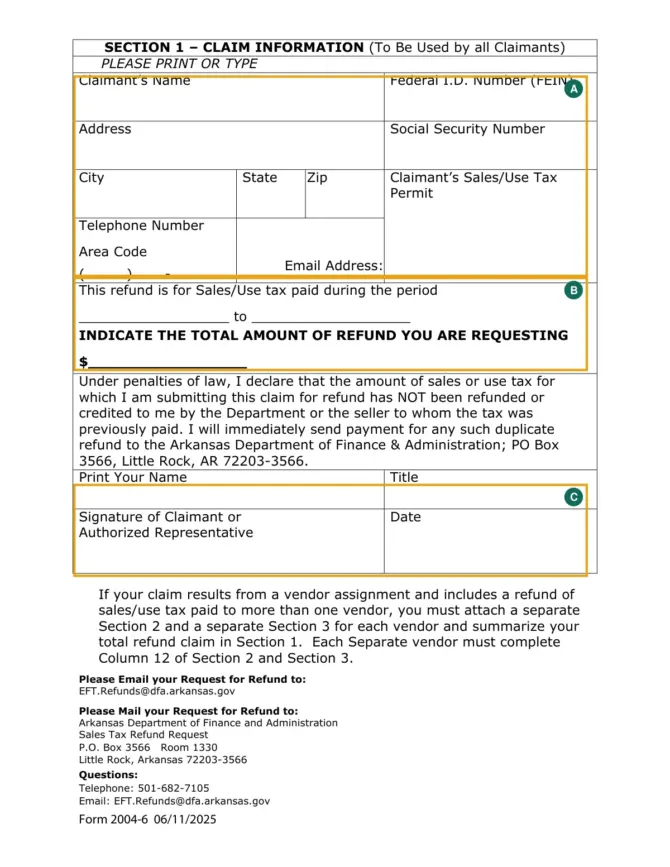
| Field group | Entries |
|---|---|
| Claimant identity | Claimant’s name, FEIN and Social Security number fields, address, city, state, ZIP code and sales/use tax permit number. |
| Contact | Telephone number including area code and email address. |
| Period | The beginning and ending dates for the sales/use tax paid that is included in the claim. |
| Total requested | The refund requested in dollars, reconciled to Section 2 and all vendor schedules. |
| Declaration | Print the signer’s name and title, obtain the claimant’s or authorized representative’s signature and enter the date. |
The signer declares under penalties of law that the claimed tax has not already been refunded or credited by DFA or the seller. The declaration also commits the claimant to repay any duplicate refund immediately. Check prior credits before signing.
Section 2: the twelve purchase-listing columns
Packet page 3 explains the schedule on page 4. Enter the claimant’s name above the listing. The instructions require Excel format unless the listing contains fewer than 25 lines; a listing with fewer than 25 lines may be submitted on paper. Exactly 25 lines falls under the electronic-format requirement.
| Column | What to record |
|---|---|
| 1 | Invoice date. |
| 2 | Vendor name. |
| 3 | Invoice number. |
| 4 | Brief description of the goods or services on the invoice. |
| 5 | How the item or service was used and the factual basis for the exemption or refund. A statute or rule citation alone is insufficient. Attach an explanation sheet if needed. |
| 6 | Purchase amount covered by the request, before tax. Include only the relevant portion of a partly refundable invoice. Account for a discount taken when paying the invoice. |
| 7 | Arkansas state tax applicable to column 6. |
| 8 | Applicable county tax. |
| 9 | Applicable city tax. |
| 10 and 11 | County name and city name, where applicable. |
| 12 | Month and year of the excise tax report on which the tax was reported and paid. The direct-paying purchaser completes this for a direct-payment claim; the vendor completes it for a vendor claim or assignment. |
Total the schedule and calculate the requested tax refund from columns 7, 8 and 9. Column 6 is the purchase price, so it is not added to the tax refund. Carry the combined tax total to Section 1.
For a paperless invoice system, documents containing the information requested in columns 1 through 12 may substitute for conventional invoices. The packet warns that incomplete information or missing invoices results in denial and return of the request.
Section 3: the seller assigns the refund right
The seller reviews Section 2 before signing the Vendor Assignment of Right to Refund on packet page 5. If the seller has not already received or requested the refund or credited the customer, it completes column 12 of Section 2 and the assignment.
Enter the seller’s legal name, business or trade name, Arkansas sales/use tax permit number, business address and telephone number with area code. Identify the buyer. The authorized seller representative prints their name and title, signs and dates the assignment.
The declaration confirms that the listed transactions were sold by the signer, the proper taxes were charged, reported and remitted, and the seller has not requested or taken the listed tax as a refund or credit or credited it to the buyer. It also includes the seller’s undertaking not to request a refund for other sales to that customer for periods covered by this claim. The seller returns Sections 2 and 3 to the customer and retains a copy.
When to claim and what happens after a denial
DFA’s Taxpayer Bill of Rights gives the general time limit for a verified state-tax refund claim: three years from filing the return or two years from paying the tax, whichever is later. Check the relevant return and payment dates for the periods included in the claim. The packet does not give a single annual due date.
If DFA issues a Notice of Claim Denial, the same page allows a petition to the Tax Appeals Commission within 90 days of the notice’s issue date. It also describes judicial review within one year of mailing the denial or the Commission’s final determination. Use the notice and the department’s current rights page for the remedy applicable to the claim.
Official packet and where to send the request
The department’s sales and use tax forms page supplies the five-page refund packet and the Section 2 Excel listing. The current PDF identifies itself as Form 2004-6; use that document title and printed date when discussing the request with DFA.
Section 1 gives EFT.Refunds@dfa.arkansas.gov for emailing the request. Its postal alternative is Arkansas Department of Finance and Administration, Sales Tax Refund Request, PO Box 3566, Room 1330, Little Rock, AR 72203-3566. Include the required sections, invoice records and remittance evidence, and follow the Excel rule for the purchase listing.
Questions about completing or delivering the claim go to (501) 682-7105 or the refund email printed on Section 1. This packet requests the erroneous sales/use tax; it contains no payment voucher or filing-fee calculation.