Arkansas Form AR1000TD lets a taxpayer figure the Arkansas tax on a qualifying lump-sum distribution from a retirement plan as if it had been received in equal amounts over ten years. Part I is a yes-or-no test of whether the distribution qualifies; Part II computes the tax, which then goes on line 31 of Form AR1000F or AR1000NR. The 2025 form (R 4/25/2025) is one page, with the instructions and the tax rate schedule on the back.
Who can use AR1000TD: the Part I questions
Part I has six answers, and some of them end the matter at once:
| Question | What it asks | Answer that rules the form out |
|---|---|---|
| 1 | Was this the plan participant’s entire balance from all of an employer’s qualified plans of one kind (pension, profit-sharing or stock bonus)? | No |
| 2 | Did you roll over any part of the distribution? | Yes |
| 3 | Was it paid to you as a beneficiary of a participant born before January 2, 1936? | No to both 3 and 4 |
| 4 | Were you the participant who received it, born before January 2, 1936, and a plan participant for at least 5 years before the year of the distribution? | No to both 3 and 4 |
| 5a | Did you use AR1000TD for a previous distribution from your own plan? | Yes |
| 5b | As beneficiary of a participant who died, was AR1000TD used for a previous distribution received for that participant? | Yes |
The AR1000TD instructions add that the form is not used if the distribution was passed through an estate. They also list 14 kinds of distribution that do not qualify, among them distributions from an IRA, a tax-sheltered annuity, a privately purchased commercial annuity or a Section 457 plan of a state or local government or tax-exempt organization; a lump-sum credit or payment from the Federal Civil Service Retirement System or the Federal Employees Retirement System; U.S. Retirement Plan Bonds; and any distribution made in the first 5 tax years of plan participation unless it was made because the employee died.
Without ten-year averaging, the instructions say to report the lump sum on line 16 of Form AR1000F or AR1000NR.
How to fill out Part II, lines 1 to 18
Part II starts from Form 1099-R. The instructions name the two boxes it uses: box 2a, the taxable amount, and box 8, the current actuarial value of an annuity if there is one.
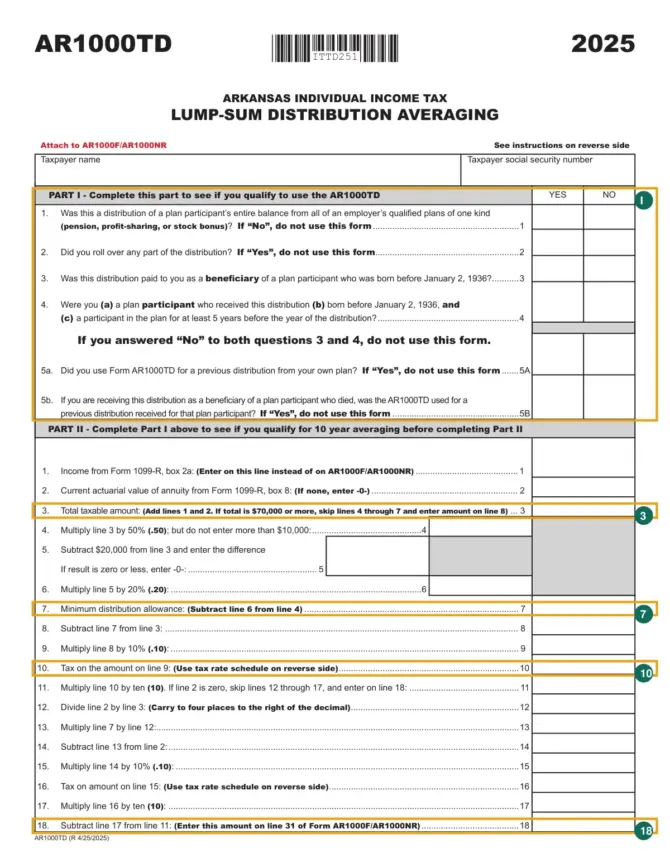
| Line | What goes on it |
|---|---|
| 1 | Income from Form 1099-R, box 2a. It goes here instead of on AR1000F or AR1000NR. |
| 2 | Current actuarial value of an annuity from box 8, or 0. |
| 3 | Total taxable amount, lines 1 and 2 added. At $70,000 or more, skip lines 4 to 7 and enter this amount on line 8. |
| 4 to 7 | The minimum distribution allowance: 50% of line 3 but not more than $10,000 (line 4), line 3 minus $20,000 but not below 0 (line 5), 20% of line 5 (line 6), and line 4 minus line 6 (line 7). |
| 8 and 9 | Line 3 minus line 7, then 10% of that. |
| 10 and 11 | Tax on line 9 from the rate schedule on the back, multiplied by ten. If line 2 is 0, skip to line 18 with this figure. |
| 12 to 17 | The annuity adjustment: line 2 divided by line 3 to four decimal places, the matching share of line 7, line 2 less that share, 10% of the result, tax on it from the schedule, times ten. |
| 18 | Line 11 minus line 17. Enter it on line 31 of Form AR1000F or AR1000NR. |
The rate schedule on the instruction page charges 0% when net taxable income is less than $5,599, then 2.0% on the excess over $5,599.99 up to $11,199.99, with higher bands above that.
Two cases with our own numbers, no annuity in either:
- A $30,000 distribution: line 4 is $10,000 (50% would be $15,000), line 5 is $10,000, line 6 is $2,000 and line 7 is $8,000. Line 8 is $22,000 and line 9 is $2,200. That is below $5,599, so the schedule gives $0 on line 10, and lines 11 and 18 are $0.
- An $80,000 distribution: line 3 is over $70,000, so line 8 is $80,000 and line 9 is $8,000. The schedule gives 2.0% of $2,400.01, or $48.00, on line 10; line 11 and line 18 are $480.
Elections, shared and repeat distributions
The instructions set several rules around the election:
- An election made this year cannot be made again in another year for another lump-sum distribution.
- File AR1000TD with an original or amended return. You have three years from the due date of the return or the date it was filed to use the method.
- More than one distribution in the year: add them together and figure the tax on the total.
- Spouses filing jointly who each received a lump sum complete a separate AR1000TD for each election and combine the tax on line 31.
- A distribution shared with recipients who were not all trusts: multiply your percentage by the total in boxes 1, 2a, 3 and 8 of Form 1099-R and enter that on line 1.
- If AR1000TD was used for another lump-sum or annuity contract distribution received in a year after 1982 and before 1989, the distributions are combined on AR1000TD and the tax paid on the earlier ones is subtracted from line 18.
Official PDF and filing with AR1000F or AR1000NR
The 2025 AR1000TD and its instructions (R 10/17/2025) are on the DFA 2025 individual income tax forms page. Attach the form to Form AR1000F (full-year residents) or AR1000NR. The same page lists AR1055-IT for more time to file the return; see our guide to AR1055-IT. For questions, the instructions give the Individual Income Tax Office at (501) 682-1100.