Form AR1000F is the Arkansas individual income tax return for people who were Arkansas residents for all of 2025, or who kept their domicile or military Home of Record in Arkansas during the year. It runs three pages: filing status, personal credits and dependents on page 1, income and tax on page 2, payments and the refund or balance due on page 3. The Department of Finance and Administration (DFA) prints the 2025 version with page 1 dated R 4/25/2025, page 2 R 6/3/2024 and page 3 R 5/19/2025, and explains every line in one booklet shared with the nonresident return.
Who files the AR1000F and who uses the AR1000NR instead
The booklet’s definitions decide the form. You are a full year resident if you lived in Arkansas all of calendar year 2025 or maintained a domicile or Home of Record here during the year. Domicile is the one place you intend as your permanent home; moving somewhere for a limited time, however long, does not change it. Anyone who moved into or out of Arkansas during 2025 is a part year resident, and anyone domiciled elsewhere is a nonresident; both file Form AR1000NR.
A full year resident has to file when gross income reaches the amount for the filing status. Gross income here means all income before deductions except the items the booklet lists as exempt, but the $6,000 retirement exemption, active-duty military pay and military retirement still count toward it.
| Filing status on the 2025 return | File if gross income is at least |
|---|---|
| Single (including divorced and legally separated) | $14,644 |
| Head of household with 1 or no dependents | $20,821 |
| Head of household with 2 or more dependents | $24,819 |
| Married filing joint with 1 or no dependents | $24,696 |
| Married filing joint with 2 or more dependents | $28,723 |
| Married filing separately | $9,470 |
| Surviving spouse (spouse died in 2023 or 2024, not remarried in 2025), 1 or no dependents / 2 or more | $20,821 / $24,819 |
Below the threshold you are not required to file, but a refund of Arkansas withholding is paid only on a filed return. Military members whose Home of Record is Arkansas file the AR1000F even when stationed in another state and report all income, including active-duty pay, which has been exempt since tax year 2014; a return is also the only way to claim that exemption. A service member stationed in Arkansas with another state as Home of Record does not report that pay here and can submit Form AR-NRMILITARY to have the account noted.
When the 2025 AR1000F is due
A calendar-year return could be filed any time after December 31, 2025 and no later than April 15, 2026. A fiscal-year return is due three and one-half months after the income year closes. The Postal Service postmark counts as the filing date, and a deadline on a weekend or legal holiday moves to the next business day.
Filing federal Form 4868 with the IRS gives the same extension in Arkansas, to November 15; no copy of the 4868 is attached anymore. Without a federal extension, Form AR1055-IT has to be filed before April 15 (Individual Income Tax Section, Attn: Extension, P.O. Box 8149, Little Rock, AR 72203-8149), and inability to pay does not qualify. Either way, check the extension box on page 1 of the return; the booklet says that without the check mark you will not receive credit for the extension. Tax still had to be paid by April 15, 2026.
A late original return draws a failure-to-file penalty of 5% per month and a failure-to-pay penalty of 1% per month, up to 35% of the tax due, plus 10% annual interest from the original due date. A separate $500 penalty applies to a frivolous return filed to delay or impede administration of state law.
Page 1: filing status, personal credits and dependents
The six filing status boxes follow federal names but have Arkansas rules. Married couples with separate incomes can compare two methods: status 4, married filing separately on the same return, puts the primary’s income in column A and the spouse’s in column B and yields one combined refund or balance; status 5 means two separate returns, and a refund on one cannot offset tax due on the other. If one spouse’s total income is negative, the couple must use status 2, married filing joint. Head of household requires being unmarried or legally separated on December 31, 2025 and keeping up a home for a qualifying person as the booklet lists; status 6 is for someone whose spouse died in 2023 or 2024, who has not remarried and who kept up the main home of a dependent child.
Line 7A gives each taxpayer and spouse one $29 personal credit, plus another $29 for each box that applies: head of household or surviving spouse, age 65 or over on January 1, 2026, blind or deaf on December 31, 2025. The “65 Special” box adds $29 for someone 65 or over who claims no retirement exemption on line 18. None of these boxes can be checked for children. Line 7B lists each dependent with name, Social Security number and relationship, again at $29 each, with a separate schedule if there are more than six. A dependent is a listed relative or household member who got over half of their support from you and had gross income under $5,200; the income limit does not apply to your child or stepchild under 19, or under 24 and a full-time student for five months. Line 7C is the total of 7A and 7B and is carried to line 34.
Driver’s license or state ID details in the taxpayer block are a request, not a requirement; DFA says the return is processed without them. The same page has boxes for an amended return, a paper Form 1099-G (DFA no longer mails them unless asked) and a mailed booklet for next year. For a taxpayer who died during 2025, the return is filed as if they had lived the whole year, with the Deceased box after the name checked; any refund check is made out to the estate.
How to fill out lines 8 to 38 on page 2
Everything is rounded to whole dollars. For filing status 4, column B holds the spouse’s figures; for every other status, use column A only. The numbers on the image are the line numbers in the table.
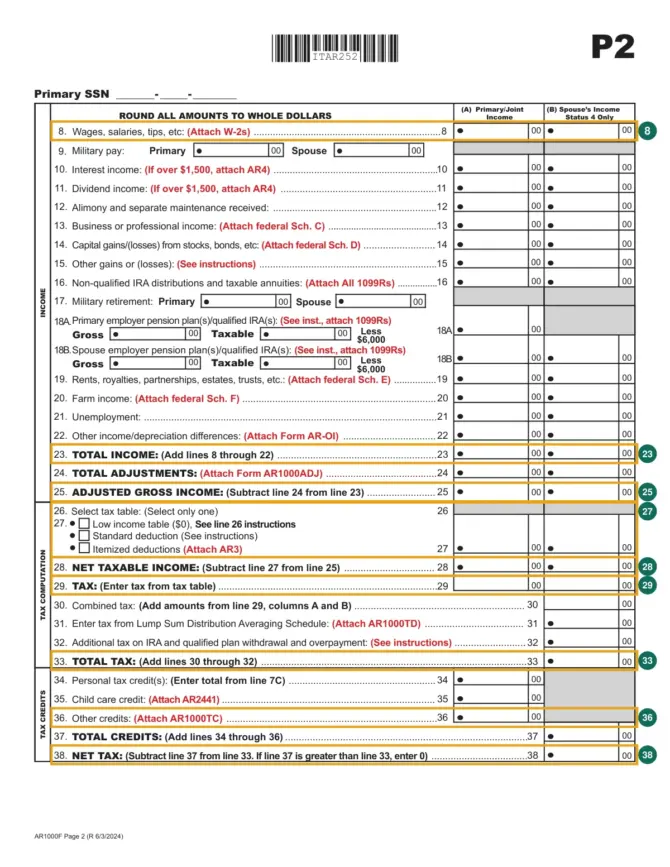
| Line | What goes there | Where the figure comes from |
|---|---|---|
| 8 | Wages, salaries and tips (active-duty military pay goes on line 9, not here) | State copies of Forms W-2 |
| 10, 11 | Interest and dividends; Form AR4 if either total is $1,500 or more | 1099 statements, Form AR4 |
| 13, 19, 20 | Business, Schedule E and farm income | Federal Schedules C, E and F, attached |
| 14 | Capital gains or losses; loss limited to $3,000 ($1,500 per spouse in status 4 or 5) | Form AR1000D and federal Schedule D |
| 16 | Non-qualified IRA distributions, annuities, early traditional IRA withdrawals | Forms 1099-R, federal Form 5329 |
| 18A, 18B | Employer pension and qualified traditional IRA income, less the $6,000 exemption per taxpayer | 1099-R box 1 (gross) and box 2a (taxable) |
| 21, 22 | Unemployment; other income such as canceled debt, gambling winnings and depreciation differences | Forms 1099-G; Form AR-OI |
| 23 to 25 | Total income, adjustments, adjusted gross income | Form AR1000ADJ for line 24 |
| 26, 27 | Tax table choice and the deduction | $0 for the low income table, else the standard deduction or Form AR3 |
| 28, 29 | Net taxable income and the tax on it | Booklet tax tables |
| 33 | Total tax: line 30 plus lines 31 and 32 | Form AR1000TD for line 31 |
| 36 | Other credits | Form AR1000TC, attached |
| 38 | Net tax: line 33 minus total credits on line 37, never below zero | Lines 33 and 37 |
The $6,000 on lines 18A and 18B covers employer-related retirement plans, public or private, and traditional IRA distributions taken after age 59½ (or earlier because of death or disability). The total exemption from both kinds cannot exceed $6,000 per taxpayer. A military retiree whose military retirement exemption on line 17 exceeds $6,000 gets no further $6,000 for other plans; if it is less, only the remainder can be used.
Line 26 asks for one tax table. The low income tables apply only when total income from all sources falls within the table’s limits for the filing status, a married couple files jointly, and nobody uses the exclusion for military pay, military retirement or employer pension income; in that case line 27 is zero, because the standard deduction is built into the table. Everyone else uses the regular table and enters on line 27 the larger of itemized deductions from Form AR3 or the standard deduction: $2,470, or $4,940 for married filing joint, and $2,470 for each spouse in status 4. If one spouse in status 4 or 5 itemizes, both must. Net taxable income above $100,000 is taxed at $3,809 plus 3.9% of the excess over $100,000.
Line 32 is 10% of the additional tax from Part I of federal Form 5329 on early retirement plan withdrawals, plus 10% of the Part II amount for a Coverdell account. Line 36 takes the total from Form AR1000TC, which collects the political contribution credit, the credit for tax paid to another state, the adoption, phenylketonuria and stillborn child credits, the additional tax credit for qualified individuals, the developmental disabilities credit and business incentive credits. Credits larger than the tax on line 33 are not refunded.
The additional tax credit for qualified individuals is easy to miss: a return filed on time with net income on line 28 of $27,600 or less gets a credit from the worksheet on page 21 of the booklet, $60 at $26,500 or below and stepping down in $100 bands. It goes on line 6 of the AR1000TC, so it reaches the return through line 36.
Business incentive credits are entered on AR1000TC by code. Corporations claim the same program credits on a different schedule, covered in the guide to Form AR1100BIC.
Payments, refund and amount due on page 3
Withholding now goes on two lines: 39A for W-2 and W-2G withholding, 39B for withholding on Forms 1099-R, 1099-PT and AR-K1. If you never got a W-2, ask the employer first, then the Social Security Administration at (800) 772-1213, and only then use federal Form 4852 with your final pay stub. Line 40 is 2025 estimated tax paid, including the January 15, 2026 installment and any credit brought forward from the 2024 return, without penalties or interest. Line 41 is tax paid with an AR1055-IT. Line 43 is the early childhood program credit for a child in a facility approved by the Arkansas Department of Education, with the certification number, Form AR2441 and Form AR1000EC attached; lines 35 and 43 together cannot exceed what Form AR2441 allows.
Line 47 is the overpayment when line 46 exceeds line 38. You can carry part or all of it to the 2026 estimated account on line 48 (credited to the primary filer only), donate through Form AR1000CO on line 49, and take the rest as a refund on line 50. Line 51 is the balance due when line 38 exceeds line 46. If net tax is $1,000 or more and you neither paid estimated tax nor had withholding of 90% of net tax, a 10% underestimate penalty applies: enter the exception number from Form AR2210 in box 52A or the computed penalty in box 52B (with Form AR2210A, code 6 in box 52A and its line 48 in box 52B), then the total on line 52C.
Direct deposit needs the routing number, account number and a checking or savings box, and is limited to U.S. banks. If you check the box saying the money will end up in a foreign account, stop there; Puerto Rico, Guam and the Virgin Islands also count as outside the United States. Refunds DFA cannot deposit are mailed as paper checks to the address on the return.
What changed on the 2025 AR1000F
The booklet’s “Special Information for Tax Year 2025” page lists these points:
- Withholding is split between line 39A (W-2) and line 39B (1099 and K-1).
- Marginal income tax rates for 2025 are 3.9%, under Act 1 of the Second Extraordinary Session of 2024.
- Members of an entity that pays the Pass-Through Entity Tax include all of its income on the return, back it out on Form AR-OI, and do not count the entity’s tax as withholding.
- The developmental disabilities credit form AR1000RC5 is now AR1000-DD and the credit is claimed on Form AR1000TC, line 7, not on page 1.
What goes in the envelope with the AR1000F
- State copies of every W-2, W-2G, 1099-R, 1099-PT and 1099-G, stapled to the left margin of page 1.
- Federal Schedules C, D, E and F and Form 4797 when lines 13, 14, 15, 19 or 20 use them.
- Arkansas schedules that feed a line: AR4, AR1000D, AR-OI, AR1000ADJ, AR3, AR2441, AR1000TC, AR1000TD, AR1000CO, AR2210 or AR2210A.
- Federal Form 5329 for early withdrawals and Form 8606 if nondeductible IRA contributions reduce the taxable amount.
- Signatures and dates of both spouses on a joint return or status 4, and the paid preparer section if someone else prepared it.
Where to mail the AR1000F and how to pay
The 2025 return can be e-filed through the Federal/State Electronic Filing Program, and Arkansas takes part in the Free File Alliance for lower incomes (details at arkansas.gov/efile). Paper returns go to one of two boxes:
| Return | Mailing address |
|---|---|
| Refund | Arkansas State Income Tax, P.O. Box 1000, Little Rock, AR 72203-1000 |
| Tax due, or no tax due and no refund | Arkansas State Income Tax, P.O. Box 2144, Little Rock, AR 72203-2144 |
The booklet says a carrier other than USPS must use the physical address; the street address it gives on that page is the Individual Income Tax Office, 1816 W. 7th Street, Suite 2300, Little Rock, AR 72201. Taxes can be paid on ATAP at atap.arkansas.gov, by credit card through ACI Payments at 1-800-272-9829 (the convenience fee is charged by the vendor; the state does not receive it), or by check or money order payable to the Department of Finance and Administration with Form AR1000V, the tax year and your Social Security number written on it. DFA asks you to allow up to 10 weeks for processing; under Act 262 of 2005 it has 90 days from the due date or the filing date, whichever is later, to refund an overpayment without interest.
Download the 2025 AR1000F PDF and the AR1000F and AR1000NR instructions from DFA’s 2025 tax forms page. Questions go to the Individual Income Tax hotline at (501) 682-1100 or (800) 882-9275, or individual.income@dfa.arkansas.gov. This page explains the form and is not tax advice for your situation.
What holds up or reduces an AR1000F
- No signature. The booklet says an unsigned return is not valid and cannot be processed.
- Missing or uncorrected W-2s. Withholding is not credited, and no refund is paid, without correct and legible W-2s or other approved documents; a W-2 must be corrected by the employer, not by you.
- Unchecked extension box on page 1, which means no credit for a federal or state extension.
- Bank details that do not match, closed accounts or a foreign destination for direct deposit, which turn the refund into a paper check.
- Information forms left off the return; DFA says not attaching them may delay processing.
Questions about the Arkansas AR1000F
Do I file an AR1000F if my income was under the filing threshold but Arkansas tax was withheld?
The threshold only decides whether you must file. A refund is paid only on a filed return, so file to get the withholding back.
How do I amend a 2025 AR1000F?
Check the amended return box at the top right of page 1, complete the whole return with the corrected entries, and attach an explanation with supporting documents; use lines 42 and 45 for earlier payments and refunds. Wait until the original has been processed. A refund claim must be filed within three years of filing or two years of paying the tax, whichever is later, and a federal change to net taxable income has to be reported to DFA within 180 days.
Does a new address or a wrong Social Security number need an amended return?
An address change goes on DFA’s Individual Income Tax Account Change Form. A Social Security number is corrected by calling (501) 682-1100 or writing to Individual Income Tax Section, P.O. Box 3628, Little Rock, AR 72203.
I moved to Arkansas in the middle of 2025. Can I use the AR1000F?
Someone who established a domicile in Arkansas, or moved out, during 2025 is a part year resident and files Form AR1000NR, which prorates the tax by Arkansas income.
Official sources
- Arkansas Department of Finance and Administration, 2025 Form AR1000F, Full Year Resident Individual Income Tax Return
- Arkansas Department of Finance and Administration, 2025 Individual Income Tax Forms and Instructions (AR1000F and AR1000NR)
- Arkansas Department of Finance and Administration, 2025 Tax Forms
- Arkansas Department of Finance and Administration, 2025 Form AR1100BIC, Schedule of Business Incentive Tax Credits