Form AR1000NOL is the Arkansas Individual Income Tax Schedule of Net Operating Loss. An individual who deducts a loss from an earlier year on a 2025 Arkansas return uses it to show, year by year from 2020 to 2025, how big the loss was, how much has been deducted, how much expired and how much is still left. The 2025 schedule is revision R 4/25/2025; its two-page instructions are dated R 8/25/2025.
The deduction itself is not claimed on the schedule. It goes on line 13 of Form AR-OI, and the AR-OI net total flows to line 22 of the AR1000F or AR1000NR.
Who files AR1000NOL and where the deduction ends up
The schedule is for the person on the return who claims the NOL deduction. A partnership, an LLC or an S corporation taxed as a partnership cannot take an NOL deduction itself. Its partners and owners can use their share of the business loss when they work out their own NOL.
The path through the return has three steps:
- Form AR-OI, line 13, “Net operating loss”: the amount claimed as a deduction this year, with Form AR1000NOL attached.
- AR-OI line 19 adds the losses on lines 12 through 18, and line 20 subtracts line 19 from the income total on line 11.
- The line 20 figure for each column goes to line 22, Other income, of Form AR1000F (full-year residents) or AR1000NR (nonresidents and part-year residents).
The 2025 booklet describes the carryforward under line 22 the same way: enter it as a subtraction from income and attach the AR1000NOL to show the amount of the loss and the year it happened.
Working out the loss: AGI minus deductions
The instructions start from adjusted gross income and subtract total deductions. If the result is negative, nontaxable income that the law does not normally require you to report is added back, less the expenses properly and reasonably incurred in earning it. What remains is the net operating loss. The instructions give two lists and say neither is exhaustive:
| Counts in figuring the NOL | Does not count |
|---|---|
| Standard or itemized deduction | Income taxes |
| Net income before income tax, before personal exemptions and before the credit for dependents | Personal exemptions and the credit for dependents |
| Casualty and theft losses from a federally declared disaster | Capital losses above capital gains |
| Your share of a partnership’s business loss | Nonbusiness deductions above nonbusiness income |
| Interest and litigation expenses on income tax related to your business | Qualified business deductions, and NOL carryovers from other years |
Because carryovers from other years sit in the second column, an old loss is never folded into the current year’s figure; it keeps its own place on the schedule. Capital losses count only up to the amount of capital gains.
How many years an Arkansas loss can be carried forward
Arkansas allows no carryback. The instructions add that this includes farming businesses, even though the IRS gives farmers a two-year exception. Forward, the period depends on when the loss occurred, under Ark. Code Ann. § 26-51-427:
| Loss occurred | Carryforward period |
|---|---|
| Before January 1, 2020 | 5 years |
| January 1, 2020 to December 31, 2020 | 8 years |
| On or after January 1, 2021 | Up to 10 years |
The count starts with the next tax year. On a calendar-year basis, a 2019 loss could be used from 2020 through 2024, which is why the 2025 schedule’s columns begin at 2020. A 2020 loss runs through 2028.
The same section of the Code requires the loss to be used in the first year it can be. You cannot skip the deduction in a year with income and save the loss for a later year.
How to fill out the AR1000NOL
The page has two identical blocks: the top one for the taxpayer and the lower one for a spouse. Each block is a grid with one column per tax year, 2020 to 2025, and five rows. The numbers below match the markers on the image.
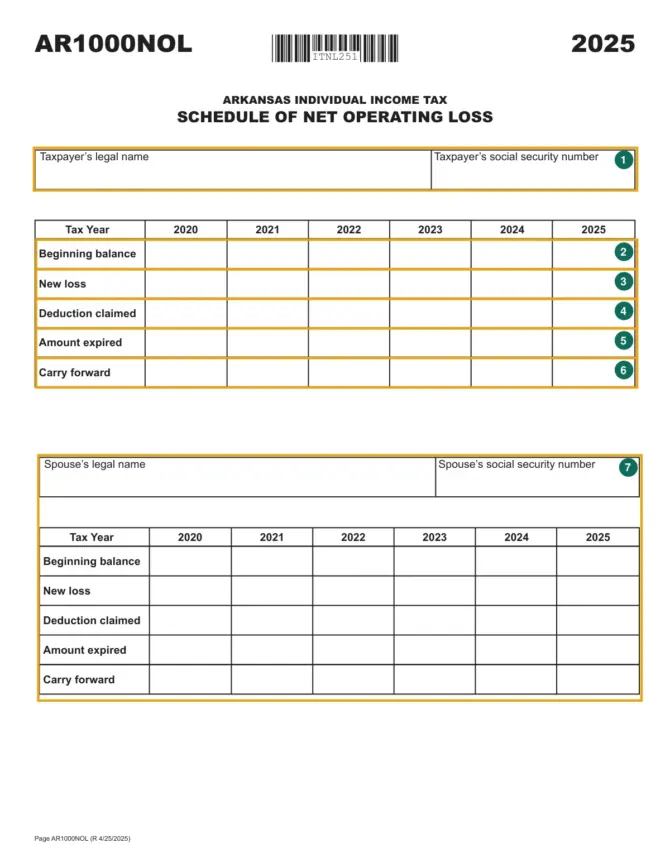
| Marker | Field or row | What to enter |
|---|---|---|
| 1 | Taxpayer’s legal name, social security number | The name and SSN of the person on the return who is claiming the NOL deduction. |
| 2 | Beginning balance | The NOL balance at the start of that year’s column. It is normally the previous column’s Carry forward amount: $5,000 carried out of one year starts the next year at $5,000. |
| 3 | New loss | A loss that arose in that column’s year and counts as an NOL. |
| 4 | Deduction claimed | The NOL deduction claimed for that year. In a year with no NOL claimed, enter -0-. |
| 5 | Amount expired | Any part of a loss still unclaimed when its last eligible year has been reached. |
| 6 | Carry forward | What you are taking into the next year. |
| 7 | Spouse block | Used only with filing status 4, married filing separately on the same return, to claim an NOL for the spouse. |
Tax Year, the column heading, is printed on the form. The instructions describe it as the period in which the NOL first occurred or to which it is carried forward, so a loss year and every year it is carried into each take a column.
A worked example with made-up figures
A single filer had a $12,000 Arkansas NOL in 2022 and deducted $4,000 of it in 2023 and $3,000 in 2024. On the 2025 return the remaining $5,000 is deducted. The top block reads:
| Row | 2022 | 2023 | 2024 | 2025 |
|---|---|---|---|---|
| Beginning balance | 0 | 12,000 | 8,000 | 5,000 |
| New loss | 12,000 | 0 | 0 | 0 |
| Deduction claimed | -0- | 4,000 | 3,000 | 5,000 |
| Amount expired | 0 | 0 | 0 | 0 |
| Carry forward | 12,000 | 8,000 | 5,000 | 0 |
The 2020 and 2021 columns stay empty because there was no loss to track. The $5,000 in the 2025 column is the figure that goes on AR-OI line 13. Under the 10-year rule a 2022 loss could be carried through 2032; in this example it is used up in 2025, so the Amount expired row stays at zero.
What the instructions rule out
- Carrying a loss back to an earlier year, including a farming loss.
- Passing over the deduction in a year it could have been used and claiming it later.
- Taking the NOL deduction at the level of a partnership, LLC or S corporation taxed as a partnership.
- Counting income taxes, personal exemptions, the dependent credit, excess capital losses, excess nonbusiness deductions, qualified business deductions or other years’ carryovers toward the loss.
- Claiming a spouse’s NOL in the top block. The lower block is for the spouse under filing status 4.
The schedule tracks one running balance per year, not each loss year separately. If you have losses from more than one year, keep your own record of when each one started so you know when its period ends and what belongs on the Amount expired row.
Where to get the 2025 AR1000NOL and where the return goes
The 2025 AR1000NOL PDF and its instructions are on DFA’s 2025 Tax Forms page, both posted 01/07/2026. The schedule is filed as part of the return, not on its own. The booklet’s deadline for a calendar-year 2025 return is April 15, 2026, unless an extension applies.
For a paper return, two DFA documents give different addresses. The 2025 AR1000F and AR1000NR instructions booklet sorts returns by result:
| Return | Mailing address in the 2025 booklet |
|---|---|
| Tax due | Arkansas State Income Tax, P.O. Box 2144, Little Rock, AR 72203-2144 |
| Refund | Arkansas State Income Tax, P.O. Box 1000, Little Rock, AR 72203-1000 |
| No tax due or refund | Arkansas State Income Tax, P.O. Box 2144, Little Rock, AR 72203-2144 |
A notice on DFA’s individual income tax Forms page says that paper returns must be filed by mail to Arkansas Individual Income Tax, PO Box 3628, Little Rock, AR 72203, and that current-year returns are not accepted by email or fax. Neither document refers to the other. Before mailing, ask the Individual Income Tax Section which address applies: (501) 682-1100 or (800) 882-9275, or individual.income@dfa.arkansas.gov.
Old figures for the Beginning balance column come from earlier returns. DFA’s booklet points to Form AR4506 for copies of Arkansas returns; federal return copies are requested from the IRS on Form 4506. This page explains the schedule and is not tax advice for a particular loss.
Questions about the Arkansas individual NOL schedule
Is AR1000NOL the same form corporations use?
Corporations have their own schedule, AR1100NOL, tied to the corporation income tax return. AR1000NOL is the individual income tax version and feeds Form AR-OI.
Can I use my federal NOL figure on the Arkansas schedule?
The Arkansas instructions build the loss from AGI minus deductions, with their own lists of items that count and do not count, and the AR1000NOL takes the figure worked out under those lists. Arkansas also has no carryback, while the IRS allows a two-year carryback for farming losses.
Do I attach AR1000NOL in a year when I only have a new loss?
The AR-OI instructions ask for the schedule with line 13, the deduction being claimed, and the booklet says to attach it to show the amount of the loss and the year it occurred. For a year with a loss but no deduction, the Individual Income Tax Section at (501) 682-1100 can confirm what to send.
Official sources
- Arkansas Department of Finance and Administration, AR1000NOL, Schedule of Net Operating Loss, 2025 (R 4/25/2025)
- Arkansas Department of Finance and Administration, Instruction for AR1000NOL (R 8/25/2025)
- Arkansas Department of Finance and Administration, AR-OI, Other Income/Loss and Depreciation Differences, 2025
- Arkansas Department of Finance and Administration, Instructions for AR-OI (R 6/24/2025)
- Arkansas Department of Finance and Administration, 2025 Individual Income Tax Forms and Instructions, AR1000F and AR1000NR
- Arkansas Department of Finance and Administration, 2025 Tax Forms
- Arkansas Department of Finance and Administration, Individual Income Tax Forms