Form AR1000TC is the one-page schedule where an Arkansas individual income tax filer lists every credit that is not a personal credit or the child care credit: seven personal-type credits on lines 1 to 7, business incentive credits by code on line 8, and the total on line 9. That total goes to line 36 of the 2025 Form AR1000F (full-year residents) or Form AR1000NR (nonresidents and part-year residents), and the schedule is attached to the return. The 2025 form is revision R 4/25/2025.
Who attaches AR1000TC to an Arkansas return
The 2025 instructions for line 36 of the AR1000F and AR1000NR send you to this schedule if you are eligible for any of these: the state political contribution credit, the other state tax credit, the credit for adoption expenses, the phenylketonuria disorder credit, the stillborn child credit, the additional tax credit for qualified individuals, the credit for individuals with developmental disabilities, or business incentive credits.
Two limits come from the instructions themselves. Line 2, the other state tax credit, is for Arkansas residents only; the AR1000TC instructions say nonresidents cannot claim it. And the credits do not create a refund: if total credits on line 37 of the return are more than the total tax on line 33, net tax on line 38 is zero and the difference is not refundable.
Personal tax credits (the total from line 7C of the return) and the child care credit from Form AR2441 have their own lines, 34 and 35, and do not go on the AR1000TC.
How to fill out AR1000TC line by line
The top of the form asks only for the primary taxpayer’s legal name and Social Security number. Every amount box is in whole dollars; the cents cell is preprinted “00”. In the image below, the numbers match the form’s line numbers, D frames the dependent rows 7A to 7F and C frames the credit code rows 8A to 8F.
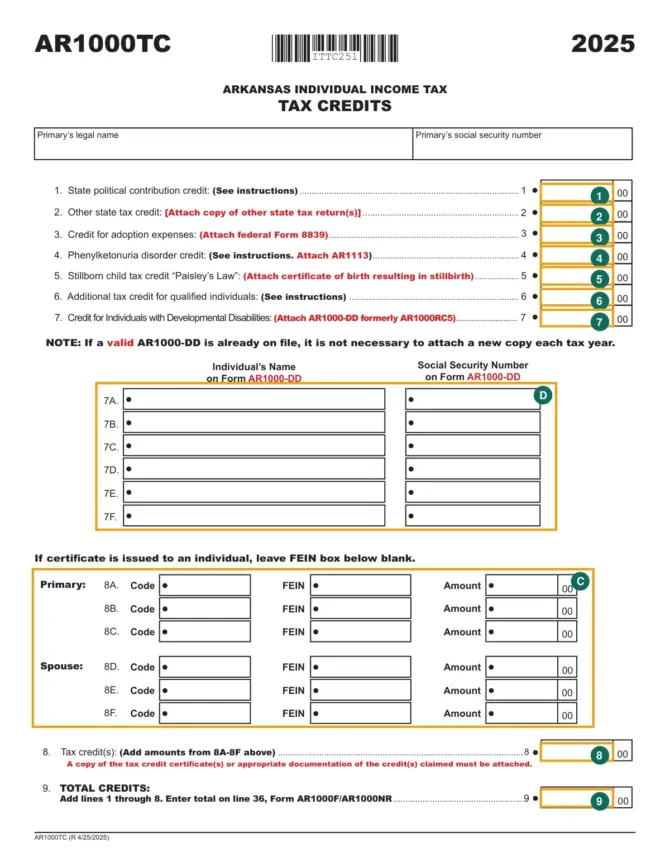
| Line | Credit | What to enter and attach |
|---|---|---|
| 1 | State political contribution credit | Cash contributions to an Arkansas candidate, approved political action committee or organized political party. Up to $50 for filing status 1, 3, 5 or 6; up to $100 total for filing status 2 or 4. |
| 2 | Other state tax credit | The lesser of the tax owed to the other state or that state’s income taxed at Arkansas rates. Attach a signed copy of the other state’s return. |
| 3 | Credit for adoption expenses | 20% of the adoption credit allowed on your federal return. Attach federal Form 8839. |
| 4 | Phenylketonuria disorder credit | The allowable amount from Form AR1113, which is attached. |
| 5 | Stillborn child tax credit (“Paisley’s Law”) | Up to $500 per stillborn birth, limited to your total tax. Attach the certificate of birth resulting in stillbirth. |
| 6 | Additional tax credit for qualified individuals | The amount from the worksheet on page 21 of the 2025 instruction booklet. Only for net taxable income of $27,600 or less on a timely filed return. |
| 7 | Credit for individuals with developmental disabilities | $500 times the number of qualifying dependents, with each dependent’s name and SSN on rows 7A to 7F. |
| 8 | Business incentive tax credits | The sum of the amounts on rows 8A to 8F. Attach the tax credit certificates or other documentation. |
| 9 | Total credits | Lines 1 through 8 added together. Copy the total to line 36 of the AR1000F or AR1000NR. |
For line 1, a “public office” means an office created under Arkansas law, or the law of a subdivision of the state, that voters fill. Contributions to candidates for federal office do not count, and the contribution has to be made by April 15, 2026 to be claimed on the 2025 return. The instructions cite Arkansas Code Annotated 7-6-201 for the definition of an approved political action committee and 7-1-101 for an organized political party.
For line 3, the base is the credit allowed on the federal return, not the adoption expenses you paid. For line 5, the cap of $500 applies per stillborn birth, and the total credit on that line cannot exceed the amount of total tax.
Line 2: working out the other state tax credit
The credit exists so that an Arkansas resident is not taxed twice on income earned outside Arkansas. You compare two numbers and enter the smaller one: the actual tax liability you have with the other state or states, and the other states’ taxable income taxed at Arkansas rates. The instructions give three steps for the second number:
- Compute line 33, Total Tax, of the AR1000F the normal way, with Arkansas income and the other states’ income and losses included.
- Redo the AR1000F temporarily with all the other states’ income and losses removed, and note the new Total Tax.
- Subtract the Step 2 total from the Step 1 total. The result is the Arkansas tax on the out-of-state income.
Some deductions on the AR1000F are tied to income and may need adjusting in Step 2; the instructions name other states’ gambling losses as an example. A signed copy of each return you filed with the other state has to be attached to the Arkansas return.
Two special cases are spelled out. A resident shareholder can claim a credit for a pro rata share of net income tax that an S corporation paid to a state that does not recognize S corporation status. Mississippi’s separate tax on gambling winnings is a different matter: it is not part of Mississippi’s income tax, and the instructions say an Arkansas taxpayer cannot claim a credit for it.
Line 6: the additional tax credit for qualified individuals
This credit is for a taxpayer whose net taxable income on line 28 of the AR1000F or AR1000NR is $27,600 or less and who files on time. The worksheet on page 21 of the 2025 booklet turns line 28 into a credit with this table:
| Net taxable income (line 28) | Credit |
|---|---|
| $0 to $26,500 | $60 |
| $26,501 to $27,600 | Drops by $5 for each $100 band: $55 for $26,501 to $26,600, down to $5 for $27,501 to $27,600 |
| $27,601 and up | $0 |
How the table is used depends on filing status. With status 1, 3, 5 or 6 the credit from the table goes straight to line 6. With status 2, married filing jointly, the worksheet reads the table once using the joint line 28 and doubles the result. With status 4, married filing separately on the same return, each spouse’s own line 28 is looked up separately and the two credits are added.
Line 7: dependents with developmental disabilities
Multiply the number of qualifying dependents by $500. Rows 7A to 7F hold one dependent each, with the name and Social Security number as they appear on Form AR1000-DD, the certificate that used to be called Form AR1000RC5. Who qualifies and what counts as a dependent are explained in the AR1000-DD instructions.
The AR1000-DD is attached the first year you claim the credit. A note printed on the AR1000TC says that if a valid AR1000-DD is already on file, a new copy is not needed each year. The booklet adds that a certification valid on January 1, 2022, and every certification issued since, has no expiration date, but the AR1000TC itself has to be submitted every year. The credit follows the child, whoever the caretaker is, and can be claimed on only one tax return per year.
Line 8: business incentive credits by code
Line 8 carries credits issued under Arkansas incentive programs. Rows 8A to 8C are for credits of the primary taxpayer and rows 8D to 8F for the spouse. Each row takes a four-digit credit code, a FEIN and an amount. When the credit was earned by a pass-through entity, the entity’s FEIN goes in the FEIN box; when the certificate was issued to an individual, the FEIN box stays blank. The six amounts are added and the total goes on line 8.
The code list is on page 2 of the AR1000TC instructions and runs from 0001 (Advantage Arkansas) to 0065 (Modernization and Automation), with gaps. The list also has 0056 Motion Picture, 0057 Retired Law Enforcement Cold Case, 0058 Philanthropic Investment and 0064 Relocating Corporate Headquarters. The code to enter is the one that matches the credit on your certificate. Corporations claim the same programs on a different schedule, Form AR1100BIC, which goes with the corporation or pass-through entity tax return.
The instructions warn that recent legislation may have changed some credit provisions, and that each credit is subject to the limits and carryover rules in its own Arkansas statute. Questions go to the DFA Tax Credits/Special Refunds Section at (501) 682-7106.
What changed for tax year 2025
The “Special Information for Tax Year 2025” page of the AR1000F and AR1000NR booklet has two entries that concern this schedule:
- Credit for individuals with developmental disabilities (Act 191 of 2023): Form AR1000RC5 was renamed AR1000-DD, the credit is claimed on line 7 of the AR1000TC with the children listed on rows 7A to 7F, and re-certification is no longer needed for a disability expected to continue indefinitely. The front of the 2025 AR1000F repeats that the credit is “now on Form AR1000TC”.
- Additional tax credit for qualified individuals (Act 1 of the Second Extraordinary Session of 2021): the credit is allowed to a taxpayer with net income up to $27,600 who files the return on time.
What goes in the envelope with the AR1000TC
- A signed copy of each other state’s return, if line 2 is filled in
- Federal Form 8839, if line 3 is filled in
- Form AR1113, if line 4 is filled in
- The certificate of birth resulting in stillbirth, if line 5 is filled in
- Form AR1000-DD for each dependent on rows 7A to 7F, in the first year of the claim
- The tax credit certificates or other documentation for every code on rows 8A to 8F
- The AR1000TC itself, with the line 9 total matching line 36 of the return
When the AR1000TC is due and where to get it
The schedule is filed with the return. Calendar-year 2025 returns were due April 15, 2026; a fiscal-year return is due three and a half months after the income year closes. A federal extension on Form 4868, or an Arkansas extension on Form AR1055-IT, moves the filing date to November 15, 2026, but it does not extend the time to pay. The booklet says e-filing is available to most full-year residents and to certain nonresidents and part-year residents. Paper returns go to one of two addresses, depending on the result:
| Return | Mail to |
|---|---|
| Tax due, or no tax due and no refund | Arkansas State Income Tax, P.O. Box 2144, Little Rock, AR 72203-2144 |
| Refund | Arkansas State Income Tax, P.O. Box 1000, Little Rock, AR 72203-1000 |
The AR1000TC has no signature line; the return it is attached to is the document you sign and date. The schedule carries no payment either. A balance due is paid through ATAP at atap.arkansas.gov, by credit card through the DFA’s card processor, or by check with Form AR1000V attached to the return.
The 2025 AR1000TC and its separate two-page instructions are listed on the DFA’s 2025 individual income tax forms page, along with the full AR1000F and AR1000NR booklet that holds the line 6 worksheet. General questions go to the Individual Income Tax hotline at (501) 682-1100 or (800) 882-9275.
Questions about Form AR1000TC
Can a nonresident claim credit for tax paid to their home state on AR1000TC?
The AR1000TC instructions say nonresidents cannot claim the other state tax credit on their Arkansas return. Line 2 is for Arkansas residents taxed by another state on income earned outside Arkansas.
Do I have to send Form AR1000-DD every year?
The AR1000-DD is attached in the first year you claim the credit, and the form notes that a valid AR1000-DD already on file does not need to be sent again. The AR1000TC listing the dependents on rows 7A to 7F is still required each year.
What happens if my credits are larger than my tax?
Net tax on line 38 of the AR1000F or AR1000NR is entered as zero, and the excess credit is not refunded. Carryover of business incentive credits depends on the statute for each credit.
Official sources
- Arkansas Department of Finance and Administration, Form AR1000TC, Schedule of Tax Credits and Business Incentive Credits, 2025 (R 4/25/2025)
- Arkansas Department of Finance and Administration, Instructions for AR1000TC (pages revised 10/22/2025 and 6/9/2025)
- Arkansas Department of Finance and Administration, 2025 Individual Income Tax Forms and Instructions, AR1000F and AR1000NR
- Arkansas Department of Finance and Administration, Form AR1000F, 2025
- Arkansas Department of Finance and Administration, Form AR1000NR, 2025
- Arkansas Department of Finance and Administration, 2025 Tax Forms