A condominium, subdivision or timeshare association that files Form 1120-H keeps its members’ dues, fees and assessments out of taxable income for that year. What is left, such as interest on reserve accounts or rent paid by nonmembers, is taxed at a flat 30%, or 32% for a timeshare association, after a $100 specific deduction. The current form is the 2025 Form 1120-H (the PDF footer reads “Created 4/16/25”), used with the 2025 instructions dated January 14, 2026.
Which associations can file Form 1120-H
Item A on the form offers three types, and the 2025 instructions define each one. A condominium management association manages and maintains a condominium project in which substantially all units are homes for individuals. A residential real estate management association does the same for a subdivision, development or similar area in which substantially all lots or buildings are homes. A timeshare association serves members who hold a timeshare right to use, or a timeshare ownership interest in, its real property; it cannot also be a condominium management association.
The instructions send readers to Regulations section 1.528-4 for “substantially all.” That regulation sets the line at 85%, measured on the last day of the association’s tax year:
- Condominium: at least 85% of the total square footage of all units is used by individuals for residential purposes. Laundry areas, pools, tennis courts, storage rooms and maintenance areas count as residential.
- Residential real estate: at least 85% of the lots are zoned for residential purposes. Commercial shopping areas and their parking do not count as residential lots.
- For both, a unit or building is not residential if, for more than half the days of the tax year, it is occupied by people who each stay less than 30 days.
Every year the association must also pass the tests that items B and C of the return report. At least 60% of gross income has to be exempt function income, and at least 90% of expenditures have to go to acquiring, building, managing, maintaining and caring for association property (for a timeshare association, also to activities for its members). No private shareholder or individual may profit from net earnings, except through that property work or a rebate of excess dues, fees or assessments. An association that is tax exempt under section 501(a) does not file Form 1120-H.
The election is made every year by filing
Filing a properly completed Form 1120-H is the section 528 election itself. It covers one tax year and generally has to be made by the due date of the return, including extensions. Once filed, it cannot be revoked for that year without IRS consent, which requires a ruling request and a user fee (Rev. Proc. 2025-1 or a successor).
An association that does not elect files its applicable return instead, for example Form 1120. The instructions tell associations to compute total tax both ways and allow filing the form that gives the lower tax. If the election was missed, Regulations section 301.9100-2 gives an automatic 12-month extension, as long as corrective action is taken within 12 months of the return’s due date, including extensions.
Exempt function income and what is taxed
Exempt function income is membership dues, fees or assessments paid by owners of condominium units, owners of real property in a residential real estate association, or owners of timeshare rights or interests. The money has to come from members acting as owners, not as customers of the association’s services: an assessment for a common activity qualifies, a charge for a service does not. The instructions give assessments for principal, interest and real estate taxes on association property, for maintaining that property, and for snow removal in public areas and trash collection as examples.
These receipts are not exempt function income, so they go on lines 1 to 7 if taxable:
- tax-exempt interest and other amounts that would be excluded from gross income anyway
- payments from nonmembers
- members’ payments for special use of facilities beyond what is generally available to all members
- interest on amounts in a sinking fund
- payments for work on property that is not association property
- members’ payments for transportation
Take a residential association with $180,000 in owner assessments that also earns $5,000 of interest on its reserve fund and $2,000 from outside groups renting the clubhouse. Gross income is $187,000, and the assessments are about 96% of it, so the 60% test is met. Only the $7,000 lands on lines 2 and 3. If $800 of clubhouse cleaning is directly connected to those rentals, line 17 is $6,200, line 19 is $6,100 after the $100 specific deduction, and line 20 is $1,830 at 30%. A timeshare association with the same figures would enter $1,952 at 32%. No net operating loss deduction and none of the special corporate deductions in Part VIII of subchapter B are allowed.
How to fill out Form 1120-H, line by line
The 2025 return is a single page. The numbers in the image were added for this guide and match the first column of the table; item A, the association type, is the row just above marker 2.
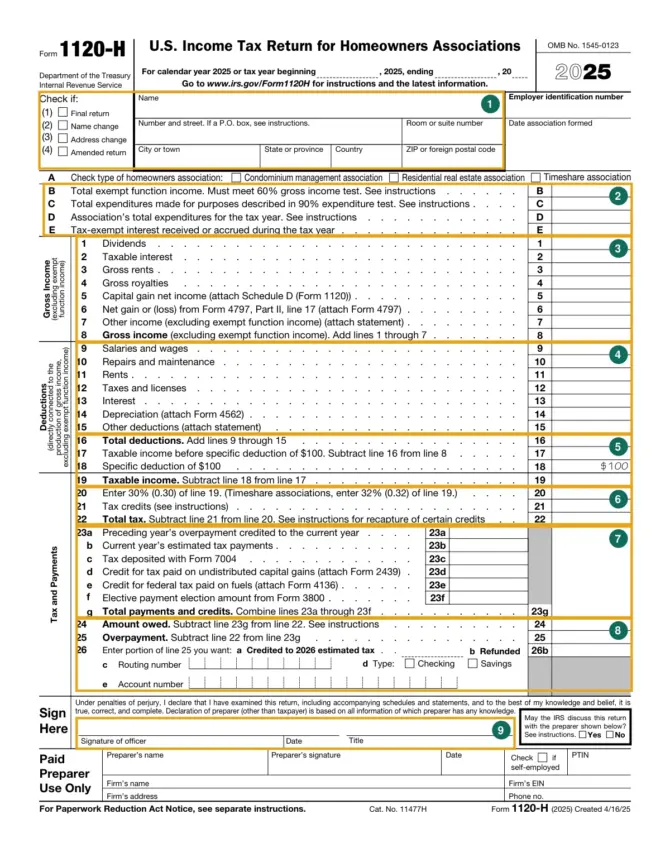
| Marker | Lines | What goes there |
|---|---|---|
| 1 | Header | Tax year dates for a fiscal or short year, the association’s true name from its charter, address, EIN, date formed, and boxes for final return, name change, address change and amended return. |
| 2 | Items B to E | B: total exempt function income. C: expenditures that count toward the 90% test. D: total expenditures for the year. E: tax-exempt interest received or accrued. |
| 3 | Lines 1 to 8 | Dividends, taxable interest, gross rents, gross royalties, capital gain net income (Schedule D (Form 1120)), Form 4797 Part II line 17, other income. Line 8 adds them. |
| 4 | Lines 9 to 15 | Salaries and wages, repairs and maintenance, rents, taxes and licenses, interest, depreciation (Form 4562), other deductions with a statement. |
| 5 | Lines 16 to 19 | Total deductions, income before the $100 specific deduction, the preprinted $100, and taxable income. |
| 6 | Lines 20 to 22 | Tax at 30% or 32% of line 19, credits, total tax including recapture. |
| 7 | Lines 23a to 23g | Prior-year overpayment, estimated tax, tax deposited with Form 7004, Form 2439 and Form 4136 credits, elective payment amount from Form 3800. |
| 8 | Lines 24 to 26e | Amount owed or overpayment, the split between credit to 2026 estimated tax and refund, direct deposit details. |
| 9 | Sign here | Signature, date and title of an authorized officer. |
Header and items B to E
Mail received in care of an accountant or attorney goes on the street line as “C/O” with the third party’s name and address. An association without an EIN applies online at IRS.gov/EIN (only associations in the United States or U.S. territories) or with Form SS-4; if the number has not arrived by the due date, write “Applied for” and the application date. To amend, file a corrected Form 1120-H with the “Amended return” box checked. The 2025 form covers calendar 2025 and fiscal years that begin in 2025 and end in 2026, and it may also serve a short 2026 year if the 2026 form is not yet out.
Item C counts current and capital spending on association property under the association’s own accounting method: a manager’s or secretary’s salary, gardening, paving, street signs, security guards, property taxes on association property, pools, tennis courts and recreation halls, and replacement of common buildings, heating, air conditioning or elevators. Spending on property that is not association property stays out of item C, and so do investments and transfers to funds for future costs, such as a sinking fund for a new roof. Item D is the association’s total spending, including amounts tied to exempt function income. Item E includes exempt-interest dividends from a mutual fund or other regulated investment company.
Lines 1 to 19
Line 2 takes taxable interest from bank deposits, notes, bonds, tax refunds and similar items, with no offset for interest expense; tax-exempt interest goes in item E, not here. Lines 3 and 4 are gross amounts, with the related expenses claimed on the deduction lines. Every sale or exchange of a capital asset goes on Schedule D (Form 1120), attached even when there is no gain. Line 7 needs a statement listing each type and amount, or a description in parentheses when there is only one item.
The deductions on lines 9 to 15 count only if they are directly connected with producing gross income other than exempt function income. Line 10 excludes amounts that improve property, which must be capitalized. A leased vehicle on line 11 also requires Part V of Form 4562. Line 12 leaves out federal income tax and taxes for local benefits that raise property value, such as paving. Interest on line 13 may be limited under section 163(j) (Form 8990). Line 14 takes depreciation and section 179 expense from Form 4562. If facilities or staff serve both exempt and nonexempt purposes, the instructions point to Regulations section 1.528-10.
Lines 20 to 26e
If line 19 is zero or less, line 20 is -0-. Line 21 takes the foreign tax credit (Form 1118) and the general business credit (Form 3800). Homeowners associations generally cannot claim the investment credit, but they can make the section 6417 elective payment election for the credits under sections 48, 48C and 48E, which is reported on line 23f from Form 3800, Part III, line 6, column (j). Recapture of the low-income housing, qualified electric vehicle or new markets credit is added on line 22 with “LIHTC,” “QEV” or “NMTC,” “recapture” and the amount written beside it. Backup withholding is included in line 23g and shown in the blank space between lines 22 and 23g with the words “Backup Withholding.”
For an overpayment, line 26a moves part or all of it to 2026 estimated tax, a choice that cannot be changed later, and line 26b is the refund. Direct deposit needs line 26c (nine digits, starting 01 to 12 or 21 to 32), one box on line 26d and an account number of up to 17 characters on line 26e. Deposit is not available to a foreign bank or a foreign branch of a U.S. bank, or to an association still waiting for its EIN. The IRS sends a check instead when the account name does not match the association, the bank rejects the numbers, or no account type is checked.
Signature
The president, vice president, treasurer, assistant treasurer, chief accounting officer or another authorized officer, such as a tax officer, signs and dates the return. A receiver, trustee or assignee signs in place of the officer, and a receiver or trustee in bankruptcy attaches a copy of the court order or instructions authorizing the signature. A paid preparer signs and completes the “Paid Preparer Use Only” area; an officer who prepares the return leaves it blank. Checking “Yes” in the signature area lets the IRS talk to the individual preparer who signed, not the firm, until the 2025 return’s due date without extensions.
When Form 1120-H is due
The return is due by the 15th day of the 4th month after the tax year ends, which is April 15, 2026 for a calendar year 2025 association. An association whose fiscal year ends June 30 files by the 15th day of the 3rd month, and a short tax year ending any time in June is treated as ending June 30. A due date on a Saturday, Sunday or legal holiday moves to the next business day. An association that misses the due date, including extensions, loses the right to elect Form 1120-H for that year on top of any late filing penalty.
Form 7004 asks for more time to file and is generally due by the regular due date. Both the 1120-H and the Form 7004 instructions say an electing association requests the extension using the original form type assigned to the entity. The Form 7004 instructions put the automatic extension at generally 6 months. It does not extend the time to pay, and tax sent with the extension is entered on line 23c.
Paying the tax and what late costs
Tax due must be paid in full by the original due date, electronically, and not enclosed with the return. The Electronic Federal Tax Payment System (EFTPS.gov, 800-555-4477) accepts same-day payments of $1 million or less submitted before 3:00 p.m. Eastern time on a business day; larger payments must be in by 8:00 p.m. Eastern the day before. A bank can also send a same-day wire through the Federal Tax Collection Service. An association that cannot pay in full may apply at IRS.gov/OPA for an installment agreement if it owes $25,000 or less and can pay within 24 months; a fee, penalties and interest apply.
- Late filing: 5% of the unpaid tax for each month or part of a month, up to 25%. For a return more than 60 days late, the minimum is the smaller of the tax due or $525, an amount raised for returns required to be filed in 2026.
- Late payment: 0.5% of the unpaid tax for each month or part of a month, up to 25%.
- Interest: charged on late tax even when a filing extension was granted, at the rate under section 6621.
Neither penalty applies if the association shows reasonable cause. The explanation goes to the IRS after a penalty notice arrives, not with the return.
Where to file Form 1120-H and the official PDF
Associations can generally e-file Form 1120-H with its schedules and attachments, along with Form 7004, and authorize an electronic funds withdrawal for a balance due. E-filing is required for an association that files 10 or more returns of any type during the calendar year, counting income tax, employment tax, excise tax and information returns (Regulations section 301.6011-5); a waiver can be requested. Paper returns go to the address for the state of the association’s principal business, office or agency:
| Principal business, office or agency in | Mailing address |
|---|---|
| Connecticut, Delaware, District of Columbia, Georgia, Illinois, Indiana, Kentucky, Maine, Maryland, Massachusetts, Michigan, New Hampshire, New Jersey, New York, North Carolina, Ohio, Pennsylvania, Rhode Island, South Carolina, Tennessee, Vermont, Virginia, West Virginia, Wisconsin | Department of the Treasury, Internal Revenue Service Center, Kansas City, MO 64999-0012 |
| Alabama, Alaska, Arizona, Arkansas, California, Colorado, Florida, Hawaii, Idaho, Iowa, Kansas, Louisiana, Minnesota, Mississippi, Missouri, Montana, Nebraska, Nevada, New Mexico, North Dakota, Oklahoma, Oregon, South Dakota, Texas, Utah, Washington, Wyoming | Department of the Treasury, Internal Revenue Service Center, Ogden, UT 84201-0012 |
| A foreign country or U.S. territory | Internal Revenue Service Center, P.O. Box 409101, Ogden, UT 84409 |
A designated private delivery service can meet the timely mailing rule, but it cannot deliver to the P.O. box; IRS.gov/PDSStreetAddresses lists the street addresses. If the address changes after the return is filed, the IRS is told with Form 8822-B.
The 2025 Form 1120-H PDF and the Instructions for Form 1120-H (2025) are on irs.gov. On October 31, 2026, the About Form 1120-H page listed no recent developments.
Before mailing the return
- Forms attached behind Form 1120-H in this order: Form 4136, Form 8978, Form 8941, Form 3800, schedules in alphabetical order, other forms in numerical order, then supporting statements.
- Every applicable entry filled in, with no “See Attached” or “Available Upon Request” in an entry space.
- The association’s name and EIN on each supporting statement.
- Amounts either all rounded to whole dollars or all with cents.
- Schedule D (Form 1120), Form 8949 and Form 8997 attached if a capital gain was deferred in a qualified opportunity fund.
- A copy of the court order attached when a receiver or trustee in bankruptcy signs.
Questions about Form 1120-H
Does an HOA filing Form 1120-H pay estimated tax?
The estimated tax and alternative minimum tax rules do not apply to an association that elects Form 1120-H. Because the election only happens when the return is filed, the form still has lines 23a and 23b for an overpayment credit and any estimated payments made.
Is interest on the HOA reserve account taxable?
Interest on amounts in a sinking fund is not exempt function income, so taxable interest goes on line 2 and is taxed at the 30% or 32% rate. Tax-exempt interest is reported only in item E.
Official sources
- Internal Revenue Service, Form 1120-H, U.S. Income Tax Return for Homeowners Associations, 2025 (Created 4/16/25)
- Internal Revenue Service, Instructions for Form 1120-H (2025), dated January 14, 2026
- Internal Revenue Service, Instructions for Form 1120-H (2025), PDF
- Internal Revenue Service, About Form 1120-H
- Internal Revenue Service, Instructions for Form 7004 (Rev. December 2025)
- Electronic Code of Federal Regulations, 26 CFR 1.528-4, Substantiality test