Arkansas Form ST-391 is the Exemption Certificate a purchaser signs to buy tangible personal property from a seller without Arkansas sales and use tax. The Department of Finance and Administration (DFA) issues it from its Sales and Use Tax Section as a one-page form citing AR Code 26-52-517 under the title, and the file now posted carries the footer “ST391 REV 09/10/2025”.

Who can sign the ST-391 certificate
The opening certification allows two kinds of signer. One is the holder of an Arkansas sales/use tax permit, or the holder’s authorized representative. The other is a nonresident purchaser, or that purchaser’s authorized representative, holding a similar permit issued by another state. In both cases the signer certifies that the permit number written on the form is current and valid.
A permit stays with the business it was issued to. DFA’s sales and use tax FAQ says permits cannot be transferred to or used by anyone else, and gives the case of a contractor working for a direct pay permit holder: the contractor cannot use the client’s permit to buy materials tax exempt, pays the tax on the materials, and may pass that tax on as part of the contract cost. ST-391 ties the certificate to that permit: the signature block asks for the business name “as stated on permit”.
DFA’s commercial farmer page also names ST-391 as one of the documents an eligible farmer can give a retailer when buying eligible items for commercial farming. That use, and the permit question it raises, is covered in the farm section below.
Filling in the exemption certificate field by field
The form has no printed field numbers. The numbers below match the frames on the image of the REV 09/10/2025 form, and the middle column quotes the form’s own wording.
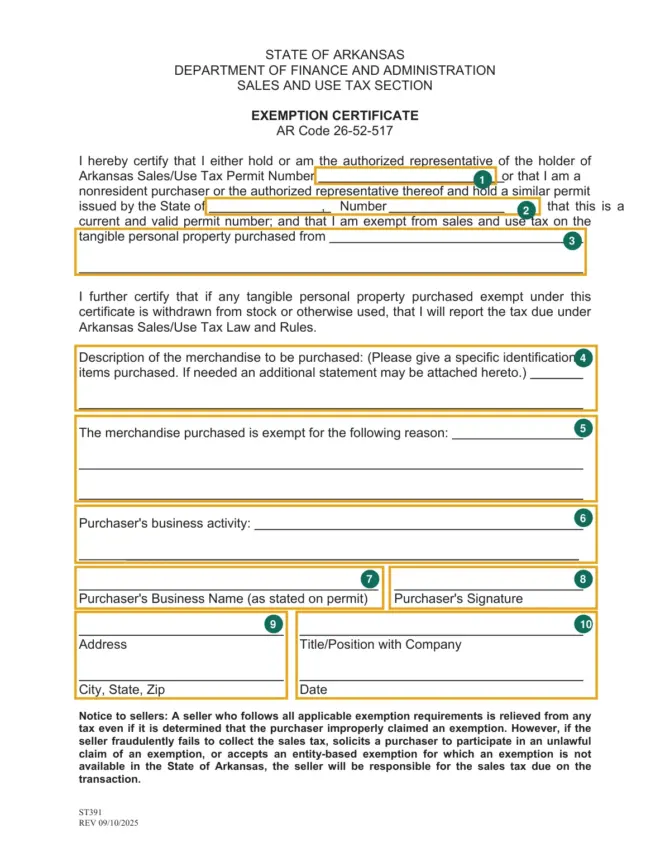
| Field | Form wording | What goes there |
|---|---|---|
| 1 | Arkansas Sales/Use Tax Permit Number | The Arkansas permit number of the purchasing business, when the purchaser holds an Arkansas permit. |
| 2 | issued by the State of ___, Number ___ | For a nonresident purchaser: the state that issued the similar permit, then that permit’s number. |
| 3 | tangible personal property purchased from ___ (two lines) | The seller the certificate is being given to. |
| 4 | Description of the merchandise to be purchased | A specific identification of the items, as the form asks. An additional statement may be attached if the lines are too short. |
| 5 | The merchandise purchased is exempt for the following reason | The exemption being claimed for those items, on up to three lines. |
| 6 | Purchaser’s business activity | What the purchasing business does, on two lines. |
| 7 | Purchaser’s Business Name (as stated on permit) | The business name exactly as it appears on the permit used in field 1 or 2. |
| 8 | Purchaser’s Signature | The permit holder or authorized representative signs here. The DFA PDF has no fillable field on this line. |
| 9 | Address; City, State, Zip | The purchaser’s street address and city, state and ZIP code. |
| 10 | Title/Position with Company; Date | The signer’s position in the business and the date of signing. |
Between fields 3 and 4 there is a second certification with no blanks to fill. By signing, the purchaser agrees that if any tangible personal property bought exempt under the certificate is withdrawn from stock or otherwise used, the purchaser will report the tax due under Arkansas sales/use tax law and rules.
Field 4 asks for “a specific identification of items purchased.” For farm purchases, DFA’s own examples are named items: tractor, combine, sprayer, seed, feed, fertilizer, stock panels.
Using ST-391 for commercial farm purchases
According to DFA’s commercial farmer page, Arkansas Code §§ 26-52-403, 404 and 405 exempt livestock, chemicals, feed, machinery and seed from sales tax, and those exemptions apply only to eligible farmers in the business of commercial farming. The page quotes A.C.A. § 26-52-517 for the meaning of eligible farmer: a person or entity engaged in farming that has demonstrated to the DFA Secretary the resources and capacity to produce food, fiber, grass sod or nursery products in commercially marketable quantities. ST-391 cites the same section number under its title.
The page gives examples on both sides and marks each list as not all-inclusive. Exempt examples include tractors, combines, milking and irrigation equipment, livestock vaccinations, seed, feed, fertilizer, agricultural chemicals and stock panels. Non-exempt examples include repairs for farm equipment, lubricants and oil for maintaining equipment, fencing and building materials, metal buildings, tires, utility trailers, golf carts, vehicles licensed for highway use, and lawn mowers or lawn and garden tractors.
The same page describes two ways for an eligible farmer to claim the exemption with a vendor:
- apply on the Arkansas Taxpayer Access Point (ATAP) for an Arkansas Farmer Sales Tax Exemption card, which shows the farm or farmer’s name and address, the issue and expiration dates and a unique card number; the card stays active for eight years, costs $20.00 at first and $10.00 to renew;
- complete Form ST-403 (Commercial Farming Sales Tax Exemption) or Form ST-391 and give it to the retailer when buying eligible items for commercial farming.
DFA’s sales and use tax forms page also lists a “3 Year Business Plan for Farmer Sales Tax Identification Card”, posted 12/22/2025.
ST-403, revision R 02/2007, is narrower than ST-391. It covers farm machinery and equipment under § 26-52-403, and the buyer certifies that the machinery will be used exclusively and directly in producing food and fiber for the commercial marketplace, or directly in producing farm products fed to livestock or poultry sold in processed form at retail. It states that a false claim leads to tax, penalty and interest and is punishable as a misdemeanor, and that sellers keep those certificates on file for six years from the date of sale. ST-391 prints no retention period.
There is one open point for a farmer using ST-391. The certificate’s first sentence is written around an Arkansas sales/use tax permit number, or a permit from another state, and field 7 asks for the business name as stated on that permit. The farmer page does not say what a farmer without a sales tax permit writes in field 1. ST-403 has no permit number line at all. For questions, the farmer page gives the email address register.tax@dfa.arkansas.gov.
What the seller does with a signed ST-391
The signed certificate goes to the seller named in field 3. DFA’s farmer page describes completing it and providing it to retailers, and the form itself prints no DFA mailing address, email address or filing instruction.
The bold notice at the foot of the form is addressed to sellers. A seller that follows all applicable exemption requirements is relieved of the tax even if it is later determined that the purchaser claimed the exemption improperly. The notice then names the cases in which the seller is responsible for the sales tax on the transaction:
- the seller fraudulently fails to collect the sales tax;
- the seller solicits a purchaser to take part in an unlawful claim of exemption;
- the seller accepts an entity-based exemption that is not available in Arkansas.
ST-391 does not say how long the seller keeps the certificate, and none of the DFA pages listed below gives a period for it. The six-year note quoted above appears on ST-403 only.
Getting the official ST-391 PDF
The Exemption Certificate (ST-391) appears on DFA’s sales and use tax forms page with a posting date of 09/15/2025, and the PDF footer reads REV 09/10/2025. The file is a fillable PDF with 17 text fields and no signature field. The forms page notes that some browsers’ built-in PDF viewers may not be compatible with DFA forms, and that Adobe Reader, or downloading the form first, may be needed to complete it properly.
The same forms page lists the Streamlined Sales Tax Certificate of Exemption (F0003) with separate instructions, and the farm machinery certificate ST-403. This guide covers ST-391 only and is not tax advice. A question about whether a particular farm item qualifies can go to the email address on DFA’s farmer page.