A company’s registered office is the address Companies House holds for delivering post to the company, and it is shown on the public register. AD01 is the notice that changes it under section 87 of the Companies Act 2006. The PDF on GOV.UK is version 7.0, dated 08/26, and runs to three pages. GOV.UK now publishes the paper version for four specific cases and points every other company to the online service.

Who files AD01 on paper, and who changes the address online
The GOV.UK page for AD01 sends companies to the online service to update the address as quickly as possible. It names four situations where a paper form is needed instead:
- the registered office has been defaulted to the Companies House address
- the company is in liquidation
- the company is applying to be restored to the register
- the company is an unregistered company
The PDF sits on a separate page headed for companies in liquidation, restoration or with a default address, and that page tells every other company to change its registered office online. The online route needs the company authentication code. If nobody can get to the current registered office to collect it, the AD01 page lets you ask for the code to be sent to your home address instead. Since 13 October 2025, signing in to WebFiling has required a GOV.UK One Login, and Companies House says you may need to verify your identity before using the service.
Section 4 accepts authentication by a director, a secretary or a person authorised under the Act, or by one of eight officeholders the form names, among them a liquidator, an administrator and a judicial factor.
A limited liability partnership cannot use AD01. The LLP version is LL AD01, a different form with its own GOV.UK page. That page lists three paper-only cases for an LLP: defaulted to the Companies House address, in liquidation, or applying for restoration.
What counts as an appropriate registered office address
The Economic Crime and Corporate Transparency Act 2023 replaced section 86 of the Companies Act 2006, fully from 4 March 2024. A company must now keep its registered office at an appropriate address at all times. An address passes if, in the ordinary course of events, a document handed in or posted there would come to the attention of a person acting on the company’s behalf, and the delivery can be recorded by getting an acknowledgement of delivery. Section 87(1A) requires the change notice to include a statement that the new address meets that test, which is the tick box in section 3 of AD01.
Companies House’s company formation guidance adds that the address must be a physical address in the UK. A Royal Mail PO Box can no longer be used, and the same goes for similar services from other companies. An accountant’s or solicitor’s address is acceptable if it meets the same requirements, and you need their permission first. The guidance warns that a company without a registered office meeting these requirements could be struck off. Section 86(3) makes a failure without reasonable excuse an offence by the company and every officer in default, punishable by a fine. The duty does not apply while the registered office is a default address nominated by the registrar.
The new address also has to be in the part of the UK where the company is registered. The notes beside section 2 give the rule for each register:
- company registered in England and Wales: the address can be in England or in Wales
- Welsh company: the address must be in Wales
- company registered in Scotland: the address must be in Scotland
- company registered in Northern Ireland: the address must be in Northern Ireland
AD01 cannot carry a company from Scotland to England, or from Northern Ireland to Wales; the checklist on page 3 asks you to confirm that the office is in the location where the company was registered. A Welsh company is one whose register entry says its registered office is to be situated in Wales. Section 88 lets a company whose office is in Wales switch that entry between “Wales” and “England and Wales” by special resolution, followed by notice to the registrar, who issues an altered certificate of incorporation. That resolution is a separate filing from the address change.
A home address used as the registered office goes on the Companies House website, and the note in section 2 says you will not be able to remove it. Companies House’s guidance on removing personal details does accept an SR01 application for a home address that was used as a registered office, but an active company has to change its registered office first. SR01 costs £34 for each document listed. If the application is accepted, the old address is partly hidden, leaving only the first half of the postcode visible.
How to fill in AD01 section by section
Type the entries, or write them by hand in bold black capitals. The form treats every field as mandatory unless it is marked with an asterisk or described as optional, and nothing in sections 1 to 4 carries either mark. The frames in the image below match sections 1, 2 and 3 on page 1; section 4 is on page 2.
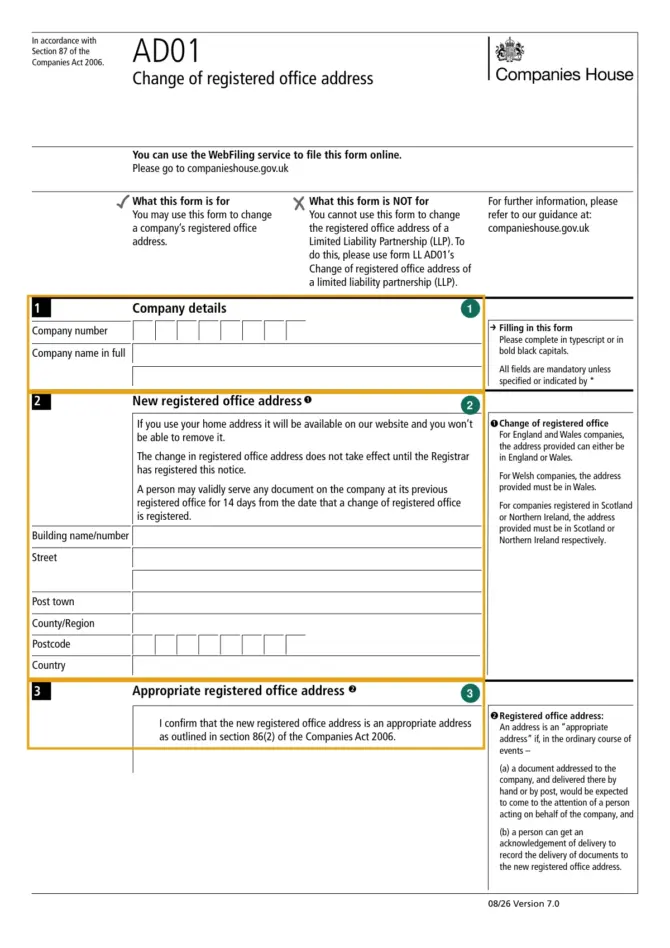
| Section | What to enter | Points to check |
|---|---|---|
| 1 | Company number in the eight boxes, and the company name in full. | Both have to match the public register. |
| 2 | New registered office: building name or number, street (two lines), post town, county or region, postcode in eight boxes, and country. | Same part of the UK as the company’s registration. A home address here becomes public. |
| 3 | Tick the box confirming the new address is an appropriate address under section 86(2). | This is the statement section 87(1A) requires. |
| 4 | Printed name of the person authenticating on behalf of the company. | No signature is needed. The name appears on the public record. |
| Presenter information (page 3) | A contact and company name, a postal address with postcode and country, a DX number and a telephone number. | Optional. Companies House uses it if there is a query, and searchers of the register can see it. |
A “person authorised” in section 4 means someone authorised under section 270 or 274 of the Companies Act 2006, as the form’s note puts it. For a United Kingdom Societas, delete “director” and state which organ of the UKS the authenticating person belongs to.
The important-information box on page 3 confirms that all of AD01 goes on the public record, so the presenter’s details are as visible as the new address.
When the new address takes effect
Moving into new premises does not by itself move the registered office. Under section 87(2), and as the note in section 2 repeats, the change takes effect only when the registrar registers the notice. The GOV.UK page for AD01 asks companies to tell Companies House within 14 days of the change taking place.
For 14 days beginning with the date the change is registered, anyone may still validly serve a document on the company at the old registered office. The company has a similar margin for its own duties: section 87(3) lets it treat the new address as its registered office, for keeping registers open to inspection and for showing the address on documents, from a date it chooses up to 14 days after giving notice. If the company unavoidably had to stop keeping its registers at the registered office without time to give notice first, section 87(4) protects it when it resumes at other premises as soon as practicable and notifies the change within 14 days.
Companies House aims to process most online filings within 24 hours; paper documents sent by post might take a week or more. Its guidance on running a limited company says that if the change is approved, Companies House tells HMRC.
A director’s service address is a separate entry. Companies House’s guidance on personal information says it can be the same as the registered office or somewhere different, and changes to a director’s name or address go on CH01.
Checks before posting AD01
Companies House can send back an AD01 that is wrongly completed or incomplete, according to page 3. The page 3 checklist, with the section 3 statement added, comes to five points:
- company name and number identical to the entry on the public register
- new registered office address given in section 2
- new registered office in the same location as the company’s registration
- box in section 3 ticked
- form authenticated in section 4
Where to get AD01 and where to send it
The PDF is on the GOV.UK page Change registered office of a company in liquidation, restoration or with a default address; the general AD01 page links to the online service. Page 3 of the form notes that some forms can be uploaded to Companies House in place of posting, and that paper sent by post has to reach the right address. The Companies House office page names its Cardiff main office for postal documents from companies on all three UK registers:
Companies House
Crown Way
Cardiff
CF14 3UZ
DX 33050 Cardiff
Post sent elsewhere may be redirected and take longer to arrive. None of the Companies House offices is open to the public, and paper left in the external post box in Cardiff gets no receipt or proof of delivery. Enclosing a stamped addressed envelope with a copy of your covering letter gets an acknowledgement that the document arrived, which is not confirmation of registration. An alternative format of AD01 is available through the Companies House forms page, and general enquiries go to enquiries@companieshouse.gov.uk or 0303 1234 500, Monday to Friday, 8:30am to 6pm.
Official PDF: AD01 — Official PDF (assets.publishing.service.gov.uk)
Questions about changing a registered office
Is there a Companies House fee for changing a registered office address?
The fees page on GOV.UK, last updated 25 September 2026, prices company filings such as incorporation, change of name, the confirmation statement and voluntary strike-off, and has no line for a change of registered office.
Can a company in Scotland move its registered office to London?
AD01 only accepts a new address in the same part of the UK as the company’s registration, so a Scottish company’s registered office stays in Scotland.
Can the registered office be a PO Box if a street address is added?
Companies House’s formation guidance says a Royal Mail PO Box, or a similar service from another company, can no longer be used as a registered office address. The address has to be a physical address in the UK, and a sender delivering post there has to be able to get confirmation of delivery.
Sources
- Companies House AD01, change of registered office address, 08/26 version 7.0
- Change a company’s registered office address (AD01), GOV.UK
- Change registered office of a company in liquidation, restoration or with a default address, GOV.UK
- Change a registered office address: limited liability partnership (LL AD01), GOV.UK
- Check the rules for registered office addresses and email addresses, GOV.UK
- Running a limited company: company information you must report, GOV.UK
- Tell Companies House about changes to your limited company, GOV.UK
- Filing your Companies House information online, GOV.UK
- Your personal information on the Companies House register, GOV.UK
- Removing your personal details from the Companies House register, GOV.UK
- Apply to remove your personal details from the Companies House register (SR01), GOV.UK
- Change the details of a director (CH01), GOV.UK
- Companies House fees, GOV.UK
- Companies House office access and opening times, GOV.UK
- Companies Act 2006, section 86, legislation.gov.uk
- Companies Act 2006, section 87, legislation.gov.uk
- Companies Act 2006, section 88, legislation.gov.uk