IHT413 is the schedule personal representatives send with the IHT400 account when the deceased owned a business, a share in a partnership or an asset used in a business on which Business Relief is being deducted. It records the open market value of the business interest, how that value was worked out and how much relief is claimed at 100% and at 50%. The value feeds IHT400 box 69 and the relief feeds box 93. The current form is marked HMRC 04/26: GOV.UK updated it on 6 April 2026, the date the £2.5 million cap on 100% Agricultural and Business Relief took effect, and the new rules are printed on page 1.
Who fills in IHT413 and what goes on a different schedule
The IHT400 notes (page 36) say IHT413 is needed if the deceased owned a business or part of one, or owned an asset used in a business and you are deducting Business Relief. The notes give a hotel, a shop and a factory as examples of property from which the deceased ran a business, alone or in partnership. If the deceased took part in more than one business, the notes say you may need a separate IHT413 for each business or partnership interest, and the form itself allows a separate copy for each business asset.
Shares stay off IHT413. Page 1 says a control holding of shares belongs on IHT412, ‘Unlisted stocks and shares, and control holdings’, and the IHT400 notes say to use IHT412 for Business Relief on shares in general. Page 3 repeats this for a company that used the deceased’s assets: the assets go on IHT413, the shares in that company go on IHT412. The summary on the GOV.UK publication page (last updated 6 April 2026) mentions shares in a company among the reasons to use IHT413, which reads differently from the form and the notes. This guide follows the instructions printed on the HMRC 04/26 form and the IHT400 notes; if a holding sits on the line between the two schedules, ask the Inheritance Tax Helpline on 0300 123 1072 before filing.
Two other assets have their own route. Business bank accounts are not listed on IHT406 with the deceased’s personal accounts; the notes put them in IHT400 box 69 with IHT413 (see IHT406, bank and building society accounts). Property from which the deceased ran a farming business goes in box 68 with Schedules IHT414 and IHT405, and where both reliefs could apply, Agricultural Relief is given first, with Business Relief available on any value above it. The notes also treat an underwriter’s business at Lloyd’s as an interest in a business.
Ownership and contract for sale, boxes 1 to 6
Page 1 starts with the deceased’s name, date of death and the Inheritance Tax reference number if you know it. Boxes 1 to 6 then test two conditions that can remove the relief.
| Box | Question | What happens next |
|---|---|---|
| 1 | Did the deceased own the business interest throughout the 2 years up to the date of death? | Yes: go to box 3. No: go to box 2. |
| 2 | Why Business Relief should still be due when the 2-year test is not met. | The notes name two cases where relief may still be available: the asset was inherited on a death, or it replaced other assets that qualified. |
| 3 | Was the business, the interest or any business asset subject to a binding contract for sale at the date of death? | No: go to box 7 on page 2. Yes: go to box 4. |
| 4 and 5 | Date of the contract, then a description and value of each asset sold under it. | Relief is not normally due on these assets. |
| 6 | Details of the exception. | Only where a business or business interest is sold to a company that will carry on the business, wholly or mainly for shares in or securities of that company. |
The notes say that where a binding contract for sale existed at the date of death, Business Relief will not normally be due unless one of the two conditions in box 6 applies. Use box 25 on page 4 for anything that does not fit.
Filling in page 2: the business or partnership interest
Page 2 carries the valuation and the main relief claim. The marked boxes are the ones that send figures or documents somewhere else.
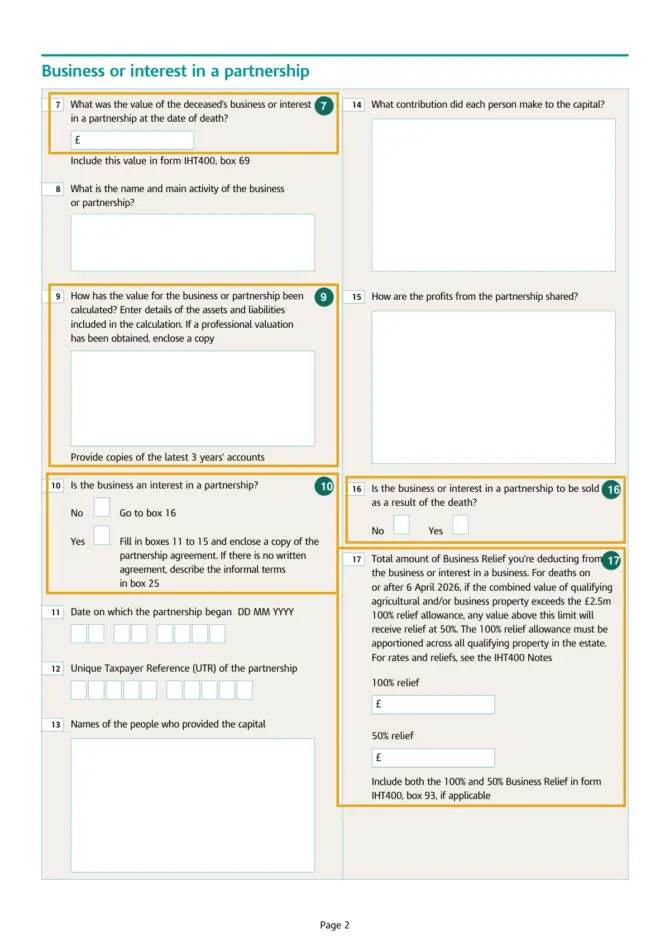
| Box | What to enter | Where it goes or what to enclose |
|---|---|---|
| 7 | Open market value of the deceased’s business or partnership interest at the date of death | IHT400 box 69 |
| 8 | Name and main activity of the business or partnership | No transfer |
| 9 | How the value was calculated, with the assets and liabilities included | Copy of any professional valuation and the latest 3 years’ accounts |
| 10 | Is it an interest in a partnership? | No: go to box 16. Yes: boxes 11 to 15 and a copy of the partnership agreement |
| 11 and 12 | Date the partnership began and the partnership’s Unique Taxpayer Reference | No transfer |
| 13 to 15 | Who provided the capital, how much each contributed and how profits are shared | Informal terms go in box 25 if there is no written agreement |
| 16 | Will the business or partnership interest be sold as a result of the death? | Yes or No |
| 17 | Business Relief deducted, split into a 100% amount and a 50% amount | IHT400 box 93 |
Box 7 asks for the open market value, which can differ from the value in the business accounts. The IHT400 notes (pages 76 and 77) explain that accounts often carry stock, goodwill and land at book value, which is cost less depreciation. If you are listing the business’s land separately on IHT400, take that value, or the deceased’s share of it, out of the business value. If not, get open market values for the land and the other book-value assets and adjust the business value up or down by the difference, or by the deceased’s share of it. Explain the working in box 9, continuing in box 25 if needed.
Box 17 and the £2.5 million relief allowance
For deaths on or after 6 April 2026, 100% relief on the combined value of qualifying agricultural and business property is limited to £2.5 million. Gifts of qualifying property made on or after 30 October 2024 and within 7 years of the death count towards that figure, as does other property treated as part of the estate, trust property included. Value above £2.5 million gets relief at 50%. Box 17 adds that the 100% allowance must be apportioned across all qualifying property in the estate, and HMRC’s apportionment guidance says the allowance is divided proportionally across the estate; it cannot all be applied to a single asset.
| Type of property (IHT400 notes, page 37) | Rate for deaths on or after 6 April 2026 |
|---|---|
| Business or interest in a business | 100% up to £2.5 million, 50% above it |
| Land, buildings or plant and machinery used in a business | 50% |
| Land, buildings or plant and machinery held in a trust | 50% |
| Shares on markets that are not ‘listed’ for HMRC purposes, such as AIM (reported on IHT412) | 50% |
| Control holdings of shares in a ‘listed’ company (reported on IHT412) | 50% |
The notes say the relief is given by deducting the relevant percentage of the capital value. Enter the 100% and 50% relief amounts in the two box 17 columns and carry both to IHT400 box 93, where the account also asks for the split between 100% and 50% relief. If you did not use HMRC’s online apportionment tool, box 93 asks you to explain how you apportioned the allowance. The tool handles estates with up to 8 agricultural and 8 business property assets. It uses the allowance on lifetime gifts first, oldest gift first, then shares what is left proportionally across the qualifying assets. It does not decide whether an asset qualifies and does not calculate the tax. HMRC’s tool page says to deduct the exemptions for spouses or civil partners and for gifts to charities before working out the allowance.
Unused allowance from a spouse or civil partner who died earlier can be transferred, which GOV.UK says could take the allowance up to £5 million. The claim is made on Schedule IHT437 after answering Yes to question 29d on IHT400. HMRC’s documents word the time limit differently. Page 1 of IHT413 and page 36 of the IHT400 notes say the claim must be made within 4 years of the survivor’s death or within 6 months of the personal representatives starting their role. The GOV.UK Business Relief guide says by the later of those two dates. Page 39 of the same IHT400 notes, in the Agricultural Relief section, counts the 4 years from the end of the month in which the survivor died. If the claim is close to any of these limits, confirm the date with the Inheritance Tax Helpline. GOV.UK adds that if the earlier spouse died before 6 April 2026, the full £2.5 million can be transferred even if their estate claimed Business Relief.
Assets used by a company or partnership, boxes 18 to 21
Page 3 is for something the deceased owned personally but let a business use: a yard used by their partnership, or machinery used by a company they controlled. List each asset and its value in box 18 and include the total in IHT400 box 69. Box 19 asks for the main activity of that business or company. In box 20 put an ‘X’ against either ‘Member of a partnership’ or ‘Control of the company’; the notes define control as more than 50% of the voting powers on all questions affecting the company as a whole.
Box 21 is the Business Relief on those assets, which goes to IHT400 box 93. The form says that for transfers after 9 March 1992 this relief is always at 50%, if the assets qualify. The notes add that land, buildings or plant and machinery only qualify if used in a business where the deceased was a partner at death, or by a company the deceased controlled.
Business Relief on lifetime gifts, boxes 22 to 24
Answer boxes 22 to 24 only if you are deducting Business Relief on a gift the deceased made in their lifetime. The ‘relevant period’ runs from the date of the gift to the date of death.
- Box 22: did the person who received the gift own the business, interest or asset throughout the relevant period?
- Box 23: would it have qualified for Business Relief if the recipient had transferred it at the date of death? The notes call this the ‘notional transfer’.
- Box 24: was it subject to a binding contract for sale immediately before the end of the relevant period?
The notes say you must answer each question so HMRC can decide whether the relief is due. GOV.UK adds that relief on a gift needs the donor to have owned the business or asset for at least 2 years before giving it, and that the recipient can replace an asset, such as machinery, with something of equal value used in the business. Such a gift also counts towards the £2.5 million allowance when it was made on or after 30 October 2024 and the donor died on or after 6 April 2026.
When Business Relief is not available
The GOV.UK Business Relief guide lists the cases where no relief is due. A business does not qualify if it mainly deals in securities, stocks or shares, land or buildings, or in making or holding investments, or if it is a not-for-profit organisation. A business that is being sold or wound up does not qualify either, apart from a sale to a company that will carry on the business with the estate paid mainly in that company’s shares, and a winding up that is part of a process to let the company’s business continue. An asset does not qualify if it also qualifies for Agricultural Relief, was not used mainly for the business in the 2 years before the death or gift, or is not needed for future use in the business. Where only part of an asset is used in the business, that part may qualify: in GOV.UK’s example, a room used as a shop in a building otherwise used as a home.
What to send with IHT413
- A copy of any professional valuation of the business (box 9).
- Copies of the latest 3 years’ accounts (box 9).
- A copy of the partnership agreement if box 10 is Yes, or a description of the informal terms in box 25.
- IHT405 for land and buildings included in box 69, as IHT400 box 69 asks.
- IHT437 if you are transferring unused 100% relief allowance from an earlier spouse or civil partner.
For land and buildings, see IHT405, houses, land, buildings and interests in land.
When and where to send IHT413
IHT413 has no deadline or signature box of its own. It goes with the IHT400 account, which the IHT400 notes say must reach HMRC within 12 months of the date of death; a late account without reasonable excuse can lead to a penalty of up to £200, and a further penalty of up to £3,000 if the delay runs to 2 years after the death. The notes give the postal address as Inheritance Tax, HM Revenue and Customs, BX9 1HT.
Box 69 sits in column B of IHT400. Tax on column B assets may be paid in 10 annual instalments as long as the assets have not been sold, and the notes list businesses, interests in businesses, and land, buildings, machinery and plant that qualify for Business Relief among the assets whose instalments are interest-free if paid by the due date.
The fillable HMRC 04/26 PDF and a Welsh version are on the GOV.UK IHT413 publication page. Read it with the IHT413 section of the IHT400 notes for deaths on or after 1 January 2022, pages 36 to 38, and the valuation notes on pages 76 and 77. The Inheritance Tax Helpline is 0300 123 1072, or +44 300 123 1072 from outside the UK.
Official PDF: IHT413 — Official PDF (assets.publishing.service.gov.uk)
Questions about IHT413
Does a family company shareholding go on IHT413?
The shares go on IHT412. Page 3 of IHT413 covers assets the deceased owned personally and a company they controlled used; Business Relief on those assets is at 50%.
Can Business Relief be claimed if the deceased owned the business for less than 2 years?
Answer No in box 1 and explain in box 2. The IHT400 notes say relief may still be available if the deceased inherited the asset on a death, or if it replaced other assets that qualified.
Which IHT400 boxes do the IHT413 figures go to?
The values from boxes 7 and 18 go in IHT400 box 69. The relief from boxes 17 and 21 goes in box 93, split between 100% and 50%.
Official sources
- Schedule IHT413, business and partnership interests and assets (HMRC 04/26)
- Inheritance Tax: business and partnership interests and assets (IHT413), GOV.UK
- IHT400 notes, deaths on or after 1 January 2022 (HMRC 04/26)
- IHT400 Inheritance Tax account (HMRC 04/26)
- Business Relief for Inheritance Tax, GOV.UK
- Work out how to apportion Agricultural and Business Relief for Inheritance Tax, GOV.UK
- Claim unused allowance for agricultural property or business property relief (IHT437), GOV.UK