IHT414 is the schedule you fill in to deduct Agricultural Relief on an IHT400 Inheritance Tax account. The current version is HMRC 04/26, five pages, and it asks how the land was farmed, who occupied it, whether it was let, and which farmhouses, cottages and farm buildings the relief is claimed on. Each agricultural holding needs its own IHT414, sent with a plan showing where the holding is and how far it extends.
Which estates fill in IHT414
Question 41 on the IHT400 asks whether you want to deduct Agricultural Relief from farmhouses, farms or farmland owned by the deceased. A “yes” means IHT414. The same land is also described on IHT405, the schedule for houses, land and buildings: box 1 of IHT414 says so, and the IHT400 Notes repeat it for box 68.
The relief covers agricultural land or pasture in the UK. The IHT400 Notes (HMRC 04/26) say land in the European Economic Area, the Channel Islands or the Isle of Man counted only for deaths and other transfers before 6 April 2024, and lifetime transfers of such land made before that date still keep the relief if the donor dies within 7 years. Farmhouses, cottages and buildings are included only if they are of a “character appropriate” to the property, meaning proportionate in size and nature to the farming done on the land.
The GOV.UK Agricultural Relief guidance sets the ownership and occupation test: the property must have been owned and occupied for agricultural purposes immediately before the transfer for 2 years if the owner, a company they controlled, or their spouse or civil partner occupied it, or 7 years if someone else did. The same page lists what does not qualify, including farm equipment and machinery, derelict buildings, harvested crops, livestock and property under a binding contract for sale. Outstanding mortgages and other secured liabilities on the property are deducted before the relief is worked out.
Relief rates and the 100% allowance for deaths from 6 April 2026
Page 1 of the form sets out the rule that changed in April 2026. For deaths on and after 6 April 2026, 100% relief on the combined value of qualifying agricultural and business property is limited to £2.5 million. That figure includes qualifying gifts made on or after 30 October 2024 within 7 years of the death and other property treated as part of the estate, trust property included. Value above £2.5 million gets 50% relief. Shares on a market that HMRC does not treat as listed, such as AIM, now qualify for 50% only.
| Situation (IHT400 Notes) | Rate |
|---|---|
| Land with vacant possession | 100% up to the allowance, 50% above it |
| Land let on a tenancy that began after 31 August 1995 | 100% up to the allowance, 50% above it |
| Other let land | 50% |
Land let on a tenancy that began before 10 March 1981 can still get the higher rate if three conditions are met: the deceased owned it since 10 March 1981, it would have qualified for full relief under the law at that date, and the deceased had no right to vacant possession, and could not have had one, from 10 March 1981 to the date of death. The Notes ask you to explain why this applies in the “Any other information” box, which they place on page 4; on the 04/26 form that box is on page 5.
An unused part of a late spouse’s or civil partner’s £2.5 million allowance can be transferred, and IHT400 question 29d sends that claim to Schedule IHT437. The time limit is worded slightly differently in two HMRC documents. IHT414 (HMRC 04/26) and the GOV.UK guidance say the claim is made within 4 years of the survivor’s death or within 6 months of the personal representatives starting their role; the IHT400 Notes (HMRC 04/26) say within 4 years from the end of the month in which the survivor dies. If a claim is close to either date, check with the Inheritance Tax Helpline on 0300 123 1072.
Where the conditions for both Agricultural Relief and Business Relief are met, the Notes say Agricultural Relief is given first and Business Relief may apply to any excess value.
Boxes 1 to 6: the holding and how it was farmed
The first two pages identify the land and build the evidence that it was farmed. Page 1 also asks for the deceased’s name, date of death and the Inheritance Tax reference number if known.
| Box | What HMRC asks for |
|---|---|
| 1 | Address, postcode and a full description of the agricultural holding. |
| 2 | When and how the deceased acquired it: inherited, received as a gift or bought. |
| 3 | Whether any part was under a binding contract for sale at the date of transfer. If so, give the contract details and mark the sold part on the plan. |
| 4 | Any planning consents granted on the holding but not yet carried out, with brief details. |
| 5 | The day-to-day farming on the land over the 7 years before the transfer, or the period of ownership if shorter. |
| 6 | What the deceased personally did in that farming over the 2 years before the transfer, for example the tasks and the hours each week. |
Box 3 can decide the claim. According to the IHT400 Notes, if contracts had been exchanged (or missives concluded in Scotland) before the death but the sale was not completed, Agricultural Relief is not due on that part.
For boxes 5 and 6 the Notes want specifics: whether it was an arable, pastoral or mixed farm, the crops usually grown, the livestock that grazed the land and, where there were several kinds, roughly how many animals and how many acres each used. Say if farming stopped at any point, when and why. If the deceased had a grazing licence or grass keep (conacre in Northern Ireland), send a copy of the licence or give full details in box 5. For deaths and other transfers from 6 April 2025, the environmental value of land managed under a qualifying environmental land management agreement is eligible for the relief.
Let land and the rate of relief, boxes 7 to 11
Box 7 asks whether the land was subject to any lease, licence or tenancy immediately before the transfer. “No” skips to box 11; “yes” leads through the tenant’s title, name and any relationship to the deceased (box 8), the date the letting started (box 9) and its original term (box 10).
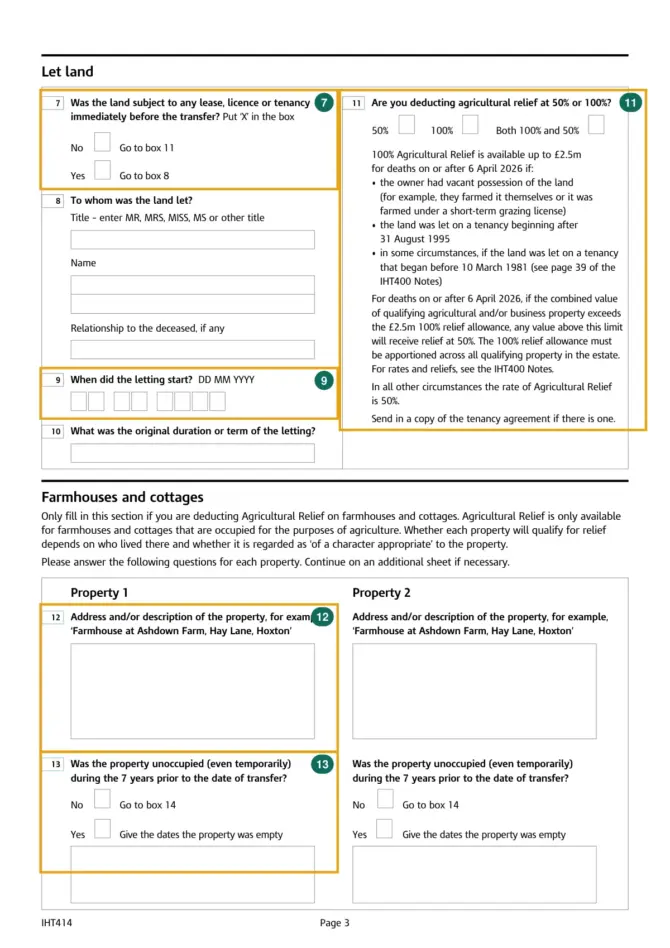
Box 11 is where you say whether you are deducting relief at 50%, 100% or both. The form lists the 100% cases for deaths on or after 6 April 2026: vacant possession, including land the owner farmed or land farmed under a short-term grazing licence; land let on a tenancy beginning after 31 August 1995; and, in some circumstances, land let on a tenancy that began before 10 March 1981. In all other cases the rate is 50%. If the qualifying property in the estate is worth more than the £2.5 million allowance, the 100% allowance has to be apportioned across all of it. Send a copy of the tenancy agreement if there is one.
On the IHT400, the value of the land goes in box 68 and the relief is deducted in box 93. The Notes give the method: at 100%, deduct the same figure that is in box 68; at 50%, deduct half of it. Box 93 also asks for the split between 100% and 50% relief, and an explanation of how the 100% allowance was apportioned if HMRC’s apportionment tool was not used. If you did use the tool, the IHT400 checklist asks you to enclose its output.
Farmhouses, cottages and farm buildings, boxes 12 to 16
This part is filled in only when relief is claimed on farmhouses or cottages, and only those occupied for agriculture can qualify. Page 3 has columns for two properties; the IHT400 Notes say to copy that page if there are more.
- Box 12: the address or a description of each property.
- Box 13: whether it stood empty at any time, even briefly, in the 7 years before the transfer, and if so the dates.
- Box 14: whether the deceased lived there. A “yes” asks who lived at the property, when, and how far they were involved in the farming described in box 5; a “no” points on to box 16.
- Box 15: if the property was let, the type of tenancy (for example agricultural tenancy or assured shorthold) and the rent paid.
- Box 16: every farm building the relief is claimed on, who used it and for what. HMRC says phrases such as “general storage” or “agricultural purposes” are not enough.
The GOV.UK guidance adds that a farmhouse or cottage is valued as if it could only be used for agriculture; any value above that agricultural value, such as the market price of a country residence, gets no Agricultural Relief. A cottage or farmhouse must be occupied by someone employed in farming, a retired farm employee, or the spouse or civil partner of a deceased farm employee, living there either as a tenant under a lease granted as part of their former employment contract or as a protected tenant with statutory rights.
Boxes 17 to 20 for gifts made before death
Page 5 applies when Agricultural Relief is claimed on a lifetime gift. The “relevant period” runs from the date of the gift to the death of the deceased, or to the death of the person who received the gift if they died first. The four questions are:
- 17: was the holding agricultural property immediately before the end of the relevant period?
- 18: did the person who received the gift own it throughout the relevant period?
- 19: was it occupied for agricultural purposes, by the recipient or someone else, throughout that period?
- 20: was it under a binding contract for sale immediately before the end of that period?
The “Any other information” box below them is for further details and for anything that did not fit on pages 1 to 4.
Where IHT414 goes: with the IHT400 and IHT405
The fillable IHT414 (HMRC 04/26) and a Welsh version are on the GOV.UK IHT414 page, which records the updated English and Welsh forms on 6 April 2026. IHT414 has no address of its own: it goes with the IHT400, and for a grant in England, Wales or Northern Ireland, or confirmation in Scotland, the IHT400 gives the address as Inheritance Tax, HM Revenue and Customs, BX9 1HT.
For an Agricultural Relief claim, the IHT400 checklist asks for a plan of the property and a copy of the lease or letting agreement where there is one. Include the IHT405 for the same land, one IHT414 per holding, and the apportionment output if you used the tool. The Inheritance Tax Helpline is 0300 123 1072, or +44 300 123 1072 from outside the UK.