IHT423 asks an account provider to send funds from a deceased person’s account directly to HMRC for Inheritance Tax. It can also instruct a broker or investment manager to sell holdings to fund the payment. The money goes towards the estate’s tax bill.
This guide covers the November 2024 form published on GOV.UK in February 2025, including its bank, building society, NS&I and investment sections.
Who can use the Direct Payment Scheme?
Ask the provider whether it participates and how it needs you to prove that you are an appropriate personal representative. The IHT400 notes limit this scheme to accounts in the deceased’s sole name; joint accounts cannot be used. Providers carry out their own checks and will usually ask for the original death certificate and any further documents they require.
The process can begin before probate or Scottish confirmation is obtained. Obtain an Inheritance Tax payment reference first, and prepare a separate IHT423 for each account. The total requested transfers must not exceed the total Inheritance Tax liability. Coordinate several account requests against that total.
Completing the bank and investment account sections
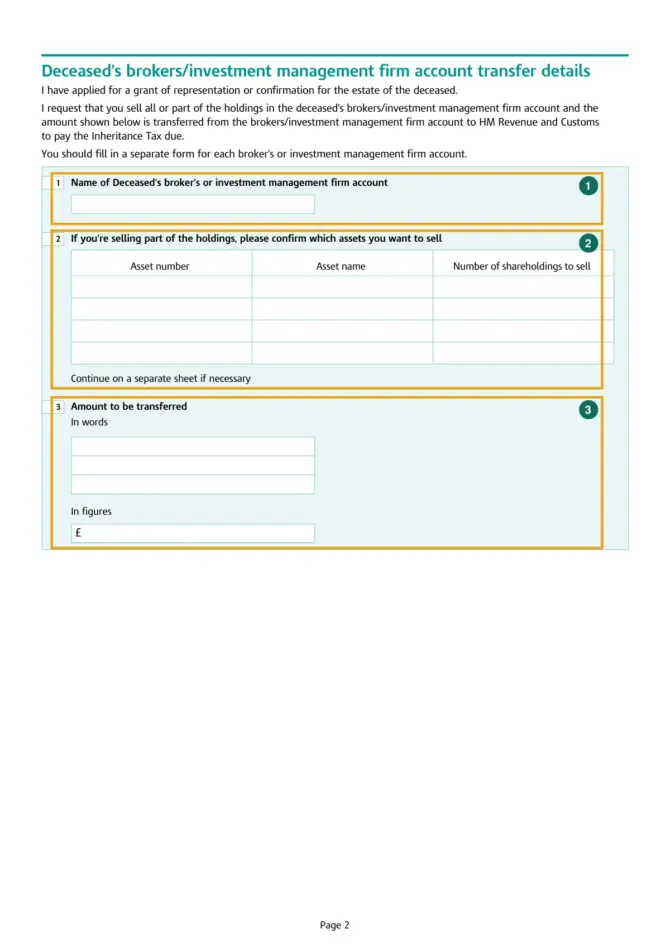
At the top of page 1, enter the deceased’s surname, first name, address with postcode, death date in day-month-year order and the Inheritance Tax reference. Then complete the section appropriate to the account. The illustration marks the three investment-account fields on page 2.
| Section and field | What to enter | Source record |
|---|---|---|
| Page 1, field 1 | Bank or building society name; leave blank for NS&I | Account statement |
| Page 1, field 2 | Sort code; leave blank for NS&I | Account banking details |
| Page 1, field 3 | The deceased’s account number | For NS&I, use the account number, not the NS&I customer number or its general account number |
| Page 1, field 4 | Building society roll or reference number, where applicable | Building society account records |
| Page 1, field 5 | Transfer amount in words and figures | Amount allocated to this account from the tax bill |
| Page 2, field 1 | Name of the deceased’s broker or investment management firm account | Investment account statement |
| Page 2, field 2 | For a partial sale, asset number, asset name and number of shareholdings to sell | Holding-by-holding instructions; continue on a separate sheet if needed |
| Page 2, field 3 | Amount to transfer in words and figures | Tax payment requested from that investment account |
For example, if the estate needs a payment from only part of a share portfolio, identify the specific holdings and quantities in page 2’s sale table. The provider must have a clear sale instruction as well as the sum to transfer.
Page 3 supplies HMRC’s domestic payment details and a separate overseas-payment block, including the account name, IBAN, BIC and bank address. Use the appropriate block from the official form when coordinating the transfer. Supply the valid Inheritance Tax reference: the form warns that HMRC cannot match payment to the account without it.
Everyone applying for the grant signs page 4
The declaration has spaces for four representatives. Each person applying for the grant of representation or confirmation must give their surname, first name, postcode, remaining address, signature and date. A completed account instruction without the required applicants’ signatures does not meet the form’s declaration instructions.
Read the refund wording before signing. The IHT400 notes say an overpayment is returned through the organisation that sent the funds, to the deceased’s account; a repayment is not issued to the estate before a grant is obtained. Do not assume a transfer can be refunded directly to an executor’s personal account.
Send IHT423 to the provider and the account to HMRC
Download and save the PDF, then complete it in Adobe Reader as directed on the publication page; the form may not work fully in a browser. Send IHT423 to the bank, building society, NS&I, broker or investment manager making the transfer. The form expressly says it is not sent to HMRC Inheritance Tax.
If you are asking HMRC to calculate the tax under the Northern Ireland procedure in the IHT400 notes, initially leave the reference and transfer amount blank and retain IHT423. Send IHT400 and the estate papers first. HMRC sends its calculation; then complete the reference and amount on IHT423 and send it to the provider. Pay any balance that the provider transfer does not cover by another permitted payment method.
When you have calculated the tax and can instruct the transfer, send IHT400 with its supplementary schedules and supporting documents to HM Revenue and Customs, Inheritance Tax Team, BX9 1HT. Northern Ireland accounts include IHT421; Scottish accounts include C1. The provider makes the transfer to HMRC. Ask the provider for its transfer timescale rather than assuming one processing period for every organisation.
Plan the transfer for the tax deadline: the ordinary estate payment deadline is the end of the sixth month after death, with interest on late payment. Any instalment arrangement for qualifying assets is selected through IHT400; sending IHT423 does not itself establish that arrangement.
Keep the account values consistent with the estate schedules. IHT406 records bank and building society accounts, while IHT411 covers listed shares and securities. If the estate involves disputed authority, complex investments or uncertain tax liability, settle those points with the estate’s adviser before instructing a sale.
Official PDF: IHT423 — Official PDF (assets.publishing.service.gov.uk)
Forms, instructions and last review
- IHT423 – Direct Payment Scheme for Inheritance Tax
- Direct Payment Schemes for Inheritance Tax (IHT423) – GOV.UK
- Pay your Inheritance Tax bill: From the deceased’s bank, savings or investment account – GOV.UK
- IHT400 notes, deaths on or after 1 January 2022
- Pay your Inheritance Tax bill: overview and payment deadline