PSC01 puts a named individual on a company’s register of people with significant control at Companies House. The paper edition on GOV.UK is 08/26 version 5.0, six pages long: page 1 is the part that goes on the public record, pages 2 and 3 hold the private details, pages 4 and 5 describe how the person controls the company, and page 6 is the checklist and posting information.
Which companies file PSC01 and for whom
The form is made under section 790LA of the Companies Act 2006. That section requires a company to notify the registrar once it has confirmation of two things: that a person is registrable in relation to it, and what that person’s required particulars are. PSC01 covers one individual. A corporate owner that counts as a relevant legal entity is notified on PSC02, and a body such as a government department or a corporation sole, recorded as an other registrable person, goes on PSC03.
Under the GOV.UK PSC guidance, someone is usually a PSC if they hold more than 25% of the shares or voting rights, can appoint or remove a majority of the directors, or can influence or control the company or a trust. The company’s register of members and its articles of association are where the guidance suggests looking for share and voting details. When a trust or a firm without legal personality meets one of the conditions, every trustee, member or partner of it is recorded as a PSC of the company.
Two situations take an individual off the PSC01 route. If the person, or any individual PSC of the company, is applying or has applied for protection from having their details disclosed on the public register, the form tells you to email secureforms@companieshouse.gov.uk for a different form. And section 790LA(4) excuses a notice for a person who was already named in the statement of initial significant control filed when the company was incorporated, as long as the company has no cause to believe that person has stopped being registrable since then.
How to fill in sections 1 to 4
Page 1 is what searchers of the register will see. Complete it in typescript or bold black capitals; a field is optional only if the form says so or marks it with an asterisk, as it does for Title.
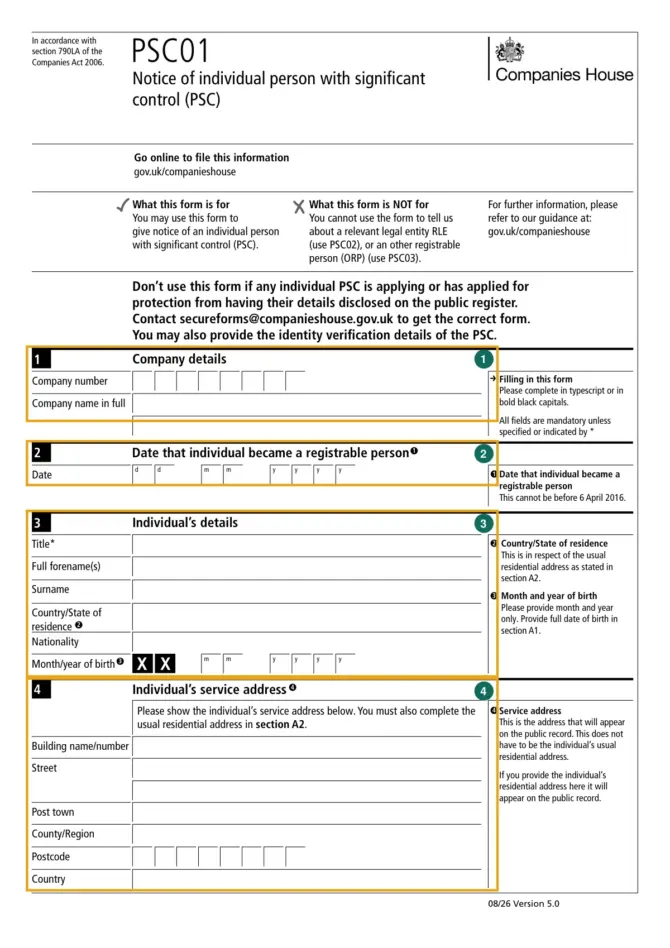
| Section | What goes in | Detail from the form |
|---|---|---|
| 1 | Company number and company name in full | Both as held on the public register |
| 2 | Date the individual became a registrable person | Day, month, year; no earlier than 6 April 2016 |
| 3 | Title, full forenames, surname, country or state of residence, nationality, month and year of birth | The day of birth boxes are pre-printed with X; the full date goes in A1 |
| 4 | Service address: building name or number, street, post town, county or region, postcode, country | Published; it does not have to be the home address |
Country or state of residence in section 3 refers to where the individual lives, the address given in A2, not the service address. For nationality, the PSC01 page on GOV.UK points to the Companies House list of nationalities and countries and says only entries from that standard list are accepted.
Section 4 is the correspondence address that appears publicly. If you write the person’s home address there, the home address becomes public. The page 6 checklist asks for a physical location: a PO Box number is accepted only as part of a full service address, and DX or LP (Legal Post in Scotland) numbers are not accepted.
Pages 2 and 3: the details kept off the register
Both pages carry the banner “This page is not shown on the public record” and a barcode that must not be covered. Page 6 confirms the exceptions to publication: the usual residential address, the day of birth and the identity verification details.
A1 and A2
A1 takes the full date of birth. A2 is the usual residential address. You may write “Same as service address” when the two are identical, but not when section 4 gives the service address as “The Company’s Registered Office”; in that case the home address is written out in full. A2 cannot be a PO Box, DX or LP number.
A3, the section 790ZF exemption
A3 asks whether the individual has applied to protect their details. Its single tick box is for someone applying for, or already granted, an exemption from the registrar disclosing their usual residential address to credit reference agencies under section 790ZF. Ticking it changes where the form is posted (see below). If the exemption application is being made with PSC01, the two must travel in the same envelope. The margin note suggests checking that the home address has not been entered in section 4, where it would be published.
A4 and A5, identity verification
A4 is completed only if the PSC has already verified their identity with Companies House and shared their personal code with the company. Tick the statement that the person has verified their identity in accordance with the Companies Act 2006 (the margin cites section 1110A) and copy the 11-character Companies House personal code into the boxes. A5 asks whether the name on the form matches the verified name. If not, tick one reason: legally changed name, preferred name, translation or a different naming convention, or prefer not to say. A5 is marked as non-statutory, and Companies House may contact you if the names differ.
Leaving A4 blank does not stop the filing; page 1 says only that you may also provide the verification details. The PSC still has to supply the code. According to the GOV.UK page on when to verify, someone who became a PSC after 18 November 2025 can give the code when first added to the register or within 14 days of being added, using the “Provide identity verification details for a PSC” service. A person who is also a director of the same company provides the code separately for each role. No verification is needed for a PSC who has died.
Sections 5 to 7: nature of control
Section 5 describes the individual’s own control and is ticked for each condition that applies. Share ownership and voting rights each have three bands, and only one band is ticked per condition:
| Band on the form | Example |
|---|---|
| More than 25% but not more than 50% | 30 of 100 voting shares |
| More than 50% but less than 75% | 60 of 100 voting shares |
| 75% or more | 100 of 100 voting shares |
The fourth statement in section 5, significant influence or control, is ticked only if none of the first three apply: shares, votes or the right to appoint or remove a majority of the board. The GOV.UK guidance says this condition applies only in limited circumstances, for example someone who influences or controls what the directors or shareholders do, and refers to the full PSC guidance for its meaning.
Section 6 is for an individual who has the right to exercise, or actually exercises, significant influence or control over a firm that is not a legal person under its governing law, where the firm’s members hold shares, votes, board appointment rights or significant influence in the company. Section 7 repeats the same four statements for the trustees of a trust the individual influences or controls. In both sections the share and voting statements again allow one band each. The GOV.UK guidance recommends reading the full PSC guidance and seeking professional advice where a trust or firm may be involved.
Section 8 confirmation date, the 14 days and authentication
Section 8 is the date the company had confirmation of the person’s status as a PSC and of all their required particulars. When those two confirmations arrive on different days, enter the later one. This is the date the deadline runs from: section 790LA(3) gives the company 14 days beginning with that day to deliver the notice. The section 2 date, when the person actually became registrable, can be earlier.
Before PSC01 is sent, the company must have obtained confirmation from the individual that their particulars are correct. The GOV.UK guidance lists what the company confirms with the PSC: name, date of birth, nationality, country of residence, service address, home address, the date they became a PSC, the date they confirmed their details and each nature of control that applies.
Section 9 is a printed name with no signature. The form may be authenticated by a director, secretary, person authorised under section 270 or 274 of the Companies Act 2006, administrator, administrative receiver, receiver, receiver manager, charity commission receiver and manager, CIC manager or judicial factor. For a UK Societas, delete “director” and state which organ of the UKS the authenticating person belongs to.
Where to send PSC01
The PSC01 page on GOV.UK links to the online service at ewf.companieshouse.gov.uk and says paper forms sent by post take longer to process. Print the PDF at full size on white A4 paper. Some forms can also go through the “Upload a document to Companies House” service. The form is supplied free of charge and has no fee section.
| Situation | Postal address printed on page 6 |
|---|---|
| Ordinary PSC01, for a company registered in England and Wales, Scotland or Northern Ireland | Companies House, Crown Way, Cardiff, CF14 3UZ (DX 33050 Cardiff) |
| A3 ticked: section 790ZF exemption applied for or granted | The Registrar of Companies, PO Box 4082, Cardiff, CF14 3WE (the whole form) |
Post sent to the wrong address may be redirected and take longer to arrive. GOV.UK records that the postal address was added to the form on 2 September 2026. The presenter box on page 6 is optional; filling it in helps Companies House with queries, and those contact details become visible to searchers.
Official PDF: PSC01 — Official PDF (assets.publishing.service.gov.uk)
Before PSC01 goes in the post
Companies House may return forms completed incorrectly or with information missing. Its page 6 checklist comes down to these points:
- Company name and number agree with the public register.
- Section 2 has the date the individual became registrable.
- Section 3 and pages 2 and 3 carry the individual’s details.
- Every address is a physical location, with no DX or LP number.
- At least one nature of control is ticked in section 5, 6 or 7.
- Section 8 has the confirmation date.
- Section 9 has a printed name.
When the same individual later stops meeting the conditions, the register is updated with PSC07, notice of ceasing to be a person with significant control.
Questions about PSC01
Can the PSC’s service address be the company’s registered office?
The A2 note expects that case: where section 4 says “The Company’s Registered Office”, the usual residential address in A2 must be written in full, not as “Same as service address”.
Will the PSC’s date of birth be public?
The month and year from section 3 are published. The full date in A1 sits on a page that is not shown on the public record, and page 6 lists the day of birth among the details kept off it.
Does PSC01 have to wait until the PSC has a personal code?
A4 is filled in only if the PSC has verified and shared the code, so the form can be sent without it. A PSC added after 18 November 2025 then has 14 days from being added to provide the code through the Companies House service.
Sources
- Companies House, PSC01 Notice of individual person with significant control (PSC), 08/26 Version 5.0
- GOV.UK, Give notice of individual person with significant control (PSC01), last updated 2 September 2026
- GOV.UK, People with significant control (PSCs), last updated 30 July 2026
- GOV.UK, When you need to verify your identity for Companies House, last updated 30 July 2026
- GOV.UK, Nationalities and countries list
- legislation.gov.uk, Companies Act 2006, section 790LA