PSC05 tells Companies House that something registered about a relevant legal entity (RLE) with significant control of your company has changed. That can be the RLE’s corporate or firm name, its principal office, its legal form or governing law, the register it is entered in and its number there, or the shares, votes and rights through which it controls the company. This guide follows version 4.0 of the form, dated 11/25 and issued under section 790LD of the Companies Act 2006.
Who uses PSC05, and for which changes?
An RLE is a corporate body or firm, so PSC05 asks for no date of birth, nationality or home address. Changes to an individual PSC go on PSC04. Changes to an other registrable person (ORP) go on PSC06. When the RLE no longer has significant control at all, the change is not a change of details: that is notified on PSC07.
A parent company that renames itself, moves its principal office, is entered in a different register or buys more shares in your company would report each of these on PSC05. Each PSC05 carries one date of change in section 3. List everything that changed on that date on the same form; a change on a different date needs its own PSC05.
When the change must be reported
Companies House’s PSC guidance says changes to PSC information, whether personal details or nature of control, must be notified within 14 days of confirming the change. The period runs from confirmation, and the form keeps the two dates apart. Section 3 is the day the change happened. Section 10 is the day the company had confirmation that there was a change, of how the details changed and of the date of the change.
The side note next to section 10 says confirmation must come from “the individual person with significant control”. That is the wording printed on this RLE form, while section 10 itself only asks for the date. Where you are unsure who should give confirmation for an entity, ask Companies House at enquiries@companieshouse.gov.uk before filing.
Filling in sections 1 to 6
Write in typescript or bold black capitals. Every field is mandatory unless the form says otherwise or marks it with an asterisk. Beyond sections 1 to 3, complete only the sections for the details that changed, then section 10 and section 11.
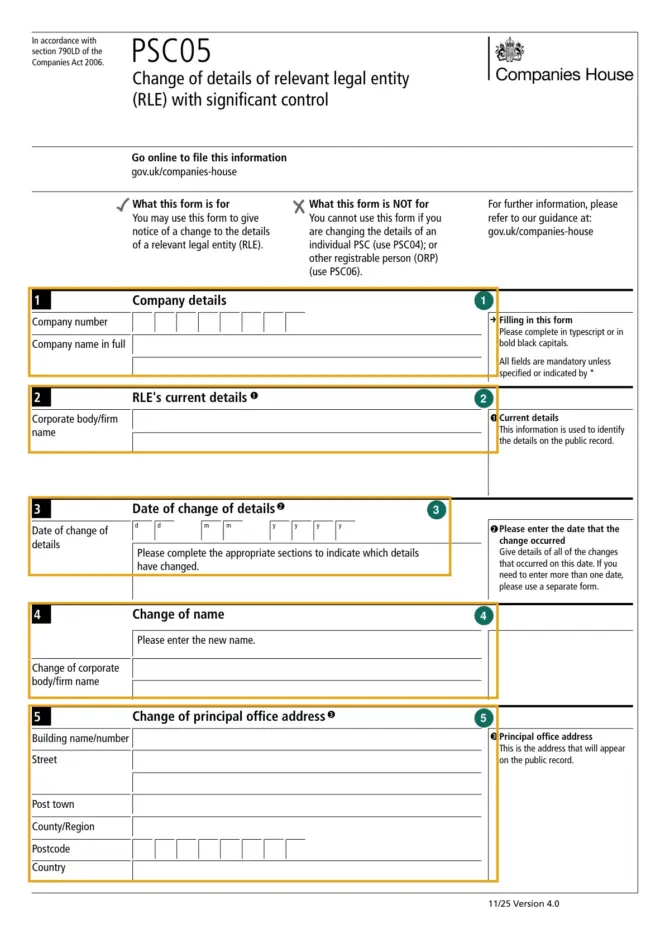
| Section | What to enter | Where to take it from |
|---|---|---|
| 1 | Company number and company name in full | Your company’s entry on the public register |
| 2 | The RLE’s corporate body or firm name as currently registered | The existing PSC record; Companies House uses it to find the entry to change |
| 3 | Date of change, day, month and year | The date the change took effect |
| 4 | New corporate body or firm name | The RLE’s own change-of-name record |
| 5 | New principal office: building, street, post town, county or region, postcode, country | The address that will appear on the public record |
| 6 | New legal form, governing law, register and country or state, registration number | The RLE’s registration in its home register |
After a rename, section 2 still takes the old name, the one Companies House already holds; the new name goes in section 4. If the RLE renamed itself and moved office on the same day, complete sections 2, 3, 4 and 5 on one form.
Section 6 covers four items: legal form, governing law, the register in which the RLE is entered, and its registration number. The register entry is marked “if applicable”. The side note adds a condition: once you give a register and its country or state, the registration number in that register must be given too. An RLE that is now entered in a different register therefore gives the register, its country or state and the new number together.
Recording the RLE’s control in sections 7 to 9
Section 7 shows how the RLE now controls your company. For shares and for voting rights there are three bands each, tick only one per category: more than 25% but not more than 50%, more than 50% but less than 75%, and 75% or more. A further box covers the right to appoint or remove a majority of the board. The significant influence or control statement is ticked only when none of the other three applies.
Tick the new conditions and also the ones that continue. Suppose an RLE raises its shareholding from 45% to 80% but keeps the same 45% of votes: section 7 shows the 75% or more share band and the more than 25% but not more than 50% voting band, not the share change alone.
Sections 8 and 9 apply only where the RLE has significant influence or control over a firm that is not a legal person under its governing law (section 8) or over a trust (section 9). Here the ticks describe what the firm’s members or the trustees hold in your company, using the same bands and the same rule of marking continuing conditions. Companies House’s guidance says this route applies only in limited circumstances and points to the full PSC guidance and professional advice where it might apply.
Authentication, the public record and where PSC05 goes
Section 11 takes the printed name of the person authenticating the form; a signature is not needed. The form lists who may do this: a director, secretary, person authorised under section 270 or 274 of the Companies Act 2006, administrator, administrative receiver, receiver, receiver manager, Charity Commission receiver and manager, CIC manager or judicial factor. For a Societas Europaea, “director” is deleted and replaced by the organ of the SE the person belongs to.
PSC05 has no private page. Everything on it appears on the public record, including the presenter details if you fill them in. The presenter box asks for a contact name, company name, address, post town, county or region, postcode, country, DX and telephone, and helps Companies House if it has a query about the form.
The PSC05 publication page links the online service for updating PSC information and says paper forms sent by post take longer. Print paper copies at full size on white A4. The form also mentions that certain forms can be uploaded to Companies House.
The form sends you to gov.uk/companies-house/offices for the postal address. Companies House’s office page says all documents go to the Cardiff main office, whether the company is registered in England and Wales, Scotland or Northern Ireland: Companies House, Crown Way, Cardiff, CF14 3UZ, or DX 33050 Cardiff. A stamped addressed envelope with a copy of your covering letter gets you an acknowledgement of receipt, which does not mean the change has been registered.
Official PDF: PSC05 — Official PDF (assets.publishing.service.gov.uk)
The page 5 checklist
Companies House says it may return forms that are completed incorrectly or have information missing. Before posting or uploading, check the points it lists:
- company name and number match the public register
- section 3 shows the date of change of details
- the sections for the details that changed are completed
- section 11 carries a printed name