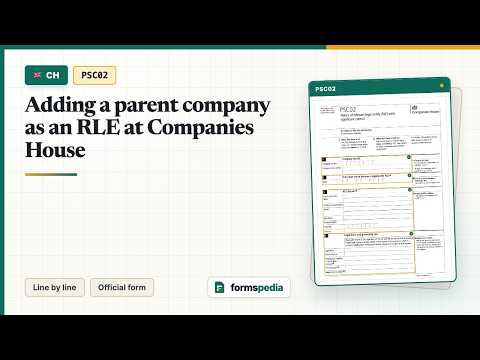
When the shares or votes in a UK company are held by another company rather than by a person, the Companies House register of people with significant control can show that corporate owner as a relevant legal entity (RLE). PSC02 is the paper notice that puts it there. The edition on GOV.UK is 11/25 version 4.0, issued under section 790LA of the Companies Act 2006: page 1 identifies the entity, pages 2 and 3 record how it controls the company, page 3 also carries the confirmation date and authentication, and page 4 is a checklist with optional presenter details.
When a corporate owner counts as a registrable RLE
An entity goes on PSC02 only if it is both relevant and registrable. The government’s PSC guidance (version 4, November 2025) calls a legal entity relevant when it meets at least one of the five control conditions and either has to report its own PSCs to Companies House, or has voting shares admitted to trading on a regulated market in the UK or the European Economic Area, or on specified markets in Switzerland, the USA, Japan or Israel. It is registrable when it is the first relevant entity in the chain of ownership above your company.
So a UK holding company that is itself under the PSC regime and holds more than 25% of your shares is reported as your RLE, and the people who own that holding company are not reported in relation to your company. The guidance makes one exception: an individual who holds shares in your company directly as well as through the holding company is also reported as a PSC if the two interests added together meet a condition. That individual goes on PSC01; the holding company still goes on PSC02.
Some owners can never be named on PSC02. The guidance gives these examples:
- an overseas company without voting shares on one of the markets above, which includes a foreign parent of a UK company and an overseas entity on the Companies House Register of Overseas Entities
- FCA-registered mutuals and investment vehicles without such shares
- Charity Commission registered entities such as charitable incorporated organisations
- a trust, because it is a legal arrangement and not a legal entity
Behind an entity that is not an RLE, you look further up the chain for an individual or a registrable RLE holding a majority stake in it, for example a majority of its voting rights or the right to appoint or remove a majority of its board. A government or government department, an international organisation or a corporation sole is reported as an other registrable person on PSC03.
Who sends PSC02, and the 14-day time limit
The notice comes from the company that is controlled, not from the RLE. From 6 April 2016 until 17 November 2025 most companies also kept their own PSC register; that local register was abolished from 18 November 2025, and Companies House now holds the PSC register for each company. What remains is the duty in section 790LA to notify the registrar.
Section 790LA(3) allows 14 days, beginning with the day on which the company had confirmation of both the entity’s status as a registrable RLE and its required particulars. Section 8 of the form records that confirmation day, so the 14 days run from the section 8 date, which can be later than the section 2 date on which the entity became registrable. No PSC02 is needed for an entity named in the statement of initial significant control on the company’s incorporation application, as long as the company has no cause to believe it has since stopped being registrable (section 790LA(4)).
Obtaining that confirmation is the company’s task. The guidance says the company must send a notice within 14 days of knowing, or having cause to believe, that an entity is a registrable RLE, and the recipient must reply within one month of receiving it. Not replying without a reasonable excuse is a criminal offence. After a warning notice, the company can restrict the interest, which means, among other effects, that the interest cannot be sold or transferred and no rights attached to it can be exercised.
Companies whose own voting shares are traded on a regulated market in the UK or the EEA, or on the specified overseas markets, do not report PSCs to Companies House at all, and nor do overseas companies operating through a UK establishment. When an RLE already on the register later stops being registrable, the change is filed on PSC07, notice of ceasing to be a person with significant control, within 14 days of the company having confirmation of it.
How to fill in PSC02 section by section
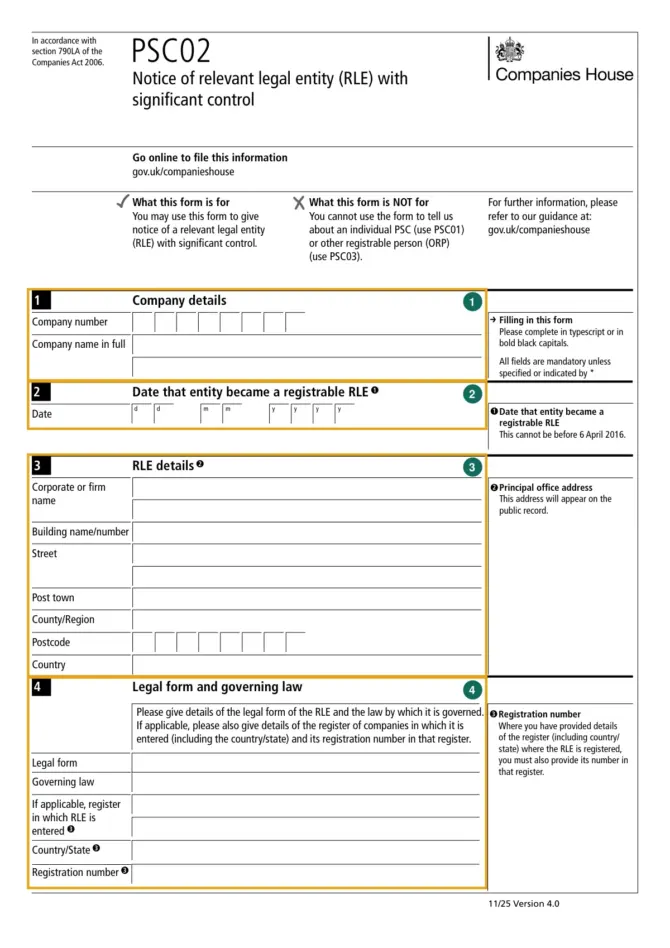
Use typescript or bold black capitals. Every field is mandatory unless the form says otherwise or marks it with an asterisk, and everything written on the form, including the RLE’s principal office address, will appear on the public record. Page 1 covers sections 1 to 4.
| Section | What to enter | Point to watch |
|---|---|---|
| 1 Company details | Company number and full name of the company being controlled. | Both must match the public register. |
| 2 Date entity became a registrable RLE | Day, month and year. | Cannot be earlier than 6 April 2016. |
| 3 RLE details | Corporate or firm name, then the principal office address: building name or number, street, post town, county or region, postcode and country. | A physical location. A PO Box (unless part of a full service address), DX or LP number is not accepted. |
| 4 Legal form and governing law | Legal form, governing law and, if applicable, the register the RLE is entered in, its country or state and its registration number. | Naming a register means the number in that register must be given too. |
| 5 Nature of control for the RLE | Share band, voting band, board appointment right, significant influence or control. | Tick each that applies; the fourth statement only if none of the first three does. |
| 6 Control through a firm | The same four statements, held by the members of a firm the RLE controls. | Only for a firm that is not a legal person under its governing law. |
| 7 Control through a trust | The same four statements, held by the trustees of a trust the RLE controls. | Only where the RLE controls the trust’s activities. |
| 8 Confirmation date | Date the company had confirmation of the RLE’s status and of all its required particulars. | If those came on different days, the later one. |
| 9 Authentication | Printed name of the person authenticating. | No signature is needed. |
Section 4 asks for details the company may need from the RLE itself. Footnote 16 of the guidance says the register must be given whether it is in the UK, for example the Charity Commission register, or abroad, such as another country’s central register of companies. For a UK holding company that register is Companies House, and the registration number is its company number.
Take Ashgrove Holdings Ltd, a UK private company, holding 600 of the 1,000 issued £1 ordinary shares in Ashgrove Joinery Ltd. In section 5 it falls in the “more than 50% but less than 75%” share band. Its voting band comes from the votes attached to those shares under the Joinery company’s articles. Because condition (i) is met, the guidance says the company does not have to work out whether condition (iv), significant influence or control, also applies. Sections 6 and 7 stay blank unless a firm or trust is involved.
Section 9 can be authenticated by a director, secretary, person authorised under section 270 or 274 of the Act, administrator, administrative receiver, receiver, receiver manager, charity commission receiver and manager, CIC manager or judicial factor. For a Societas Europaea, “director” is deleted and the organ of the SE that the person belongs to is written in. The note beside section 9, worded for an individual PSC, says confirmation that the particulars are correct must be obtained before the form is sent.
Choosing the nature of control in sections 5 to 7
The share and voting statements cover holdings held directly or indirectly, and for each you tick one band only: more than 25% but not more than 50%, more than 50% but less than 75%, or 75% or more. The guidance measures a shareholding by the nominal value of all issued shares, leaving out shares never issued and shares bought back and cancelled. Voting rights come from the company’s articles, which may give some classes no vote or more than one vote per share.
The board statement asks whether the RLE can appoint or remove directors holding a majority of the voting rights at board meetings. Where directors have unequal votes or someone has a casting vote, the guidance points to the articles to decide who could carry a board vote on all or substantially all matters.
Sections 6 and 7 are for control that runs through a firm or a trust. The RLE must have the right to exercise, or actually exercise, significant influence or control over the firm’s or trust’s activities, and the firm’s members or the trust’s trustees, acting as such, must meet one of the four conditions in your company. In the guidance a firm is an entity without legal personality under its own law, such as an English limited partnership; LLPs and Scottish limited partnerships have legal personality and are not firms. Each section has the same pattern as section 5: one band per share or voting statement, the board statement, and the influence statement ticked only when nothing else in that section applies.
Identity verification and the RLE’s officers
Since 18 November 2025 every individual PSC has to verify their identity with Companies House and give a Companies House personal code. That duty does not reach an RLE’s people yet. Paragraph 4.7.10 of the guidance says identity verification does not yet apply to relevant officers of registrable RLEs, and Companies House’s page on when to verify lists officers of corporate PSCs among the roles it will bring in at a later date. PSC02 version 4.0 accordingly has no box for a personal code.
An individual reported on PSC01 next to the RLE, such as the shareholder holding a direct and an indirect stake described above, is covered. Someone who became a PSC after 18 November 2025 can give the code when first added to the register or within 14 days of being added.
Page 4 checks before the form goes in
Companies House says it may return forms completed incorrectly or with information missing. The page 4 checklist asks you to confirm that:
- the company name and number match the public register
- section 2, the date the entity became a registrable RLE, is completed
- all applicable RLE details in sections 3 and 4 are completed
- addresses are physical locations, not a PO Box (unless part of a full service address), DX or LP number
- the nature of control is shown
- the form is authenticated
The presenter box on page 4 is optional. Companies House uses those details if it has a query about the form, and they can be seen by anyone searching the public record.
Filing online or posting the paper PSC02 to Cardiff
The PSC02 publication page, last updated on 18 November 2025, links to the four-page PDF and to the WebFiling service for updating PSC information. Companies House recommends the online route because paper forms sent by post take longer to process. The page sets no limit on who may use the paper form; it does require printing at full size on white A4 paper.
Paper notices for companies registered in England and Wales, Scotland and Northern Ireland all go to the main office:
Companies House
Crown Way
Cardiff
CF14 3UZ
DX 33050 Cardiff
The office is not open to the public, and documents left in its external post box get no receipt. Companies House will acknowledge a posted document if you include a stamped addressed envelope and a copy of your covering letter, though that only shows the document arrived, not that it has been registered. The Companies House office page also asks for the full company name and number, without abbreviations, on everything sent.
Other PSC forms
- PSC01: an individual person with significant control
- PSC03: an other registrable person, such as a government body or corporation sole
- PSC05: a change to the details of an RLE already on the register
- PSC07: an individual, RLE or other registrable person ceasing to have significant control
Sources
- PSC02, notice of relevant legal entity (RLE) with significant control, 11/25 version 4.0, Companies House
- Give notice of relevant legal entity with significant control (PSC02), GOV.UK
- Register of people with significant control: guidance for PSCs, version 4, November 2025
- People with significant control (PSCs), GOV.UK
- When you need to verify your identity for Companies House, GOV.UK
- Give notice of change of details for relevant legal entity with significant control (PSC05), GOV.UK
- Give notice of ceasing to be a person with significant control (PSC07), GOV.UK
- Companies House office access and sending post, GOV.UK
- Companies Act 2006, section 790LA, legislation.gov.uk