Form FIE-V is the paper slip a bank or other financial institution puts in the envelope when it mails a check for Alabama financial institution excise tax. It goes with a payment of less than $750 toward Form ET-1, the single-entity return, or Form ET-1C, the consolidated return, and with estimated and extension payments. The Alabama Department of Revenue lists the voucher under form year 2026; the 2026 ET-1 instructions explain that the 2026 form is used for calendar, fiscal or short years that begin in 2025.
Who mails Form FIE-V and who has to pay electronically
The voucher prints the rule in its “Who must file” paragraph: a taxpayer that owes less than $750 on an ET-1 or ET-1C and does not pay electronically completes Form FIE-V and sends it with the payment. The same paragraph extends the requirement to every estimated tax payment and every extension payment of this tax mailed on paper. The ET-1 instructions put it the other way round: any excise tax payment mailed to the Department must be remitted with Form FIE-V.
Section 41-1-20 of the Code of Alabama requires electronic payment for any single business tax payment of $750 or more, and the voucher warns of substantial penalties for not doing so. A payment of that size never goes on paper, so it never needs Form FIE-V. The voucher also says not to send it when no payment is due, or when the payment was already made electronically.
The tax itself is imposed by Section 40-16-4 on institutions that meet the definition in Section 40-16-1: national banking associations, banks, trust companies, industrial or other loan companies, building and loan associations and others employing moneyed capital in competition with national banks. The ET-1 instructions add that simply lending money does not make a taxpayer a financial institution. A business corporation paying corporate income tax on Form 20C uses a different voucher, Form BIT-V.
How to fill out the FIE-V voucher
The fillable part is the lower third of the page, below the dashed line. The numbers in the image are added for this guide; the voucher itself does not number its fields. M marks the two mailing addresses printed in the upper half.
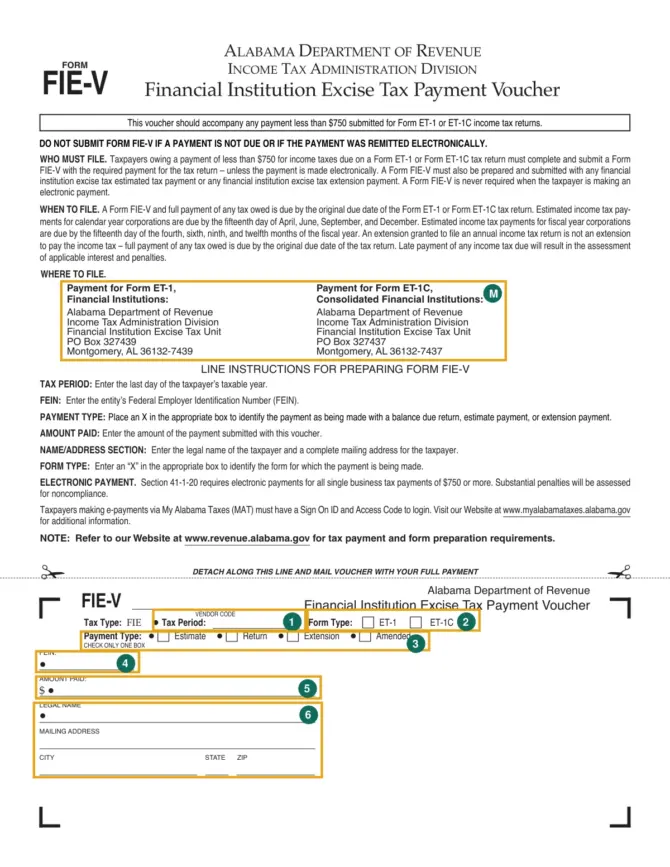
| Marker | Field on the voucher | What to enter |
|---|---|---|
| 1 | Tax Period | The last day of the institution’s taxable year, for example December 31, 2025 for a calendar-year 2025 return. |
| 2 | Form Type: ET-1 or ET-1C | An X in the box for the return the payment belongs to. ET-1C is for a consolidated group that has elected to file on a consolidated basis. |
| 3 | Payment Type | One box only: Estimate, Return, Extension or Amended. |
| 4 | FEIN | The entity’s federal employer identification number. |
| 5 | Amount Paid | The amount of the check or money order in the envelope. On a balance-due return this matches line 21 of the ET-1 or line 7 of the ET-1C. |
| 6 | Legal name, mailing address, city, state, ZIP | The taxpayer’s legal name and full mailing address. |
The tax type is preprinted as FIE, so there is nothing to choose there. The line instructions describe the payment type boxes as identifying a balance-due return, an estimate or an extension payment; they say nothing about the Amended box, and nothing about the Vendor Code line above Tax Period.
For a consolidated group, the ET-1C instructions say all payments made for the group are credited to the account of the parent financial institution, so the FEIN and legal name on the voucher are the parent’s.
The PDF asks for the data to be keyed in, with a note not to handwrite anything. A green Print button at the top builds a two-dimensional barcode from the entries. The compatibility notice says the file should be saved first and opened in Adobe Reader or Acrobat, and that printing from the Menu or File command gives blank pages. If a required field is empty, the form lists what needs fixing before it lets you print.
When the payment is due
The voucher ties the balance payment to the original due date of the ET-1 or ET-1C and states that an extension to file is not an extension to pay. Late payment brings interest and penalties. The ET-1 and ET-1C instructions set the late payment penalty at 1% per month, up to 25%, with interest at the rate in Section 40-1-44.
The two instruction booklets describe the return due date differently, and neither prints a calendar date. The 2026 ET-1 instructions say the return is due one month after the due date of the corresponding federal return, including extensions, and that tax not paid by the unextended due date, “without the benefit of the additional one-month extension granted by Act 2022-53”, accrues interest. The 2026 ET-1C instructions describe the ET-1C as due on the same date as the federal return. Whether a balance is due on the federal date or a month later is not settled by the published text. The Financial Institution Excise Tax Unit answers questions at 1-800-322-4106 or 334-242-1170, option 6, from 8:00 a.m. to 5:00 p.m. Central time.
A paper payment under $750 counts as on time when the U.S. Postal Service cancellation is dated no later than midnight of the due date, according to the ET-1 instructions.
Estimated and extension payments
Under the ET-1 instructions, an institution with an Alabama liability of more than $500 pays estimated tax; the ET-1C instructions use “$500 or more” for a consolidated group. Each installment is 25% of the required annual payment, due on the 15th day of the 4th, 6th, 9th and 12th months of the taxable year. For a calendar year that is April 15, June 15, September 15 and December 15, the dates printed on the voucher. Each installment mailed under $750 takes its own FIE-V marked Estimate.
An installment paid late is charged interest at the federal underpayment rate under 26 U.S.C. § 6621 and the 10% penalty in Section 40-2A-11. Form 2220E is the form for claiming relief when the annualized or seasonal method was used, or when a large corporation based its first installment on the prior year’s tax. If the estimates fall short of the tax for the year, the remaining balance is due by the original due date of the return, and a mailed payment of that balance goes with a voucher marked Extension.
Where to download Form FIE-V and where to mail it
The voucher is on the Department’s forms page under Financial Institution Excise Tax, listed as Form FIE-V, Payment Voucher, 2026. The 2025 listing has a separate PDF whose instructions and addresses read the same. The address depends on the box marked at marker 2:
| Payment for | Mail to |
|---|---|
| Form ET-1, financial institutions | Alabama Department of Revenue, Income Tax Administration Division, Financial Institution Excise Tax Unit, PO Box 327439, Montgomery, AL 36132-7439 |
| Form ET-1C, consolidated financial institutions | Alabama Department of Revenue, Income Tax Administration Division, Financial Institution Excise Tax Unit, PO Box 327437, Montgomery, AL 36132-7437 |
Cut along the dashed line and send the voucher with the full payment. Make the check or money order payable to Alabama Department of Revenue and write the FEIN, the form number or payment type (for example ET-1, extension payment) and the tax year end on it. When the voucher travels with a paper return, the ET-1 instructions ask that the payment, the voucher and the return go loose in the envelope, not stapled or attached to each other.
What the 2026 return instructions list as new
The voucher has no “What’s New” section of its own. The 2026 ET-1 and ET-1C instructions each open with one, and both items concern payments:
- ET-1 instructions: a non-logged-in My Alabama Taxes (MAT) option lets institutions without a Department account make a payment. It asks for banking information, the filing period, the payment type and the FEIN or Alabama tax account number.
- ET-1C instructions: credit card payments through MAT for taxpayers who have an account.
The voucher’s own text still says MAT e-payments need a Sign On ID and Access Code.
Paying electronically instead of mailing a voucher
The ET-1 instructions name two electronic routes. MAT is reached from the MAT icon on revenue.alabama.gov, with technical help at 1-800-322-4106 or 334-242-1170, option 5. ACH Credit requires approval from the Department in advance through Form EFT:001, the EFT Authorization Agreement; its hotline is 1-877-256-2447 or 334-353-7659. After paying electronically, check the electronic payment indicator next to line 21 of the ET-1 or line 7 of the ET-1C and leave the voucher out.
Questions about Form FIE-V
Is Form FIE-V required for a payment of exactly $750?
The voucher and Section 41-1-20 require electronic payment for $750 or more, so a $750 payment is made electronically and needs no voucher. One sentence in the ET-1C instructions says “over $750”, but the same booklet also uses “$750 or more”.
Does each estimated payment need a new voucher?
Each mailed estimated payment goes with a voucher marked Estimate, showing the tax period of the year being paid.
Which address does a consolidated group use?
Payments for Form ET-1C go to PO Box 327437, the address printed on the right side of the voucher. ET-1 payments go to PO Box 327439.
Official sources
- Alabama Department of Revenue, Form FIE-V, Financial Institution Excise Tax Payment Voucher (form year 2026)
- Alabama Department of Revenue, Forms: Financial Institution Excise Tax
- Alabama Department of Revenue, Form ET-1 instructions, 2026
- Alabama Department of Revenue, Form ET-1C instructions, 2026
- Alabama Department of Revenue, Form FIE-V (form year 2025)
- Alabama Department of Revenue, Form BIT-V, Business Income Tax Payment Voucher