An Arkansas offer in compromise is a request to the Department of Finance and Administration (DFA) to settle a state tax debt for less than the full amount. The request is made on the Offer in Compromise (OIC) Program Application, a six-page fillable PDF marked Revised 8/2026, which its own checklist calls Form 2000-4. It is issued under 26 CAR §§ 5-101 through 5-107 and Ark. Code Ann. § 26-18-705, and it goes to the OIC Program by email or mail together with federal financial statements and a set of attachments. An application that is missing any of them is withdrawn from review.
Who can apply, and when a payment plan is the answer instead
DFA’s Offers in Compromise page sets three conditions. You must be insolvent, the debt must be final, and it must be a debt you do not dispute. Insolvent has the meaning in 26 CAR § 5-101: you cannot pay your debts as they fall due in the usual course of business, or your debts are more than the reasonable market value of what you own. A debt is final when you can no longer challenge it by protesting with the Tax Appeals Commission or in court. Before applying you must also file every return or report you are required to file; if you are not required to file, the page asks you to say so on the application or checklist.
The page is direct about the odds. Settlements are approved only in extraordinary circumstances, acceptance is at the Department’s discretion, a lack of funds alone does not justify a compromise, and the offer has to reasonably reflect the most you are able to pay. DFA looks at your maximum current income and earning potential. There are no formal appeal rights if the offer is rejected.
If you cannot pay in full now but are not insolvent, DFA points you to a payment plan agreement instead. Interest keeps running during the installment period, DFA files a Certificate of Indebtedness (lien), and a default cancels the plan. You can ask the Collections Section at 501-682-5000 or 1-800-292-9829, or set up a payment agreement yourself in ATAP. Section 8 of the application asks you to explain why a payment plan will not work for you, so the two routes are compared on the form itself.
A request to remove only penalty and interest does not need the application. The checklist page says to email it to PRO.TaxInfo@dfa.arkansas.gov with your account or letter ID number, a contact phone number and an explanation of circumstances.
Take a business that has closed with sales tax periods unpaid. The owner fills in the sales tax permit number in section 4, checks Sales/Use Tax in section 6 and lists the months, and can attach a sales tax transcript showing all periods due instead of typing them out. The rules add that for sales, use or withholding tax the offer must state whether tax was collected but not remitted for those periods. The application has no separate box for it; its page 5 asks why the tax was not collected or paid for the periods in the offer.
How to complete Form 2000-4, section by section
The application has ten numbered sections on pages 1 to 4, an explanation page with a second signature block on page 5, and the attachment checklist with section-by-section instructions on page 6.
| Section | What it asks for | Who completes it |
|---|---|---|
| 1 | Name, home street address, city, state and ZIP, telephone, fax and email of the individual or primary business owner | Offers for an individual, a partnership or a closely held corporation |
| 2 | Business name, address, telephone and fax | Business debts: sole proprietorship, corporation, LLC, partnership or S corporation |
| 3 | Social Security numbers, primary and secondary | Individuals applying; both spouses if you file joint returns |
| 4 | Sales tax permit number | Sales tax offers; if you do not know the number, DFA gives 501-682-1895 |
| 5 | Up to two FEINs or other Arkansas tax permit numbers | Withholding, income or other tax offers |
| 6 | Boxes for individual income, withholding, sales/use and other taxes, with the years or months and years covered | Everyone; attach a page if you need more room |
| 7 | Every prior bankruptcy: date filed, docket number, date of discharge or dismissal | Everyone; write “NA” if there were none |
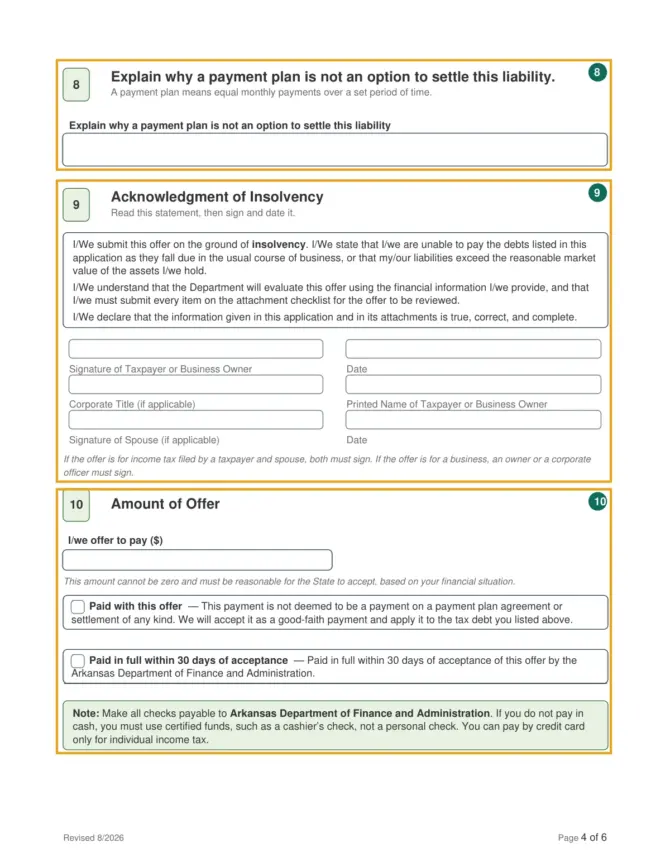
| 8 | Why a payment plan, meaning equal monthly payments over a set period, is not an option | Everyone |
| 9 | Acknowledgment of insolvency, signed and dated, with corporate title and printed name | Both spouses for a joint income tax debt; an owner or corporate officer for a business |
| 10 | The dollar amount offered and one of two payment boxes | Everyone; the amount cannot be zero |
The frames on the image mark sections 8, 9 and 10 on page 4.
Page 5, the explanation of circumstances, is required: the form says the offer will not be reviewed if it is left blank. It asks why the tax was not collected or paid for the periods in the offer. If any debt on your federal financial statements (IRS Forms 433-A, 433-B or 433-F) is owed to a family member, describe the debt and the relationship. Page 5 is signed and dated again, with a “Prepared by” line; if someone other than the taxpayer prepared the form, attach a power of attorney. DFA’s own Power of Attorney form is linked from the same page.
Section 10: the amount offered and how it is paid
The amount cannot be zero and must be reasonable for the State to accept based on your financial situation. If you leave it blank, the offer is treated as incomplete and withdrawn without review. You then check one box:
- Paid with this offer. DFA accepts the money as a good-faith payment and applies it to the tax debt listed; it is not treated as a payment on a payment plan or a settlement of any kind.
- Paid in full within 30 days of acceptance of the offer by DFA.
Checks are made payable to the Arkansas Department of Finance and Administration. If you do not pay in cash, you must use certified funds such as a cashier’s check; a personal check is not accepted. A credit card can be used only for individual income tax. The application does not give a separate payment address or explain how a card payment is made, so ask the OIC Program at (501) 682-7751 before paying that way.
Section 10 also asks where the money comes from, for example a bank loan or savings. The checklist on page 6 says to give it “in the space provided”, and page 4 says to list it “in box below in Item #10”, but the August 2026 PDF has no box or field for it under section 10. The form allows separate sheets in other sections; whether a sheet is acceptable here is a question for (501) 682-7751.
Signing page 5 also means agreeing that you stay responsible for the full liability until DFA accepts the offer in writing and you meet all its terms. The original amount stays on DFA’s records until then.
Attachments DFA requires
The checklist on page 6 is completed and sent with the application. Every item that applies to you must be included:
- The completed Form 2000-4.
- IRS Form 433-A or 433-F for an individual or sole proprietor, Form 433-B for a business, and both kinds for a partnership, single-member LLC or closely held corporation.
- Copies of your Arkansas and federal income tax returns for the most recent two years, if you have not filed them.
- Your last three pay stubs, or proof of other income such as a pension, Social Security, alimony or rent.
- Bank statements with check copies or images for the last 6 months, or 12 months if the tax due is over $25,000, plus statements for any other account you can write checks on.
- A credit report less than 30 days old.
- IRS documents if they apply: a copy of your IRS offer in compromise and acceptance letter, or other IRS arrangements.
- An affidavit about transfers of real and personal property within the last two years.
- Your most recent real and personal property tax assessments.
- If you went through bankruptcy, the order of discharge and a complete copy of the petition and schedules, with the statement of intent for Chapter 7.
- A power of attorney, if a representative is involved.
DFA can ask for more information after it receives the offer. If you are also negotiating with the IRS, the rules require the federal tax types, periods, amounts and the exact amount offered there; Formspedia explains the federal application in its guide to IRS Form 656.
What happens after the offer is filed
The rules in 26 CAR §§ 5-105 to 5-107 describe the effect of a decision:
- Acceptance or rejection is at the sole discretion of the Director, and a final decision is not subject to administrative or judicial review.
- Filing an offer does not stop the time limit for asking for administrative or judicial relief under the Arkansas Tax Procedure Act for any period in the offer.
- An accepted compromise settles the entire liability for the tax type and period it covers. It can be reopened only for falsification or concealment of facts or assets, or for a mutual mistake of a material fact.
- Settling a civil liability does not settle a criminal liability for the same period.
The rules also allow a compromise when the controversy is over the amount of tax due, but the application and DFA’s page are written for insolvency offers on debts that are final and undisputed. A disputed assessment is challenged by protest with the Tax Appeals Commission or in court, as the page’s definition of a final debt shows.
Where to download and send the application
The OIC Program Application (Revised 8/2026) is listed on DFA’s Offers in Compromise page with the date 08/24/2026, next to the rules and the three federal 433 forms. Page 1 gives two ways to file:
| Method | Address |
|---|---|
| Email (preferred) | PRO.TaxInfo@dfa.arkansas.gov |
| Arkansas Department of Finance and Administration, OIC Program, P.O. Box 2717, Little Rock, AR 72203-2717 |
The Settlement or Compromise of Tax Liabilities Rules, dated 08/06/2026 on the same page, give a different address in 26 CAR § 5-103: the Office of Revenue Legal Counsel, P.O. Box 1272, Room 209, Little Rock, Arkansas 72203. The checklist tells you to email the package to the address on page 1. If you plan to mail it, the Problem Resolution and Tax Information Office can confirm the address at 501-682-7751, 8:00 a.m. to 5:00 p.m. Central time, Monday through Friday. This page explains the form; it is not advice on whether an offer suits your situation.
Questions about Arkansas offers in compromise
Can I file an offer while I am still protesting the assessment?
DFA’s page says the debt must be final, meaning you can no longer challenge it with the Tax Appeals Commission or in court, and it must be a debt you do not dispute.
Can I pay the offer amount with a personal check?
The application requires cash or certified funds such as a cashier’s check, payable to the Arkansas Department of Finance and Administration. A credit card is accepted only for individual income tax.
Is there an appeal if DFA rejects the offer?
DFA’s page says there are no formal appeal rights, and 26 CAR § 5-106 makes the Director’s final decision not subject to administrative or judicial review.