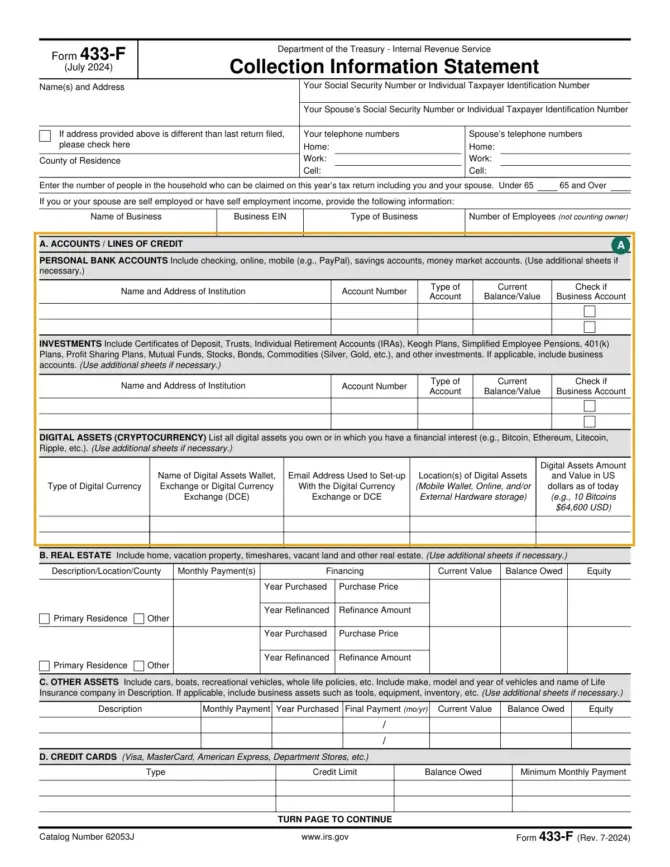
IRS Form 433-F is a Collection Information Statement. It gives the IRS a current view of assets, debts, income and necessary household expenses when it needs to determine how a wage earner or self-employed person can pay an outstanding tax liability. The July 2024 revision includes a separate table for digital assets.
When the IRS asks for Form 433-F
The IRS may direct an applicant who cannot make the minimum required installment payment to complete a financial statement. Follow the form and submission instructions given for your account. When the IRS calls for Form 433-F with a paper installment agreement request, include it with Form 9465 and the required financial records.
How to fill out Form 433-F
Enter the name, address and county, and check the address-change box if it differs from the last return. Give the taxpayer and spouse identification and contact numbers, and count household members who can be claimed by age group. For self-employment, include the business name, EIN, type and employee count excluding the owner.
| Section | What to report |
|---|---|
| A, accounts and investments | List bank and mobile payment accounts and investments, including applicable business accounts and accounts with no balance. Give institution and account details, type, current value and business-account status. Enter bank loans with the relevant debt or asset details rather than in the account list. |
| A, digital assets | Give each asset type, wallet or exchange name, email used with the exchange, storage location, amount and current U.S. dollar value. |
| B and C, property and other assets | List real estate, including your home, and other assets such as vehicles, whole life insurance and business equipment. Record payment, acquisition and financing details where requested. Equity is current market value less the amount owed. For a leased vehicle, enter “lease” in the year purchased column. |
| D, credit cards | List cards and lines of credit even with no balance. Give the type, limit, balance owed and minimum monthly payment. |
| E, business | List receivables by debtor, including government grants or contracts as applicable, and total what is available to pay the IRS now. If accepting credit cards or digital assets, give the relevant merchant or exchange details. |
| F, wages | Give employer name and address, pay frequency, gross pay and federal, state and local tax per pay period, and time at the job. Use an extra sheet for other employers. A current pay stub can replace the section under the form instructions. |
| G, non-wage income | Report monthly amounts including support, pensions, Social Security, interest and other income. Report self-employment and rental amounts net of qualifying cash expenses. Use zero for a net loss. Attach the current profit and loss information requested on the form. |
| H, necessary expenses | Give monthly actual amounts for food and personal care, transport, housing and utilities, medical costs and other necessary expenses. Use only the total for food and personal care when the form’s condition about the allowable standard applies. Keep real estate costs out of H if already included in B. |
Convert weekly expenses by multiplying by 4.3, biweekly by 2.17 and twice-monthly by 2. Divide quarterly bills by 3. Do not count depreciation as a rental cash expense. The instructions ask for Schedule C or a current profit and loss statement to substantiate net self-employment income.
Where to send the signed financial statement
Use the submission route the IRS gives for the payment-plan request. If filing it with Form 9465, follow the filing instructions for that request, which distinguish requests attached to a tax return from standalone requests. Sign and date the declaration and include the spouse’s signature when applicable. Keep a copy and supporting records. The IRS may ask for evidence of income or reported expenses after review.
Official PDF: Form 433-F — Official PDF (irs.gov)