Every domestic and foreign private foundation, along with every section 4947(a)(1) nonexempt charitable trust treated as a private foundation, files IRS Form 990-PF (Return of Private Foundation or Section 4947(a)(1) Trust Treated as Private Foundation) each year to report its revenue, expenses, grants, balance sheet, and investment excise tax. The return also tracks the 5% minimum investment return and mandatory qualifying distributions across Parts IX through XII, while screening for Chapter 42 excise tax triggers in Part VI-B. Once filed, the return and its schedules are open to public inspection under section 6104.
What changed on the 2025 Form 990-PF
The 2025 edition of Form 990-PF (created July 22, 2025) and its January 2026 instructions implement the federal transition from paper checks to electronic payment processing. Tax payments and refunds are processed electronically through IRS Direct Pay, the Electronic Federal Tax Payment System (EFTPS), Electronic Funds Withdrawal during e-filing, card or digital wallet, or direct deposit via Form 8050 (Direct Deposit of Corporate Tax Refund). The excise tax rate on net investment income for domestic foundations under section 4940(a) remains 1.39%, and the rate on U.S.-source gross investment income for exempt foreign foundations under section 4948 remains 4%. For 2025 returns, the gross receipts threshold for the higher daily late-filing penalty under section 6652(c) increased to $1,309,500 ($130 per day up to $65,000, compared with $25 per day up to $13,000 for smaller foundations).
Who must file Form 990-PF
Annual filing is required even if the foundation had zero revenue, held minimal assets, or made no grants. Under General Instruction A, Form 990-PF must be filed by:
- Tax-exempt private foundations under section 501(c)(3), including private operating foundations and exempt operating foundations
- Taxable private foundations whose exempt status was revoked without a section 507 termination
- Organizations agreeing to private foundation status with an exemption application pending on the Form 990-PF due date, or still within the timely filing window under section 508(a)
- Organizations that made an election under section 41(e)(6)(D)(iv)
- Private foundations completing a section 507(b) termination
- Section 4947(a)(1) nonexempt charitable trusts treated as private foundations under section 6033(d)
All financial activity and assets of any single-member LLC or other disregarded entity owned by the foundation must be consolidated into the foundation’s return.
Organizations that file a different return
Public charities excluded under sections 509(a)(1)–(4) file Form 990 (Return of Organization Exempt From Income Tax), Form 990-EZ, or Form 990-N (Electronic Notice (e-Postcard) for Tax-Exempt Organizations Not Required to File Form 990 or Form 990-EZ) with Schedule A (Form 990) (Public Charity Status and Public Support). A section 4947(a)(1) trust treated as a private foundation with zero Subtitle A taxable income may file Form 990-PF in lieu of Form 1041 (U.S. Income Tax Return for Estates and Trusts) by checking Part VI-A, line 15; if it owes Subtitle A tax, it files both forms. Taxable private foundations also file Form 1120 (U.S. Corporation Income Tax Return).
Recommended order for completing the parts
Because later schedules feed into Part I and Part V, General Instruction B recommends completing the form in this sequence:
- Complete the heading (Items A–H and J), complete Part II (Balance Sheets), enter Item I from Part II, line 16, column (c), and complete Part III (Changes in Net Assets).
- Complete Part IV (Capital Gains and Losses for Tax on Investment Income) so net capital gain flows to Part I, line 7, column (b) and net short-term capital gain flows to Part I, line 8, column (c).
- Complete Part I, columns (a) and (b), plus column (c) if required for a private operating foundation, a section 170(b)(1)(F)(iii) common fund foundation, or a foundation claiming net losses on a revenue-producing charitable activity.
- Complete Parts XV-A and XV-B, then Parts VI-A, VI-B, VII, VIII-A, and VIII-B.
- Complete Part XIV, lines 1–3b, and fill in Part I, column (d) on a strict cash basis.
- Complete Part IX (Minimum Investment Return), Part XI (Qualifying Distributions), Part V (Excise Tax Based on Investment Income), and Part X (Distributable Amount). Note that the Sequencing Chart in General Instruction B (page 2 of the 2025 instructions) refers to Part XI, lines 1–4 in Step 8 and Part XI, lines 5–6 in Step 10, whereas Part XI on the 2025 Form 990-PF and in the Specific Instructions contains only lines 1a–4.
- Complete Part XII (Undistributed Income) or Part XIII (Private Operating Foundations), complete Part XVI, and sign on page 13.
How to fill out Form 990-PF part by part
Round all entries to whole dollars, enter -0- where an amount is zero or where negative figures are barred, and never enter Social Security numbers on the return or attachments.
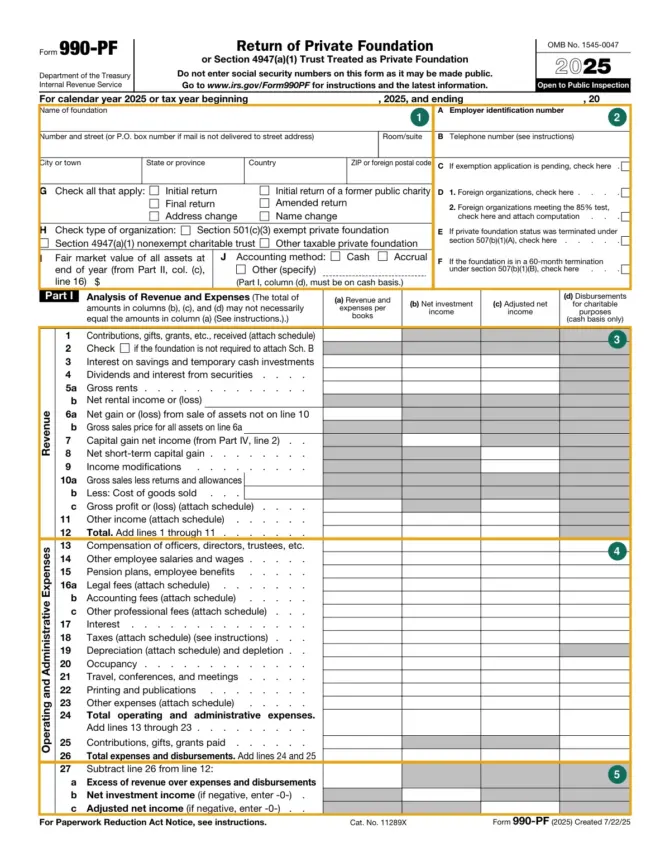
Heading and Items A through J (page 1)
In Marker 1, enter fiscal-year or short-year dates if not on the 2025 calendar year, followed by the foundation’s legal name and principal office address. For an address change, check Item G and file Form 8822-B. In Marker 2, enter the EIN in Item A and telephone number in Item B, and check Item C if an exemption application is pending. Check Item D1 if organized outside the United States; check Item D2 if meeting the 85% foreign support test under section 4948(b) (attach the support computation, check the Part X box, and skip Parts X, XII, and XIV, plus Part IX unless an operating foundation). Check Item E for a section 507(b)(1)(A) termination by distributing all net assets to 60-month public charities, or Item F for a 60-month termination under section 507(b)(1)(B) after advance notice on Form 8940 (Request for Miscellaneous Determination).
At the bottom of Marker 1, check all applicable boxes in Item G and the entity type in Item H. Enter ending asset fair market value from Part II, line 16, column (c) in Item I (required for every filer), and check the accounting method in Item J. Even if Accrual is checked in Item J, Part I, column (d) must be completed on the cash basis.
| Part I line | Line label on Form 990-PF | What to enter in columns (a), (b), (c), and (d) |
|---|---|---|
| Lines 1 and 2 | Contributions, gifts, grants, etc., received; Schedule B checkbox | Enter total contributions on line 1, column (a). Check line 2 if exempt from attaching Schedule B (Form 990) (Schedule of Contributors), generally required when any contributor gave $5,000 or more. Exclude gifts from column (b). |
| Lines 3, 4, and 5a–5b | Interest, dividends, and gross/net rents | Report savings interest on line 3 and dividends/bond interest on line 4 across columns (a)–(c), excluding section 103 tax-exempt interest from column (b). Enter gross rents on line 5a and net rental income or loss on line 5b. |
| Lines 6a–6b, 7, and 8 | Net gain/loss from asset sales, capital gain net income, and net short-term capital gain | Enter per-books net gain or loss from non-inventory sales on line 6a, column (a), and gross sales price on line 6b. Carry Part IV, line 2 to line 7, column (b) (minimum -0-) and Part IV, line 3 to line 8, column (c). |
| Lines 9, 10a–10c, 11, and 12 | Income modifications, gross profit on inventory, other income, and total revenue | Use line 9, column (c) for repayments of prior qualifying distributions and proceeds from charitable-use asset sales. Report net inventory profit on lines 10a–10c, other revenue on line 11, and total revenue on line 12. |
| Lines 13–15 and 16a–16c | Compensation, employee wages, benefits, and professional fees | Allocate officer compensation, wages, benefits, legal fees (16a), accounting fees (16b), and other professional fees (16c) across books in column (a), investment management in column (b), income production in column (c), and cash-basis charitable administration in column (d). Attach schedules for lines 16a–16c. |
| Lines 17–24 | Interest, taxes, depreciation/depletion, occupancy, travel, printing, other expenses, and total operating expenses | Report interest on line 17 (the 2025 Specific Instructions skip from line 16c directly to line 18 without a heading for line 17) and deductible taxes on line 18 (do not deduct section 4940 or section 511 tax in column (b)). Use only straight-line depreciation and cost depletion in columns (b) and (c) on line 19, limit business meals to 50% in column (b) on line 21, and sum lines 13–23 on line 24. |
| Lines 25, 26, and 27a–27c | Contributions, gifts, grants paid; total expenses and disbursements; net figures | Report grants paid on line 25 (column (d) on cash basis matching Part XIV, line 3a) and sum lines 24 and 25 on line 26. Subtract line 26 from line 12 to enter excess revenue on line 27a, net investment income on line 27b (minimum -0-), and adjusted net income on line 27c (minimum -0-). |
Part I notes and instruction cross-reference error (page 1)
Part I spans revenue (Marker 3, lines 1–12), operating expenses and grants (Marker 4, lines 13–26), and net totals (Marker 5, lines 27a–27c). No dollar of expense may be deducted in both column (b) and column (d). Note that in the Specific Instructions for Part I, line 14 (page 18), the IRS directs foundations using an employee leasing company or CPEO to report officer, director, trustee, and key employee compensation “in Part IV”; that is an official cross-reference typo, as Part IV covers capital gains while officer and key employee compensation is reported in Part VII on page 6.
Parts II, III, IV, and V: Balance Sheets, Capital Gains, and Investment Excise Tax (pages 2 and 3)
In Part II, report beginning book value in column (a), ending book value in column (b), and ending fair market value in column (c). Foundations whose assets reached $5,000 or more at any point during the year must complete all applicable lines and attach itemized schedules; foundations under $5,000 all year need only complete summary lines 16, 23, 29, and 30. Follow FASB ASC 958 on lines 24–25 or non-ASC 958 categories on lines 26–28, and reconcile net assets in Part III.
In Part IV, domestic foundations may aggregate sales of publicly traded securities on one row labeled publicly traded securities, while itemizing other capital sales. Columns (i)–(k) apply the December 31, 1969 fair market value step-up for pre-1970 holdings. Capital losses offset gains only down to -0- on line 2, with no carryback or carryover. Exempt foreign foundations skip Part IV.
In Part V, exempt operating foundations under section 4940(d)(2) check line 1a, enter their determination letter date, and enter N/A on line 1. Other domestic foundations multiply net investment income (Part I, line 27b) by 1.39% on line 1b, while exempt foreign foundations check line 1b and multiply U.S.-source gross investment income (Part I, line 12, column (b)) by 4%. Taxable foundations and section 4947(a)(1) trusts with Subtitle A tax complete lines 2 and 4. Report estimated tax payments on line 6a, withholding from Form 1042-S (Foreign Person’s U.S. Source Income Subject to Withholding), Form 8288-A (Statement of Withholding on Dispositions by Foreign Persons of U.S. Real Property Interests), or Form 8805 (Foreign Partner’s Information Statement of Section 1446 Withholding Tax) on line 6b, payments with Form 8868 on line 6c, backup withholding on line 6d, any Form 2220 (Underpayment of Estimated Tax by Corporations) penalty on line 8, and tax due or overpayment on lines 9–11. Quarterly estimated tax deposits are required via EFTPS (using Form 990-W (Estimated Tax on Unrelated Business Taxable Income for Tax-Exempt Organizations)) whenever expected annual tax is $500 or more.
Parts VI-A, VI-B, VII, and VIII: Compliance, Chapter 42 Triggers, and Governance (pages 4 through 7)
Part VI-A covers 16 activity questions, including political or lobbying activity (line 1), governing instrument changes requiring a conformed copy (line 3), unrelated business gross income of $1,000+ requiring Form 990-T (Exempt Organization Business Income Tax Return) (lines 4a–4b), liquidation or 25%+ substantial contraction (line 5), state Attorney General filings (lines 8a–8b), substantial contributors giving $5,000+ and over 2% of total gifts (line 10), controlled entities under section 512(b)(13) (line 11), donor-advised fund distributions (line 12), public inspection compliance (line 13), section 4947(a)(1) substitution for Form 1041 (line 15), and foreign accounts over $10,000 requiring FinCEN Form 114 (Report of Foreign Bank and Financial Accounts) (line 16).
Part VI-B screens for Chapter 42 excise taxes reported on Form 4720 (Return of Certain Excise Taxes Under Chapters 41 and 42 of the Internal Revenue Code): self-dealing under section 4941 (line 1), undistributed income under section 4942 (line 2), excess business holdings over the 20%/35% limits under section 4943 (line 3), jeopardizing investments under section 4944 (line 4), and taxable expenditures under section 4945 (line 5), including individual travel/study grants lacking advance approval on Schedule H (Form 1023) (Application for Recognition of Exemption Under Section 501(c)(3) of the Internal Revenue Code) or Form 8940, and grants requiring expenditure responsibility under Regulations section 53.4945-5(d). Lines 6–8 cover personal benefit contracts on Form 8870 (Information Return for Transfers Associated With Certain Personal Benefit Contracts), prohibited tax shelter transactions on Form 8886-T (Disclosure by Tax-Exempt Entity Regarding Prohibited Tax Shelter Transaction), and section 4960 compensation over $1,000,000.
Part VII lists all officers, directors, trustees, and managers regardless of pay (line 1), plus up to five non-officer employees (line 2) and five independent contractors (line 3) paid over $50,000. Parts VIII-A and VIII-B summarize the four largest direct charitable activities and current-year program-related investments (PRIs).
Parts IX, X, XI, and XII: Minimum Investment Return and Qualifying Distributions (pages 7 through 9)
| Form part | Core calculation | Key rules from the 2025 instructions |
|---|---|---|
| Part IX (Minimum Investment Return) | Net noncharitable-use assets multiplied by 5% (prorated by days for short tax years on line 6) | Average monthly fair market values of securities (line 1a) and cash (line 1b), add other noncharitable assets (line 1c), apply any supported blockage discount up to 10% (line 1e), subtract acquisition debt (line 2), and deduct 1.5% of net assets as cash deemed held for charitable activities (line 4). |
| Part X (Distributable Amount) | Minimum investment return minus Part V excise tax and income tax, plus recoveries | Operating foundations and section 4948(b) foreign foundations check the top box and skip Part X. For nonoperating foundations, line 7 is the payout required by the close of the following tax year. |
| Part XI (Qualifying Distributions) | Part I, line 26, column (d) plus Part VIII-B PRIs, charitable-use asset purchases, and set-asides | Up-to-60-month set-asides on lines 3a–3b require either advance IRS approval on Form 8940 (suitability test) or an attached startup distribution schedule (cash distribution test). |
| Part XII (Undistributed Income) | Allocation of 2025 qualifying distributions against 2024 undistributed income, prior years, corpus, and 2025 distributable amount | Distributions on line 4 apply first to remaining 2024 undistributed income on line 4a, then to earlier years (line 4b) or corpus (line 4c) only if a signed election statement is attached, and then to the 2025 distributable amount on line 4d. Excess distributions carry forward up to five years in column (a). |
Parts XIII, XIV, XV-A, XV-B, and XVI (pages 10 through 13)
Private operating foundations complete Part XIII across a four-year window to show they spent at least 85% of the lesser of adjusted net income or minimum investment return directly for active exempt conduct (lines 2a–2g) and met the 65% assets test, the two-thirds endowment test (3.33% of net investment assets), or the 85% support test (lines 3a–3c). Foundations with $5,000+ in assets complete Part XIV to disclose substantial-contributor or 10%-owner managers (line 1), grant application rules or the preselected-organizations checkbox (line 2), and itemized grants paid (line 3a) and approved for future payment (line 3b) using IRS recipient status codes (PF, POF, EOF, PC, GOV, SO-DP, SO I, SO II, SO III FI, SO III NFI, TPS, NC, or I). Parts XV-A and XV-B classify non-contribution revenue into unrelated business income, excluded income under sections 512–514 (exclusion codes 01–43), and exempt-function income. Part XVI reports transfers to and transactions over $500 with noncharitable 501(c) or 527 organizations, followed by the officer/trustee signature and paid preparer PTIN on page 13.
When and how to file Form 990-PF
File Form 990-PF by the 15th day of the 5th month after the tax year ends (May 15, 2026 for a calendar-year 2025 return), or by the 15th day of the 5th month after complete liquidation, dissolution, or termination. Submit Form 8868 by the regular due date for an automatic 6-month filing extension, and pay any Part V balance electronically by the original fifth-month deadline.
Electronic filing mandate and official mailing-address and payment gaps
Under section 6033(n) and General Instruction J, all 2025 Form 990-PF returns must be filed electronically through an IRS-authorized Modernized e-File (MeF) provider. E-file accepts only the current tax year and the two immediately preceding tax periods. Two inconsistencies in the 2025 official IRS publications affect paper filings and check instructions:
- General Instruction J (page 8) requires delinquent returns outside the three-year e-file window (such as 2020 and earlier returns after December 26, 2023) to be filed on paper with the top banner
The IRS no longer accepts electronic filing of the tax year 2020 returns after December 26, 2023, and Specific Instructions for Item A (page 14) direct filers with multiple EINs to write to the Internal Revenue Service Center “at the address shown under J. When and How To File, earlier.” However, neither General Instruction J nor the IRS page Where to file – Tax-exempt and government entities prints a postal address for Form 990-PF. Filers needing a paper routing address should call IRS Exempt Organizations Customer Account Services at877-829-5500. - Although What’s New (page 1), General Instruction P (page 9, which also mentions “See below for an exception to this rule for small foundations” with no exception text printed below), and Part V, line 11 (page 24) require electronic payment processing, the instructions for Part V, line 9 (page 24) retain an erroneous “To pay by check or money order” paragraph instructing the filer to write
2025 Form 1041on the check and mail it withForm 1041and Form 1041-V. Foundations should disregard that Form 1041 carryover and remit Part V balances electronically.
State Attorney General copy and public inspection rules
When filing with the IRS, send a copy of Form 990-PF (and any Form 4720) to the Attorney General of each state listed in Part VI-A, line 8a, the state of the principal office, and the state of incorporation. Under section 6104(d), keep the three most recent annual returns and the original exemption application (Form 1023 or Form 1024 and determination letter) available for public inspection and copying, or post complete copies free of charge on a public website, including all donor names and addresses on Schedule B (Form 990).
Common mistakes that trigger IRS notices or Chapter 42 excise taxes
Including accrued grants in Part I, column (d)
Grants approved by the board but unpaid at year-end belong in Part XIV, line 3b (Approved for future payment), not in Part I, line 25, column (d). Entering accrued grants in column (d) overstates Part XI qualifying distributions.
Claiming nondeductible taxes or unadjusted depreciation in Part I, column (b)
Do not deduct prior-year section 4940 excise taxes or section 511 unrelated business income taxes on Part I, line 18, column (b), do not claim more than 50% of business meals on line 21, column (b), and do not use accelerated depreciation or percentage depletion on line 19, columns (b) and (c).
Counting ineligible grants toward the 5% payout
Grants to controlled organizations, to other nonoperating private foundations (unless redistributed out of corpus within one year under section 4942(g)(3) with attached verification), or to non-functionally integrated Type III supporting organizations cannot be entered in Part I, line 25, column (d) or Part XI.
Applying distributions to corpus without attaching a formal election
Entering a distribution amount on Part XII, line 4b or line 4c without attaching a signed manager election statement under Regulations section 53.4942(a)-3(d)(2) causes the IRS to reallocate the payout automatically to lines 4a and 4d.
Leaving out expenditure responsibility statements or numeric weekly hours
Failing to attach a separate Regulations section 53.4945-5(d) statement for each grant covered by a Yes answer on Part VI-B, line 5c makes the grant a taxable expenditure under section 4945. Likewise, writing as needed instead of a numeric hour average in Part VII, column (b), or writing generic grant purposes like charitable grant in Part XIV, line 3a, triggers incomplete-return penalties under section 6652(c).
Frequently asked questions
Does a private foundation with zero revenue or less than $5,000 in assets still have to file Form 990-PF?
Yes. Every private foundation and section 4947(a)(1) trust treated as a private foundation must file Form 990-PF every year regardless of asset size or revenue; the Form 990-N e-Postcard is available only to qualifying public charities. Foundations whose total assets stayed under $5,000 all year may complete only summary lines 16, 23, 29, and 30 in Part II and skip Part XIV, but must complete the rest of the return and report ending asset fair market value in Item I.
Are donor names and addresses on Schedule B (Form 990) public for a private foundation?
Yes. The contributor redaction rule under section 6104 that shields donor identities on public charity returns does not apply to private foundations. All contributor names, addresses, and gift amounts on Schedule B (Form 990) attached to Form 990-PF must be included in public inspection copies.
What is the penalty for filing Form 990-PF late or filing an incomplete return?
Under section 6652(c), the IRS assesses $25 per day (up to the lesser of $13,000 or 5% of gross receipts), or $130 per day (up to $65,000 or 5% of gross receipts) if annual gross receipts exceed $1,309,500. Responsible managers who fail to cure a delinquent or incomplete return after written IRS demand owe $10 per day up to $6,500, and failing to file for three consecutive years results in automatic revocation of exempt status under section 6033(j).
How long does a private foundation have to distribute its Part X distributable amount?
A nonoperating private foundation has until the end of the following tax year (December 31, 2026 for a calendar-year 2025 return) to pay out its Part X, line 7 distributable amount in qualifying distributions. Any portion of the prior year’s distributable amount still undistributed at the end of the current year is subject to a 30% initial excise tax under section 4942 on Form 4720.
Official sources
- IRS About Form 990-PF, Return of Private Foundation or Section 4947(a)(1) Trust Treated as Private Foundation
- IRS Form 990-PF (2025 PDF)
- IRS Instructions for Form 990-PF (2025 HTML)
- IRS Instructions for Form 990-PF (2025 PDF, revised January 15, 2026)
- IRS Where to File – Tax-Exempt and Government Entities