Form 1041-A is the information return a trustee files for a trust that claims a charitable deduction under section 642(c). It reports the trust’s income and deductions, what was set aside or paid out for charitable purposes, and a two-column balance sheet. The form has no tax computation lines; it reports the charitable information required by section 6034.
Which trusts file Form 1041-A
The instructions printed with the form say the trustee must file Form 1041-A for a trust that claims a charitable or other deduction under section 642(c), unless one of these exceptions applies:
- the trust must distribute all of its income for the year currently to the beneficiaries, as determined under section 643(b)
- it is a charitable trust described in section 4947(a)(1)
- for tax years beginning after 2006, it is a split-interest trust described in section 4947(a)(2)
- it is an electing small business trust (ESBT) described in section 641(c)
Split-interest trusts described in section 4947(a)(2) file Form 5227, Split-Interest Trust Information Return, instead. That form meets the section 6034 requirement for them. The trust’s income tax return is a separate filing; Part I of Form 1041-A points to the instructions for Form 1041 or Form 5227 for the income and deduction amounts.
What changed on the current revision
The form’s What’s New section covers one change: the Tax Cuts and Jobs Act of 2017 (P.L. 115-97) amended section 641(c)(2), so ESBTs are no longer subject to the charitable information reporting requirement under section 6034 and do not file Form 1041-A.
The revision date is September 2018, and that is still the current one. The IRS About Form 1041-A page, last reviewed on March 30, 2026, links this PDF as the current revision and lists no recent developments. The header leaves the year blank (“For calendar year 20”) for the trustee to complete.
How to fill out Parts I to III
Enter the name of the trust, its employer identification number, the trustee’s name and the trustee’s address at the top. The numbered lines then follow three parts.
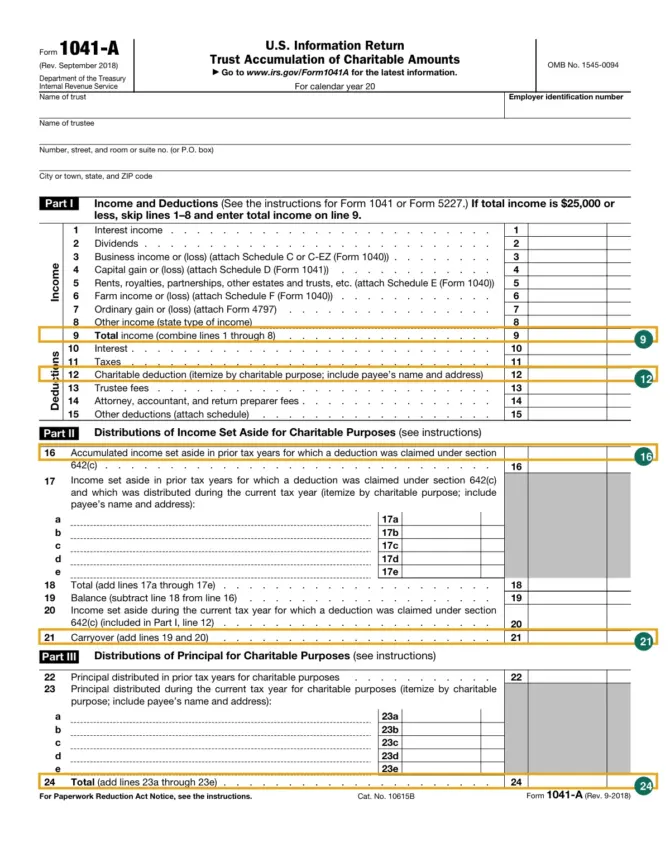
| Line | What goes on it |
|---|---|
| 1 to 8 | Income by type: interest, dividends, business income (Schedule C), capital gain or loss (Schedule D (Form 1041)), rents, royalties, partnerships and other estates and trusts (Schedule E), farm income (Schedule F), ordinary gain or loss (Form 4797), and other income with its type stated. |
| 9 | Total income. If it is $25,000 or less, skip lines 1 to 8 and enter only the total here. |
| 10 to 15 | Deductions: interest, taxes, the charitable deduction on line 12 itemized by charitable purpose with each payee’s name and address, trustee fees, attorney, accountant and return preparer fees, and other deductions with a schedule. |
| 16 | Income set aside in prior years for which a section 642(c) deduction was claimed, accumulated. |
| 17a to 17e, 18 | Part of that prior-year set-aside income distributed this year, itemized by charitable purpose with payee names and addresses, and the total. |
| 19 to 21 | Balance (line 16 minus line 18), income set aside this year that is included in line 12, and the carryover on line 21 (lines 19 and 20 added). |
| 22 to 24 | Principal paid out for charitable purposes in prior years, principal distributed this year itemized on lines 23a to 23e, and the total on line 24. |
The itemized lines need more than a category. For lines 17a to 17e, the instructions ask for enough detail for each class of activity, and say not to stop at a label such as religious, charitable, scientific, literary or educational: describe the purpose of the deduction as well, with the amount and what it paid for. Lines 23a to 23e follow the same standard for payments out of principal. The instructions also state that amounts permanently set aside must be earned from amounts transferred to the trust before October 9, 1969, and refer to the Form 1041 instructions for the rules on that deduction.
If the lines run out, attach sheets that show the same information in the same order, with the trust’s EIN on each sheet and the line of the form they relate to. Totals stay on the printed form. Money items may be rounded to whole dollars.
Part IV balance sheet and the trustee’s signature
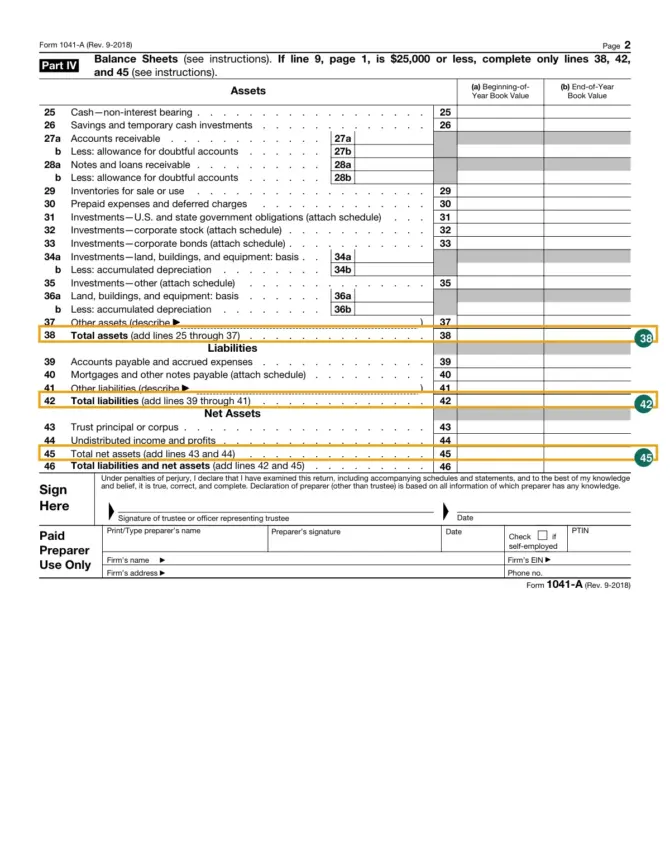
Part IV is completed using the accounting method of the trust’s books, in two columns: (a) book value at the beginning of the year and (b) at the end. All filers complete both columns. A trust with $25,000 or less on line 9 completes only lines 38 (total assets), 42 (total liabilities) and 45 (total net assets).
Several asset and liability lines need an attached schedule:
- line 28, notes and loans receivable: for each loan, the borrower’s name and title, original amount, balance due, dates, repayment terms, interest rate, security, purpose and the consideration furnished by the lender
- lines 31 to 33, government obligations, corporate stock and corporate bonds: each security held at year-end and whether it is carried at cost or end-of-year market value; U.S. and state or municipal obligations are not combined
- lines 34 and 36, land, buildings and equipment held for investment and not held for investment: cost or other basis, accumulated depreciation and end-of-year book value
- line 35, other investments, and line 40, mortgages and other notes payable
The trustee or an authorized representative signs. When the trustee, or an employee or officer of the trust, fills in the form, the paid preparer area stays blank, and someone who prepares it without charge does not sign it either. A paid preparer signs, completes the preparer details and gives the trustee a copy.
When and where to file Form 1041-A
The official Form 1041-A PDF has the form on pages 1 and 2 and the instructions on pages 3 and 4. File it by April 15 following the close of the calendar year, or the next business day when that date falls on a weekend or legal holiday. For calendar year 2026, that is April 15, 2027.
An automatic extension comes from Form 8868, filed by the trustee on or before the original due date. File it at this address:
Department of the Treasury
Internal Revenue Service Center
Ogden, UT 84201-0027
Section 6652(c)(2) provides separate penalties of $10 a day, up to $5,000, against both the trust and the trustee for a late return, unless there is reasonable cause. An amended return repeats the entire form with “Amended Return” written across the top, and the trustee may file one at any time for the same period. Public inspection of the form follows Regulations section 301.6104(b)-1(d).