Form 1041-ES is the package a fiduciary uses to work out and pay quarterly estimated income tax for an estate or trust. The 2026 edition, created November 20, 2025, has four parts: the instructions, a 17-line estimated tax worksheet kept with the fiduciary’s records, a capital gains tax worksheet, and four payment vouchers. Only the vouchers go to the IRS, and only with a payment. The IRS describes the package as primarily for first-time filers: once it receives the first voucher, it sends the estate or trust a 1041-ES package for the next year with the name, address and EIN already printed on the vouchers.
Which estates and trusts have to pay estimated tax for 2026
A fiduciary generally has to make estimated payments when the estate or trust expects to owe at least $1,000 in tax for 2026 after subtracting withholding and credits, and expects withholding and credits to be less than the smaller of two amounts:
- 90% of the tax on the 2026 return (66 2/3% if the estate or trust qualifies as a farmer or fisher), or
- the tax on the 2025 return, raised to 110% when the adjusted gross income on that return was more than $150,000 and less than 2/3 of gross income for 2025 and 2026 comes from farming or fishing.
The second amount is not available if no 2025 return was filed or the 2025 return covered less than 12 months. Household employment taxes count toward the tax shown on the return only if the estate or trust will have federal income tax withheld, or would have to make estimated payments even without them.
Three kinds of fiduciaries do not have to make payments at all:
- the fiduciary of a domestic decedent’s estate or a domestic trust that had a full 12-month 2025 tax year with no tax liability;
- the executor of a decedent’s estate, for any tax year ending before the date two years after the death;
- the trustee of a trust that was treated as owned by the decedent and will receive the residue of the estate under the will (or, if no will is admitted to probate, is primarily responsible for debts, taxes and administration expenses), for the same two-year window.
Put in dates: after a death in March 2026, the executor makes no estimated payments for any tax year of the estate that ends before the second anniversary of the death in March 2028. A trust created under the will and funded from the estate is not on the list of exceptions, so its trustee starts from the $1,000 test above.
What changed in the 2026 package
The What’s New section lists one item: the capital gains and qualified dividends thresholds for 2026. The 0% rate applies up to $3,300, the 20% rate applies to amounts above $16,250, and the 15% rate covers the range between. Those figures appear as $3,300 on line 8 and $16,250 on line 19 of the Tax Computation Worksheet Using Maximum Capital Gains Rates on page 4.
How to fill out the 2026 Estimated Tax Worksheet
The worksheet on page 5 is not filed. It produces the installment amount that goes on each voucher. Use the estate’s or trust’s 2025 Form 1041 and its instructions as a guide to the income and deductions you expect for 2026. The markers on the image match the rows of the table.
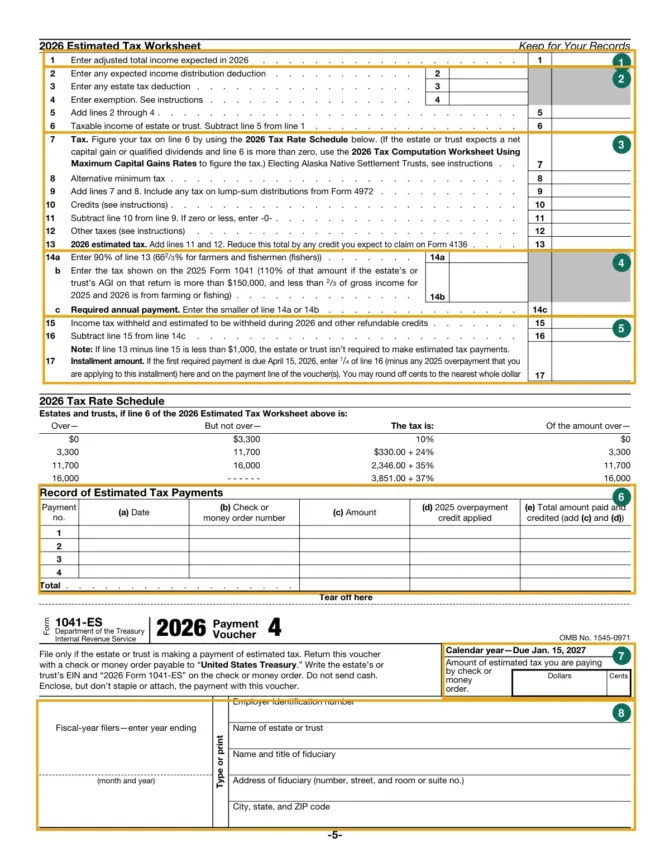
| Marker | Lines | What to enter |
|---|---|---|
| 1 | Line 1 | Adjusted total income expected in 2026. |
| 2 | Lines 2 to 6 | Any expected income distribution deduction (line 2), any estate tax deduction (line 3) and the exemption (line 4, amounts below). Line 6 is line 1 minus the total of lines 2 to 4. |
| 3 | Lines 7 to 13 | Tax on line 6 from the 2026 Tax Rate Schedule, or from the capital gains worksheet if a net capital gain or qualified dividends are expected. Add alternative minimum tax (line 8) and any lump-sum distribution tax from Form 4972 (line 9), subtract credits (line 10), add other taxes (line 12). Line 13 is the 2026 estimated tax, reduced by any credit expected on Form 4136. |
| 4 | Lines 14a to 14c | 90% of line 13 (66 2/3% for farmers and fishers) on 14a, the tax shown on the 2025 Form 1041 (or 110% of it, under the AGI rule above) on 14b, and the smaller of the two on 14c, the required annual payment. |
| 5 | Lines 15 to 17 | Income tax withheld and expected to be withheld in 2026 plus other refundable credits (line 15), line 14c minus line 15 (line 16), and the installment amount (line 17). |
The exemption on line 4 depends on the kind of entity:
| Entity | Line 4 exemption |
|---|---|
| Decedent’s estate | $600 |
| Trust required by its governing instrument to distribute all income currently | $300, even if it distributed amounts other than income during the year |
| Qualified disability trust | $5,300, not subject to phaseout |
| Qualified funeral trust | None |
| Any other trust | $100 |
A qualified disability trust is one described in 42 U.S.C. 1396p(c)(2)(B)(iv), set up solely for a disabled individual under 65, whose beneficiaries have all been determined by the Commissioner of Social Security to have been disabled for some part of the year. A trust still qualifies if its corpus may revert to a person who is not disabled after there are no disabled beneficiaries left.
Line 7 for an Electing Alaska Native Settlement Trust is 10% of line 6, unless the trust expects qualified dividends or a net capital gain; then Part IV of Schedule D of Form 1041-N serves as the worksheet. Credits on line 10 are the ones explained in the instructions for Schedule G, lines 2a to 2d, of Form 1041.
Line 12 collects the other taxes the package names:
- Net investment income tax: 3.8% of the smaller of undistributed net investment income or the excess of AGI over the amount where the top bracket begins, which is $16,000 for tax years beginning after 2025. It does not apply to trusts whose unexpired interests are all devoted to charitable purposes. Form 8960’s instructions have the detail.
- Recapture of the investment credit, low-income housing credit, qualified electric vehicle credit, Indian employment credit, new markets credit or the credit for employer-provided childcare facilities.
- Tax on accumulation distributions of trusts.
- Tax under section 641(c) on S corporation income of an electing small business trust.
- Household employment taxes, under the same two conditions given for the $1,000 test.
The note under line 16 is the cut-off: if line 13 minus line 15 is less than $1,000, the estate or trust does not have to make estimated payments. Otherwise, when the first payment is due April 15, 2026, line 17 is one quarter of line 16, minus any 2025 overpayment applied to that installment, rounded to whole dollars if you like.
The 2026 Tax Rate Schedule printed under the worksheet is short:
| Line 6 over | But not over | Tax |
|---|---|---|
| $0 | $3,300 | 10% |
| $3,300 | $11,700 | $330.00 plus 24% of the amount over $3,300 |
| $11,700 | $16,000 | $2,346.00 plus 35% of the amount over $11,700 |
| $16,000 | $3,851.00 plus 37% of the amount over $16,000 |
A worked example with no capital gains: a trust that keeps all its income and expects line 6 of $12,500 has a line 7 tax of $2,346 plus 35% of $800, or $2,626. If line 16 then comes to $8,000, each of the four vouchers carries $2,000.
Due dates for trusts, calendar-year estates and fiscal-year estates
A trust, and an estate that uses the calendar year, can pay the whole estimated tax by April 15, 2026, or in four equal installments:
| Voucher | Due |
|---|---|
| 1 | April 15, 2026 |
| 2 | June 15, 2026 |
| 3 | September 15, 2026 |
| 4 | January 15, 2027 |
The January 15, 2027 payment can be skipped if the 2026 Form 1041 is filed by January 31, 2027 and the full balance is paid with it. A date that falls on a Saturday, Sunday or legal holiday moves to the next business day. A trust with a short tax year finds its due dates in Notice 87-32, 1987-1 C.B. 477.
An estate on a fiscal year pays by the 15th day of the 4th, 6th and 9th months of its 2026 tax year and the 1st month of the next one, or pays the whole amount on the first of those dates. It can skip the last installment by filing Form 1041 by the last day of the month after the year closes and paying the full balance.
When income arrives late in the year, two rules help. If the estate or trust receives income unevenly, the annualized income installment method in Pub. 505 can lower or remove one or more payments. And if a change in income after March 31, 2026 (or after the third month of a fiscal year) first makes estimated tax necessary, the installments are figured with that same annualized method.
Farmers and fishers, meaning estates and trusts with at least 2/3 of gross income for 2025 or 2026 from farming or fishing, have a single date instead. They either pay the full estimated tax (line 16) by January 15, 2027, or file the 2026 Form 1041 by March 1, 2027 and pay all the tax then, with no estimated payments. Fiscal-year estates in this group pay by the 15th day of the first month after the year ends, or file by the first day of the third month after it and pay in full.
Filling in a payment voucher
Each voucher is printed with the due date for calendar-year filers, so use the one that matches the payment. Send a voucher only when you are sending money.
- Marker 8 on the image: the estate’s or trust’s name and EIN, the fiduciary’s name and title, and the fiduciary’s address. Fiscal-year filers also write the month and year the tax year ends in the box on the left.
- Marker 7: the amount of this payment only. A 2025 overpayment credited to 2026 reduces what you send, but the credited amount is not written in this box.
- The check or money order is payable to “United States Treasury”, with the EIN and “2026 Form 1041-ES” written on it. Enclose it loose with the voucher; do not staple or attach it, and do not send cash.
- Do not add a balance due on the 2025 Form 1041 to the check for 2026 estimated tax.
The Record of Estimated Tax Payments (marker 6) stays with the fiduciary: date, check or money order number, amount, any 2025 overpayment applied, and the total for each of the four payments. The vouchers cannot be used to report a new address. A fiduciary who has moved files Form 8822-B; see Form 8822-B on this site.
Paying electronically or mailing the voucher
The IRS recommends paying electronically and lists the options at irs.gov/Payments. Paper vouchers go by U.S. Postal Service only:
Internal Revenue Service
P.O. Box 932400
Louisville, KY 40293-2400
This is not the service center where Form 1041 itself is filed, and the package says not to send the vouchers there.
A financial institution that is an authorized federal tax depositary and acts as fiduciary for at least 200 taxable trusts required to pay estimated tax must deposit those payments through the Electronic Federal Tax Payment System (EFTPS). Any other fiduciary may enroll voluntarily at www.EFTPS.gov or by calling 800-555-4477. An EFTPS deposit is on time only if it is submitted by 8 p.m. Eastern time the day before the due date.
Checks have a ceiling. The IRS cannot accept a single check, cashier’s checks included, for $100 million or more. A larger payment by check has to be split into checks each under $100 million; the limit does not apply to electronic payments.
Official PDF: Form 1041-ES — Official PDF (irs.gov)
Where the penalty comes from
The penalty is charged when Form 1041 is filed, separately on each underpaid installment for the number of days it stayed unpaid. It can apply when not enough was paid, when payments were late, or when they were not in the required amount, and it can apply even if the return shows an overpayment. Pub. 505 explains the conditions under which it can be waived.
Changing the estimate partway through the year does not erase an earlier shortfall. To amend, refigure line 16 of the worksheet and use Worksheet 2-7, Annualized Estimated Tax Worksheet, in Pub. 505 for each remaining period. If a payment for an earlier period was less than one quarter of the amended estimated tax, the estate or trust may owe a penalty for it when the return is filed.
Passing payments to beneficiaries on Form 1041-T
The fiduciary, or the executor for an estate’s final year, can elect to treat any part of the estate’s or trust’s estimated payments as paid by a beneficiary instead. The beneficiary is treated as having made that payment on January 15 after the end of the tax year. The election is made on the 2026 Form 1041-T, Allocation of Estimated Tax Payments to Beneficiaries, filed on or before the 65th day after the tax year closes; section 643(g) has the rules.
Other estimated tax forms
Form 1041-ES covers federal tax only. A state that taxes trusts may run its own voucher; Nebraska, for example, uses Nebraska Form 1041N-ES for fiduciary estimated payments.
Questions about Form 1041-ES
Does a new estate have to make estimated tax payments?
A decedent’s estate is exempt for any tax year ending before the date two years after the death. After that window, the $1,000 test and the 90% or 100% (110%) safe harbors apply.
Do I send the Estimated Tax Worksheet to the IRS?
The worksheet is marked “Keep for Your Records”. Only a payment voucher goes to the Louisville P.O. box, and only with a payment.
Can a trust pay all of its 2026 estimated tax at once?
A trust may pay the whole amount by April 15, 2026. A fiscal-year estate may pay it all by the 15th day of the 4th month of its tax year.
What if we never received preprinted 2026 vouchers?
Use the blank vouchers in the Form 1041-ES package and fill in the name, EIN and fiduciary details yourself.
Official sources
- Internal Revenue Service, Form 1041-ES (2026), Estimated Income Tax for Estates and Trusts
- Internal Revenue Service, About Form 1041-ES, Estimated Income Tax for Estates and Trusts