Form 2220 works out whether a corporation paid its estimated tax on time and, if it did not, how large the underpayment penalty is for each installment. C corporations, S corporations, tax-exempt organizations that owe unrelated business income tax and private foundations all use it. In most cases nobody has to send it in: the IRS figures the penalty itself and bills the corporation. The form becomes mandatory when the corporation relies on one of the special installment methods in Part II, and for 2025 also when the corporate alternative minimum tax relief applies. This page follows the 2025 Form 2220 and its instructions dated October 28, 2025.
Who has to attach Form 2220 to the return
The note at the top of page 1 sets the default. A corporation that simply wants to know its penalty may complete the form, carry the page 2, line 38 figure to the estimated tax penalty line of its income tax return, and keep the form out of the return. The instructions turn that into a requirement in three cases, and only when the Part I, line 3 amount is $500 or more:
- the corporation uses the adjusted seasonal installment method (line 6);
- it uses the annualized income installment method (line 7);
- it is a large corporation figuring its first required installment from the prior year’s tax (line 8).
If any of those boxes is checked, Form 2220 goes with the return even when no penalty is owed, and the box on Form 1120, page 1, line 34 (or the comparable line on Form 1120-C, 1120-L, 1120-S or another return) is checked as well.
Whether a penalty exists at all depends on the payments. Generally a corporation owes it if it did not pay on time at least the smaller of the tax shown on its 2025 return or the tax shown on its 2024 return. The 2024 figure counts only if that return covered a full 12 months and showed some tax. There is no penalty when the 2025 tax on line 3 is under $500.
Each installment is tested on its own date. A corporation can owe a penalty for April even though it overpaid in September, and even if the return ends in a refund.
What changed on the 2025 Form 2220
The What’s New section of the 2025 instructions extends the relief for the corporate alternative minimum tax (CAMT). For tax years beginning in 2025, the IRS waives the section 6655 penalty for missed estimated payments attributable to CAMT. The instructions attach three points to the relief:
- affected corporations still file the 2025 Form 2220, even with no penalty;
- they may leave the CAMT liability out of the required annual payment;
- they enter an amount on the estimated tax penalty line of the return (Form 1120, line 34), even if that amount is zero.
The instructions warn that a corporation that skips these steps may receive a penalty notice and then need an abatement request to get the relief. The authority cited is Notice 2025-27, 2025-26 I.R.B. 1611.
How to fill out Form 2220, Part I and Part II
Page 1 has the header (name and employer identification number), Part I for the required annual payment, Part II for the reasons for filing, and Part III for the underpayment. The marked numbers on the image are the line numbers discussed below.
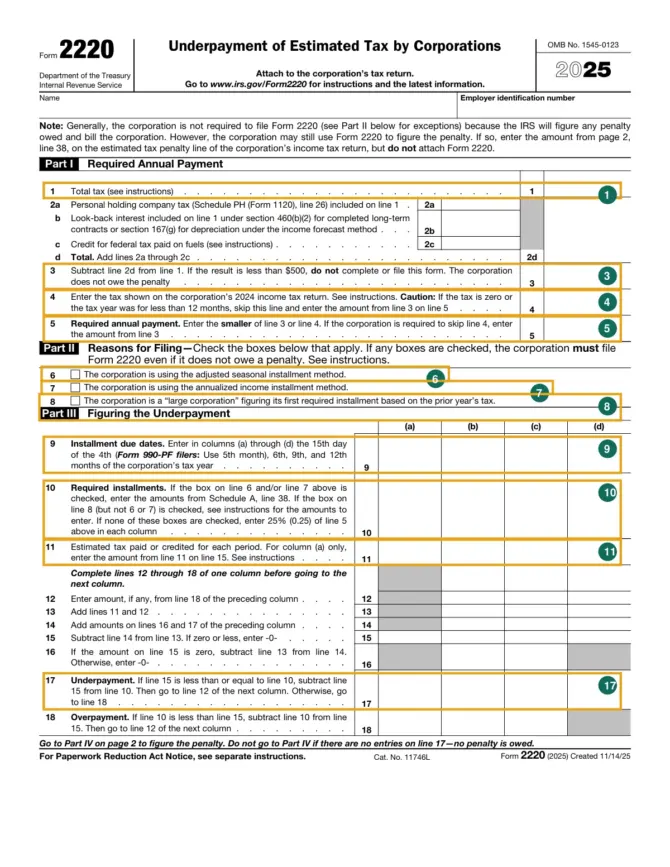
| Line | What goes there | Where the figure comes from |
|---|---|---|
| 1 | Total tax | Form 1120, line 31, or the matching line of another return. Leave out tax from a section 338(a)(1) sale (write “Sec. 338 gain” with the tax in brackets on the dotted line, unless a section 338(h)(10) election was made) and CAMT from Schedule J, line 3 (write “CAMT” with the amount in brackets). |
| 2a to 2d | Personal holding company tax, look-back interest under section 460(b)(2) or 167(g), and the credit for federal tax paid on fuels | 2a from Schedule PH (Form 1120), line 26; 2c from Form 1120, Schedule J, Part II, line 20b. Line 2d is their total. |
| 3 | Line 1 minus line 2d | If under $500, stop: no form and no penalty. |
| 4 | Tax on the 2024 return | Figured the same way as line 3 but with the 2024 taxes and credits. Skip it if the corporation filed no 2024 return showing tax, or if 2024 was shorter than 12 months. |
| 5 | Required annual payment | The smaller of line 3 or line 4; line 3 if line 4 was skipped. |
| 6 and 7 | Checkboxes for the adjusted seasonal and annualized income installment methods | Checked only if Schedule A on pages 3 and 4 is completed. |
| 8 | Checkbox for a large corporation using last year’s tax for its first installment | The definition is in the next section. |
S corporations fill in line 4 differently. They enter the investment credit recapture tax and built-in gains tax shown on the 2025 return plus any excess net passive income tax shown on the 2024 return, and skip line 4 if 2024 was a short year. On Schedule A, lines 1, 2, 3 and 21, “taxable income” for a Form 1120-S filer means excess net passive income or the amount taxed under section 1374(a).
A large corporation is one (other than an S corporation) that had, or whose predecessor had, taxable income of $1 million or more in any of the 3 tax years before 2025. Taxable income here ignores net operating loss and capital loss carrybacks and carryovers, and members of a controlled group split the $1 million among themselves. Such a corporation may base only its first installment on the 2024 tax.
Part III: due dates, payments and the underpayment
Line 9 holds four dates: the 15th day of the 4th, 6th, 9th and 12th months of the tax year (Form 990-PF filers use the 5th month for the first one). For a calendar-year corporation in 2025 that means April 15, June 15, September 15 and December 15. June 15, 2025 fell on a Sunday, and the line 11 instructions treat a payment made on the next day that is not a Saturday, Sunday or legal holiday as on time for that installment. Two columns may show the same date when the IRS has extended a due date, for example under disaster relief.
Line 10 is normally 25% of line 5 in each column. When line 6 or 7 is checked, the amounts come from Schedule A, line 38. A large corporation that checked only line 8 and whose line 4 is smaller than line 3 enters 25% of line 4 in column (a), then makes up the difference in column (b). Suppose line 3 is $400,000 and line 4 is $240,000: column (a) is $60,000, column (b) is 25% of ($400,000 minus $240,000 plus $400,000), or $140,000, and columns (c) and (d) are $100,000 each.
Line 11 shows the estimated tax paid for each period. Column (a) counts payments made by the first due date; each later column counts payments after the previous due date and by its own. An overpayment from the 2024 return credited to 2025 estimated tax belongs here too. Lines 12 through 18 then carry each column’s shortfall or excess forward, and the instructions require finishing all of one column before starting the next. An amount on line 17 in any column is an underpayment and sends the corporation to Part IV; if line 17 is blank in every column, there is no penalty.
Part IV: the penalty, quarter by quarter
The penalty runs from each installment due date to the earlier of the payment date or the 15th day of the 4th month after the tax year ends. That end date goes on line 19. C corporations with tax years ending June 30 and S corporations use the 3rd month, and Form 990-PF and 990-T filers use the 5th month. A short tax year ending in June is treated as ending June 30.
Line 20 counts the days from the line 9 due date to the line 19 date, and lines 21 through 36 split those days into calendar quarters. Each pair multiplies the line 17 underpayment by the days in that quarter divided by 365 and by the rate for the quarter. Payments are applied to the oldest unpaid installment first, whatever installment the corporation meant them for. A calendar-year corporation that was $10,000 short on April 15, 2025 and paid it on June 9 has 55 days on line 21, and line 22 comes to $10,000 × 55/365 × 7%, or $105.48.
| Lines | Days counted | Rate |
|---|---|---|
| 21 and 22 | after 4/15/2025, before 7/1/2025 | 7%, printed |
| 23 and 24 | after 6/30/2025, before 10/1/2025 | 7%, printed |
| 25 and 26 | after 9/30/2025, before 1/1/2026 | 7%, printed |
| 27 and 28 | after 12/31/2025, before 4/1/2026 | 7%, printed |
| 29 and 30 | after 3/31/2026, before 7/1/2026 | blank on the form; 6% on the IRS rate page |
| 31 and 32 | after 6/30/2026, before 10/1/2026 | blank on the form; 7% on the IRS rate page |
| 33 and 34 | after 9/30/2026, before 1/1/2027 | blank on the form; 7% on the IRS rate page |
| 35 and 36 | after 12/31/2026, before 3/16/2027 | blank on the form; not yet listed on November 1, 2026 |
The starred lines tell the filer to use the penalty interest rate the IRS sets for each quarter, which it publishes in a news release and a revenue ruling and gives out at 800-829-4933. The rates in the table come from the IRS quarterly interest rates page, row “Underpayment (corporate and non-corporate)”, the same row that shows 7% for all four quarters of 2025, matching the rate printed on lines 22 through 28.
Line 37 adds the quarter amounts in each column and line 38 totals the four columns. That total is the penalty entered on Form 1120, line 34, or the comparable line of another return. If more than one payment went toward a single installment, or a fiscal-year underpayment runs past the line 35 date, the corporation attaches its own computation for that piece and includes it in line 38.
Schedule A for seasonal or uneven income
Pages 3 and 4 hold Schedule A, which can lower one or more installments when income arrives unevenly during the year. The instructions use a ski shop with most of its income in winter as the example. Schedule A compares up to three amounts for each installment and keeps the smallest: the adjusted seasonal installment, the annualized income installment and the regular installment. Once Schedule A is used for one due date, it must be used for all four. Part I alone (box 6), Part II alone (box 7) or both (boxes 6 and 7) are completed, and Part III always.
Schedule A, Part I, the adjusted seasonal method, is open only if the base period percentage for some 6 consecutive months is at least 70%. That percentage averages, over the 3 preceding tax years, the share of each year’s taxable income earned in those same 6 months. Lines 1 and 3 take taxable income from the tax years beginning in 2022, 2023 and 2024; line 2 takes the 2025 figures.
Schedule A, Part II, the annualized method, starts with the annualization periods on line 20 and the matching multipliers on line 22:
| Option | Line 20 periods (months) | Line 22 amounts |
|---|---|---|
| Standard, corporations | 3, 3, 6, 9 | 4, 4, 2, 1.33333 |
| Option 1, corporations | 2, 4, 7, 10 | 6, 3, 1.71429, 1.2 |
| Option 2, corporations | 3, 5, 8, 11 | 4, 2.4, 1.5, 1.09091 |
| Standard, tax-exempt organizations and private foundations | 2, 3, 6, 9 | 6, 4, 2, 1.33333 |
| Option 1, tax-exempt organizations and private foundations | 2, 4, 7, 10 | 6, 3, 1.71429, 1.2 |
Options 1 and 2 are available only if the corporation filed Form 8842 by the due date of its first required installment, and the election cannot be changed for that year. Line 21 is the taxable income (Form 1120, line 30) for each period. Credits on line 28 are not annualized, although income or deduction items used to figure a credit are.
Extraordinary items, such as a net operating loss carryover, a section 481(a) adjustment or a gain or loss from disposing of 25% or more of the business assets, are added after annualizing, on line 9b (Part I) or line 23b (Part II). Items from a transaction totaling less than $1 million are de minimis and may be annualized with the rest of the income instead. Part III of Schedule A then compares, column by column, the seasonal or annualized installment on line 34 with the regular installment on line 37, and line 38 carries the smaller one to page 1, line 10.
Instructions that change the result
These points come from the form and its instructions, and each one changes either the penalty or how the IRS handles the return:
- A corporation with CAMT that does not file the 2025 Form 2220 and leaves the Form 1120, line 34 penalty line empty may get a penalty notice and need an abatement request.
- Schedule A used for only some due dates is not allowed; it applies to all four or none.
- Option 1 or Option 2 periods without a timely Form 8842 election cannot be used.
- A payment counts against the oldest unpaid installment first, so a June payment can leave the June installment short.
Forms used with Form 2220
Form 1120, line 34 is where the penalty lands for a regular C corporation; line 31 of the same return supplies the total tax for Form 2220, line 1, and line 30 supplies taxable income for Schedule A. Other filers use the matching lines of Form 1120-C, 1120-F, 1120-FSC, 1120-L, 1120-ND, 1120-PC, 1120-REIT, 1120-RIC, 1120-S, 1120-SF, 990-PF or 990-T, whose instructions explain the total tax for estimated tax purposes. Form 8842 is the election for annualization Options 1 and 2.
State corporate estimated tax runs separately; for example, Formspedia also covers the Arkansas AR1100ESCT estimated tax vouchers for corporations.
Where to get Form 2220 and where it goes
The IRS posts the 2025 Form 2220 PDF and the instructions on its About Form 2220 page. The form has no mailing address of its own. When it must be attached, it travels with the corporation’s income tax return to wherever that return is filed. When it is not required, the corporation keeps it with its records and only the line 38 amount appears on the return. This page explains the form; it is not tax advice for a particular corporation.
Questions about Form 2220
Does a corporation have to file Form 2220 if it owes the penalty?
The IRS figures the penalty and sends a bill, so the form is required only when a Part II box applies and line 3 is $500 or more, or, for 2025, when the CAMT relief applies.
Does a refund on the return cancel the estimated tax penalty?
The instructions say no: each installment is measured on its own date, so an early shortfall can carry a penalty even if the return shows a refund.
Can an S corporation owe the underpayment penalty?
Form 2220 covers S corporations. Their required annual payment uses the built-in gains, investment credit recapture and excess net passive income taxes, and the penalty period runs at most to the 15th day of the 3rd month after the tax year.
What rate goes on lines 30 through 36?
The IRS rate for each calendar quarter, published quarterly. For April through June 2026 the IRS rate page lists 6%, and 7% for the rest of 2026.
Official sources
- Internal Revenue Service, Form 2220 (2025), Underpayment of Estimated Tax by Corporations
- Internal Revenue Service, Instructions for Form 2220 (2025), October 28, 2025 (PDF)
- Internal Revenue Service, Instructions for Form 2220 (2025), web version
- Internal Revenue Service, About Form 2220
- Internal Revenue Service, Quarterly interest rates
- Internal Revenue Service, Form 1120 (2025), U.S. Corporation Income Tax Return