Form 3115 is the application a taxpayer files to get IRS consent to change either an overall method of accounting, such as moving from the cash method to an accrual method, or the accounting treatment of a single item, such as repair costs or depreciation. The current form is the December 2022 revision, eight pages long, and the instructions carry the same revision date. Before you fill in a line, you have to know which of two procedures your change falls under, automatic or non-automatic, because that decides which Parts you complete, whether a user fee is due, when the form is filed and where it goes.
Automatic or non-automatic: which procedure applies
The instructions are direct about the order: unless published guidance says otherwise, you must use the automatic change procedures if you are eligible for them for the requested year of change. Automatic changes are the ones described in the List of Automatic Changes. The 2022 instructions cite Rev. Proc. 2022-14 “or any successor”; the IRS page for Form 3115 now links Rev. Proc. 2025-23, which updates that list and applies to a Form 3115 filed on or after June 9, 2025, for a year of change ending on or after October 31, 2024. Most listed changes have a designated change number (DCN). Three examples: DCN 7 for moving from an impermissible to a permissible depreciation method, DCN 184 for deducting repair and maintenance costs or capitalizing improvements under the tangible property regulations, and DCN 233 for a small business taxpayer moving to the overall cash method.
Under section 5.01(1) of Rev. Proc. 2015-13, as summarized in the instructions, an applicant can generally use the automatic procedures only if, among other conditions:
- on the filing date, the change is described in the List of Automatic Changes and the applicant meets every requirement in that section of the list;
- the change is not to the principal method under Regulations section 1.381(c)(4)-1(d)(1) or 1.381(c)(5)-1(d)(1);
- the year of change is not the final year of the trade or business;
- for an overall method change, no overall change was made or requested in any of the 5 tax years ending with the year of change, and for an item change, no change for the same item in that period.
Some listed changes waive one or more of these rules; the waiver is stated in the list itself. If you are not eligible, the non-automatic procedures may be open to you. The IRS National Office then reviews the request and issues a letter ruling, a user fee is required, and each unrelated item or submethod needs its own Form 3115. The non-automatic route is closed when published guidance requires the change to be made automatically, and when the year of change is the final year of the trade or business, unless the change results from a section 381(a) transaction or the National Office accepts compelling circumstances.
| Question | Automatic change | Non-automatic change |
|---|---|---|
| Parts to complete | Part I, Part II, Part IV and any schedule the change needs | Part II, Part III, Part IV and any schedule the change needs |
| User fee | None | $13,225 standard fee under Rev. Proc. 2026-1, with reduced fees in some cases |
| When | Original with the timely filed return for the year of change (extensions included); signed copy no earlier than the first day of that year | During the tax year for which the change is requested |
| Where | Original attached to the return; signed copy to the IRS in Ogden, Utah | IRS National Office in Washington, DC |
| What comes back | Consent is granted if you file on time and comply, subject to IRS review; no acknowledgment of receipt | Acknowledgment normally within 60 days, then a letter ruling |
Consolidated groups, controlled foreign corporations and 10/50 corporations have their own rules on filing, issue under consideration and audit protection in Rev. Proc. 2015-13. If one of these applies to you, read the sections the instructions cite or ask a tax professional before filing.
Who files Form 3115 and who signs it
The instructions separate the filer, who files the form, from the applicant, whose method is changing. In general they are the same. For a consolidated group, the common parent files for itself and for any member, and the member becomes the applicant. A separate Form 3115 is generally needed for each applicant and for each separate trade or business, including a qualified subchapter S subsidiary or a single-member LLC. Identical changes can share one form when the applicants are entities with a common sponsor, members of one consolidated group, separate trades or businesses of the same entity, partnerships wholly owned within a consolidated group, or certain CFCs and 10/50 corporations; a schedule then lists each applicant and its identification number.
Who signs depends on the filer. Spouses filing a joint return both sign and both names go on the first line. A partnership’s form is signed by a general partner or LLC member with personal knowledge of the facts and authority to sign. Corporations, S corporations and cooperatives use an officer with authority to bind the filer; a consolidated group uses an officer of the common parent. An estate or trust is signed by the fiduciary, an exempt organization by a principal officer. A preparer who is not the filer signs as well and adds the firm’s name. If the original is e-filed, the preparer does not sign that original but still fills in the preparer section and signs the duplicate automatic copy.
The contact person on page 1 has to be someone authorized to sign Form 3115 or the filer’s authorized representative. A representative needs a Form 2848 attached, even when that representative prepared or signed the form, or the IRS will not discuss the application with them. A Form 8821 does not fill that role: its instructions say a designee under Form 8821 cannot speak for you or represent you before the IRS.
Page 1: filer details, Part I and the signature
Page 1 holds the identification block, two sets of checkboxes, all of Part I and the first two lines of Part II. The letters and numbers in the image below match the rows of the table.
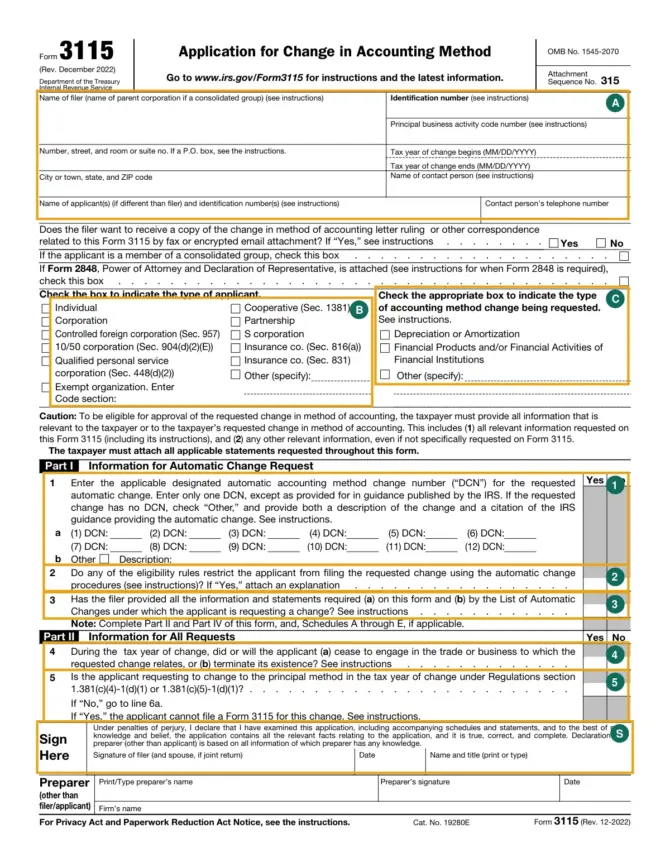
| Marker | Field | What to enter |
|---|---|---|
| A | Name, address, identification number, principal business activity code, tax year of change, contact person, applicant line | The filer’s name on the first line. Individuals enter an SSN (or ITIN), both spouses’ numbers on a joint return; everyone else enters an EIN; a foreign entity with no EIN requirement writes “Not applicable”. Businesses enter the 6-digit PBA code from their income tax return instructions. The year of change is the first tax year in which the proposed method is used, even if no affected items arise that year. Use the applicant line only when someone else is filing for the applicant. |
| (unmarked) | Fax or encrypted email, consolidated group box, Form 2848 box | “Yes” to fax or encrypted email requires an attached statement; encrypted email also needs the signed memorandums of understanding if not already provided. |
| B | Type of applicant | One box: individual, corporation, CFC, 10/50 corporation, qualified personal service corporation, exempt organization (with Code section), cooperative, partnership, S corporation, insurance company under section 816(a) or 831, or other. |
| C | Type of accounting method change | Depreciation or amortization; financial products or financial activities of financial institutions; or other. For a non-automatic “Other”, add a short description and the most specific Code section. For an automatic change, Part I line 1 satisfies this. |
| 1 | DCN | One DCN in line 1a unless guidance allows a single form for concurrent changes; the instructions give DCN 184 with DCN 192 as an example, and Rev. Proc. 2025-23 tells a taxpayer making two or more tangible property changes under its section 11.08 to file one form listing every DCN. A change without a DCN goes on line 1b “Other” with the revenue procedure or guidance that allows it. |
| 2 | Eligibility rules | “Yes” means a rule restricts automatic filing, and you attach an explanation of why you still qualify. If the rule is waived for your change, answer “No”. |
| 3 | All required information | Confirms the form and the statements demanded by the List of Automatic Changes are attached. |
| 4 | Ceasing the business or terminating | The IRS ordinarily will not consent to a change in that case. Incorporating a trade or business or contributing its assets to a partnership counts as ceasing it. “Yes” needs a statement explaining eligibility. |
| 5 | Change to the principal method | “Yes” means you cannot file Form 3115 for this change; no consent is needed for the principal method. |
| S | Signature | Signed under penalties of perjury. For an automatic change, the original attached to the return does not need a signature; the duplicate copy must be signed and may be a photocopy. |
A qualified small taxpayer, defined in Rev. Proc. 2025-23 as one with average annual gross receipts of $10,000,000 or less for the three preceding tax years, has a reduced filing requirement for some DCNs. For DCN 7, for example, that means the identification section, signature, Part I, Part II except lines 13, 15b, 16c, 17 and 19, Part IV except line 25, and Schedule E.
Part II, lines 6 to 19: examinations, earlier changes and gross receipts
Part II applies to every request. Most lines are yes/no questions, and many “Yes” answers require an attachment.
| Line | What it asks | What the instructions add |
|---|---|---|
| 6a to 6d | Returns under examination, issue under consideration, examining agent’s name and phone, copy to the agent | You are under examination once an IRS representative contacts you to schedule or conduct one. The copy goes to the examining agent no later than the date you file Form 3115. |
| 7a, 7b | Audit protection and the category that gives it | Boxes: not under exam, 3-month window, 120-day window (with the date the exam ended), method not before the director, negative adjustment, CAP (with the date the member joined the group), other, audit protection at end of exam. DCN 17 changes get no audit protection; answer “No” and attach that explanation. |
| 8a to 8d | Returns before Appeals or a federal court | Name the Appeals officer or government counsel and send them a signed copy by the date you file. |
| 9 | Statement on parent corporations | Needed if line 6a or 8a is “Yes” for a present or former consolidated group: each parent’s name, ID number, address and the tax years involved. |
| 10 | Partnership or S corporation | Whether the method is an issue for a partner, member or shareholder; if so, attach an explanation. No audit protection applies to an issue under consideration unless guidance says otherwise. |
| 11a to 11c | Changes in the 5 tax years ending with the year of change | Describe each, say whether consent was granted, and explain any withdrawn, denied or unsigned request. |
| 12 | Pending letter ruling, method change or technical advice requests | Give names, ID numbers, type of request and issue for each. |
| 13 | Overall method change | “Yes” sends you to Schedule A. |
| 14a to 14d | Item, present method, proposed method, present overall method | Also state whether any federal tax credit, grant or subsidy was claimed for the item; the instructions name the employee retention credit for payroll tax changes. |
| 15a, 15b | Description of each trade or business | With several businesses, say whether each keeps separate books, what each provides, each overall method and which one is changing. |
| 16a to 16c | Legal basis, authorities, contrary authorities | Required for non-automatic requests. For automatic requests, only the DCNs listed in the instructions need 16a and 16b; 16c is never required for an automatic change. |
| 17 | Use of the method in books and financial statements | Insurance companies add whether it will be used for annual statement purposes. |
| 18 | Conference request | A conference with the National Office if it proposes an adverse response. |
| 19a, 19b | Gross receipts for the 3 preceding tax years, and the 4th for section 460 contracts | Used for the section 448(c) gross receipts test. The inflation-adjusted amount is set each year; the instructions give $27,000,000 for years beginning in 2022. |
The 3-month window on line 7b runs from the 15th day of the 7th month to the 15th day of the 10th month after the close of the tax year, and it only helps an applicant that has been under examination for at least 12 consecutive months when the window opens. The 120-day window follows the end of an examination.
Part III: what a non-automatic request adds
Line 20 asks whether your change is described anywhere as an automatic change; if it is, attach an explanation of why you are filing non-automatically. Line 21 calls for true copies of all contracts, agreements and other documents directly related to the change, line 22 for your reasons, and line 23, for a consolidated group member, whether every other member already uses the proposed method.
Lines 24a and 24b carry the user fee. A fee is due for each applicant; a filer that is not itself changing pays nothing for itself. Appendix A of Rev. Proc. 2026-1 sets these amounts for non-automatic Forms 3115:
| Situation | Fee |
|---|---|
| Standard fee | $13,225 |
| Gross income under $400,000, with the required certification | $3,450 |
| Gross income of $400,000 or more but under $10 million, with the required certification | $9,775 |
| Each additional applicant asking for an identical change on the same form | $280 |
| Letter ruling for an extension of time to file Form 3115 under Regulations section 301.9100-3 | $13,900, plus the fee for a non-automatic change itself |
The certification states gross income as reported on the last federal income tax return filed for a full 12-month tax year ending before the request. The fee is paid in U.S. dollars through pay.gov before the form is sent, and a copy of the receipt goes with the request. The fee is counted per applicant. One non-automatic Form 3115 asking for the same change in three separate trades or businesses of one company has three applicants, so one pays the standard or reduced fee and the other two pay $280 each.
Part IV: the section 481(a) adjustment
Line 25 asks whether the change is made on a cut-off basis. If so, only items arising on or after the start of the year of change follow the new method, there is no section 481(a) adjustment, and you skip lines 26 to 29. Otherwise line 26 takes the adjustment, marked as an increase or decrease in income, with a summary of how it was computed and, for several applicants, a list of each applicant’s share.
The adjustment period is generally one tax year for a negative adjustment and four tax years (the year of change plus the next three) for a positive one. An applicant under examination spreads a positive adjustment over only two years unless it checked the 3-month window, 120-day window, method not before the director or CAP box on line 7b. Line 27 is for the remaining part of an adjustment from an earlier change that some DCNs require you to pick up now; the instructions cite DCNs 234 and 262. Line 28 lets you take a positive adjustment entirely in the year of change, either under the de minimis election for an adjustment under $50,000 or under the eligible acquisition transaction election. Line 29 asks whether any part comes from transactions with related parties.
A short illustration: a calendar-year business switching for 2026 finds that its beginning inventory would be $15,000 higher under the proposed method than under the present one. That is a positive $15,000 adjustment, which, if the business is not under examination, is taken into account over 2026 to 2029. Because it is under $50,000, the business may instead check the $50,000 de minimis election box and take the whole amount in 2026.
Schedules A to E: which one your change needs
| Schedule | Used for | What it asks |
|---|---|---|
| A, Part I | Any change in overall method (cash, accrual, hybrid), including DCNs 122, 126, 127, 128, 233, 257, 258 and 259 | Present and proposed method; lines 2a to 2g as of the close of the year before the change (receivables, advance payments, payables, prepaid expenses, supplies, inventory, other); line 2h net adjustment, also entered on Part IV line 26; recurring item exception; profit and loss statement and balance sheet |
| A, Part II | Non-automatic change to the cash method | A description of inventory items and supplies, and whether any Code section requires an accrual method |
| B | Deferral method for advance payments, cost offset methods, AFS income inclusion rule under section 451(b) | Detailed descriptions of the present and proposed methods with the items listed in the instructions for each line |
| C | Changes within the LIFO inventory method | Part I: methods and submethods, copies of Forms 970, a new Form 970 if changing to IPIC. Part II: pooling, including natural business unit pools |
| D | Long-term contracts under section 460, inventory valuation, section 263A cost allocation | Part I: contract methods and a representative actual contract. Part II: identification and valuation methods, value at the end of the prior year. Part III: Sections A to C on allocating and capitalizing costs, 28 cost lines in Section B |
| E | Depreciation or amortization, for each item or class of property | CLADR, capitalized depreciation, elections already made, a property statement including credits or grants received, asset class, method, recovery period, convention, special depreciation allowance and type of asset account |
Schedule E has limits. Form 3115 is not used to make or revoke an election under section 167, 168, 179 or 197, to change a placed-in-service date, to change salvage value (other than to zero where guidance treats it as zero) or to change a useful life under section 167 (other than to or from a period assigned by the Code, regulations or guidance).
When Form 3115 is due and what happens if you miss it
For an automatic change, the original goes with the federal income tax return for the year of change, filed on time including extensions, and the signed duplicate is sent no earlier than the first day of the year of change and no later than the day the original is filed. A calendar-year business changing for 2026 could therefore not send its duplicate before January 1, 2026. A non-automatic request has to be filed during the tax year of change, and the instructions suggest filing as early in that year as possible so the IRS can answer before the return is due.
An automatic change request may get an automatic 6-month extension from the return’s due date (excluding extensions) under Regulations section 301.9100-2 and section 6.03(4)(a) of Rev. Proc. 2015-13. Beyond that, a late Form 3115 gets more time only in unusual and compelling circumstances, through a letter ruling request under Regulations section 301.9100-3 that carries its own user fee.
Where to send Form 3115
The December 2022 Form 3115 and its instructions are on irs.gov. The addresses below are from the Address Chart in the instructions and match section 9 of Rev. Proc. 2026-1.
| Delivery | Non-automatic request | Automatic request (signed duplicate copy) |
|---|---|---|
| Internal Revenue Service, Attn: CC:PA:LPD:TSS, P.O. Box 7604, Benjamin Franklin Station, Washington, DC 20044 | Internal Revenue Service, Ogden, UT 84201, M/S 6111 | |
| Private delivery service | Internal Revenue Service, Attn: CC:PA:LPD:TSS, Room 5336, 1111 Constitution Ave. NW, Washington, DC 20224 | Internal Revenue Service, 1973 N. Rulon White Blvd., Ogden, UT 84201, Attn: M/S 6111 |
| Fax | 877-773-4950 (secure) | 844-249-8134 |
| Encrypted email | Userfee@irscounsel.treas.gov | Not available |
A non-automatic form can also be hand delivered to the courier’s desk at 1111 Constitution Ave. NW between 8:00 a.m. and 4:00 p.m., where a receipt is given. Email requires two memorandums of understanding signed by the taxpayer, not the representative. A faxed automatic duplicate needs a cover sheet with the subject “Form 3115”, the sender’s name, title, phone number and address, the taxpayer’s name, the date and the page count, and no EIN or SSN on the cover sheet. Extra copies go to the examining agent, Appeals officer or government counsel when lines 6 or 8 apply. If no acknowledgment of a non-automatic request arrives within 60 days, the instructions give this inquiry address: Internal Revenue Service, Control Clerk, CC:IT&A, Room 4512, 1111 Constitution Ave. NW, Washington, DC 20224.
What stops a Form 3115 from being processed or approved
- A non-automatic form sent without the user fee: the Technical Services Support Branch receives and controls a non-automatic Form 3115 only if the fee is submitted with it.
- Relying on a DCN whose underlying authority has become obsolete or been superseded: no change can be made under it.
- Missing the filing window: apart from the automatic 6-month extension open to automatic requests, relief requires unusual and compelling circumstances and a separate fee.
- Leaving out relevant information: the caution on page 1 says approval requires everything relevant to the change, including information the form does not ask for.
What changed in the December 2022 revision
The instructions list two items under What’s New. The Schedule B instructions were expanded for changes to the deferral method for advance payments, cost offset methods and methods that conform to the AFS income inclusion rule under section 451. And for specified research or experimental expenditures paid or incurred in tax years beginning after 2021, no deduction is allowed: domestic amounts are capitalized and amortized over 5 years and foreign amounts over 15 years, with the change made under DCN 265 and Rev. Proc. 2023-11.
That second item describes the law at the time the instructions were printed. Rev. Proc. 2025-28, issued after Public Law 119-21 of July 4, 2025, modifies the automatic consent procedures for changes under section 174 and new section 174A and covers elections for domestic research or experimental expenditures paid or incurred in tax years beginning after December 31, 2024. Read it before filing a research expenditure change. The IRS page for Form 3115, last reviewed March 30, 2026, lists no recent developments for the form itself.
Official sources
- Internal Revenue Service, Form 3115, Application for Change in Accounting Method (Rev. December 2022)
- Internal Revenue Service, Instructions for Form 3115 (Rev. December 2022)
- Internal Revenue Service, About Form 3115, Application for Change in Accounting Method
- Internal Revenue Bulletin 2025-24, Rev. Proc. 2025-23, List of Automatic Changes
- Internal Revenue Bulletin 2026-01, Rev. Proc. 2026-1, Appendix A schedule of user fees and section 9 submission rules
- Internal Revenue Service, Rev. Proc. 2025-28, domestic research or experimental expenditures
- Internal Revenue Service, Instructions for Form 8821