Form 3520-A is the yearly information return of a foreign trust that has at least one U.S. owner, meaning a U.S. person treated as owning part of the trust under the grantor trust rules of sections 671 through 679. The trustee files it, but the legal exposure sits with the U.S. owner: if the trust does not file, the owner pays the penalty unless a substitute return goes in with the owner’s own Form 3520. The form in use is Rev. December 2023, read with the Instructions for Form 3520-A revised 12/2025, which apply to tax year 2025 and later years until the IRS replaces them.
Everything on the return is in English and every amount is in U.S. dollars. The five pages split into two groups: pages 1 and 2 describe the trust as a whole, and pages 3 to 5 are statements written for each U.S. owner and each U.S. beneficiary who received a distribution.
Who files Form 3520-A and who is exempt
The filer is the foreign trust. A trust counts as foreign unless a U.S. court can exercise primary supervision over its administration and one or more U.S. persons control all of its substantial decisions; failing either test makes it foreign. Each U.S. person treated as an owner of any portion is responsible for getting the trust to file and to send out the annual statements.
A transfer is one way a foreign trust ends up in this position. When a U.S. person transfers property to a foreign trust (other than a deferred compensation or charitable trust described in section 6048(a)(3)(B)(ii)), the trust is treated as having a U.S. beneficiary unless its terms bar any distribution of income or corpus to a U.S. person at any time, even after the transferor’s death, and cannot be amended to allow one (the regulations under section 679 have the details). A rule from the HIRE Act goes further: since March 18, 2010, a foreign trust that lends cash or marketable securities to a U.S. person who does not repay at a market rate of interest, or lets a U.S. person use trust property without paying fair market value within a reasonable time, is treated as having a U.S. beneficiary and is therefore a grantor trust.
Some arrangements are carved out of foreign trust information reporting altogether:
- Certain Canadian retirement plans, including RRSPs and RRIFs, under Rev. Proc. 2014-55.
- Certain tax-favored foreign trusts run exclusively or almost exclusively for pension, retirement, medical, disability or educational benefits, under Rev. Proc. 2020-17.
- The same kinds of tax-favored trusts under proposed Regulations section 1.6048-5. Taxpayers may rely on the proposed rules for tax years ending after May 8, 2024, if they and all related persons apply them in their entirety and consistently.
None of these exemptions removes a Form 8938 obligation under section 6038D or the FinCEN Form 114 (FBAR) requirement.
Due date, Form 7004 and the Ogden address
Form 3520-A, with the owner statements (pages 3 and 4) and beneficiary statements (page 5), is due by the 15th day of the 3rd month after the end of the trust’s tax year; for a trust on the calendar year that is March 15. The trust must also hand copies of those statements to its U.S. owners and U.S. beneficiaries by the same date.
The trust gets more time only by filing Form 7004 under the trust’s own EIN by that same 15th day of the 3rd month. On line 1 of Form 7004 the form code for Form 3520-A is 27. The Form 7004 instructions describe the automatic extension to file as generally 6 months and note that the IRS no longer confirms approval; it writes only if the request is disallowed. An extension of the owner’s income tax return does not stretch the Form 3520-A deadline.
The paper return goes to:
Internal Revenue Service Center
P.O. Box 409101
Ogden, UT 84409
Form 3520 uses the same P.O. box, so a substitute Form 3520-A attached to the owner’s Form 3520 lands at that address as well. A paper Form 7004 for Form 3520-A goes there too, for a filer in any location. Note that a new address written on Form 7004 does not update IRS records; a trust whose mailing address or responsible party has changed reports it on Form 8822-B.
How to fill out page 1 of Form 3520-A
The top of the form takes the calendar year, or the beginning and end dates of a fiscal year. Fiscal-year trusts write, on every statement, the calendar year in which the fiscal year begins. The numbered frames on the image match the rows of the table.
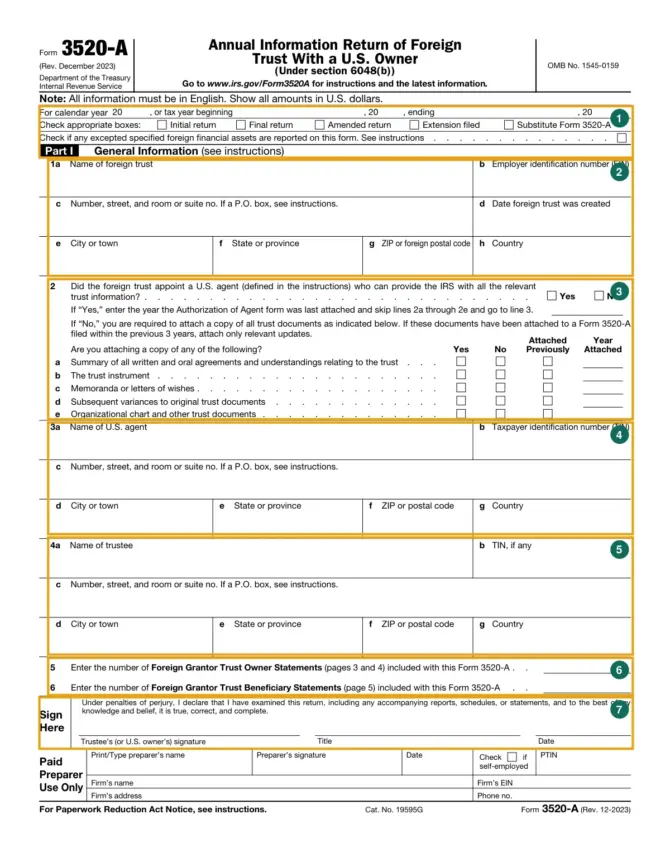
| Mark | Lines | What to enter |
|---|---|---|
| 1 | Tax year and checkboxes | Initial return (first return of the trust), Final return (trust ceases to exist), Amended return, Extension filed (Form 7004 filed on time), Substitute Form 3520-A (U.S. owner filing with Form 3520), and the box for excepted specified foreign financial assets |
| 2 | 1a to 1h | The trust’s name, EIN, address, the date it was created and its country |
| 3 | 2 and 2a to 2e | Whether a U.S. agent was appointed; if Yes, the year the Authorization of Agent was last attached; if No, which trust documents are attached now or were attached earlier, and in what year |
| 4 | 3a to 3g | Name, TIN and address of the U.S. agent |
| 5 | 4a to 4g | Name, TIN (if any) and address of the trustee |
| 6 | 5 and 6 | How many owner statements (pages 3 and 4) and beneficiary statements (page 5) are included |
| 7 | Sign here | Signature, title and date of the trustee, or of the U.S. owner on a substitute return |
Line 1b and other TINs
Line 1b takes only the trust’s EIN. An SSN or ITIN is never used for the trust. Individuals are identified by SSN or ITIN, while estates, trusts, partnerships and corporations use an EIN. A trust without an EIN can apply online at IRS.gov/EIN; one whose principal place of business is outside the United States and its territories can also apply by phone at 267-941-1099. A preparer’s PTIN belongs only in the PTIN box at the bottom of page 1.
Line 2, with a U.S. agent
A U.S. agent is a U.S. person with a binding contract allowing it to act for the trust when the IRS requests records or testimony or issues a summons under sections 7602, 7603 and 7604. A U.S. grantor, a U.S. beneficiary, or a domestic corporation they control may serve. The agreement follows the Authorization of Agent format printed in the instructions, signed by the trustee and by the agent, with no PTIN on it. Attach it every 3 years, or in the year a change happens. The trust is not treated as having an agent unless lines 3a to 3g are filled in. If the agent’s role ends (resignation, liquidation, death), the trust has 90 days to file an amended Form 3520-A.
Line 2, without a U.S. agent
Check No and attach a summary of the trust terms including oral agreements with the trustee, all trust documents and revisions (the trust instrument, memoranda or letters of wishes and similar papers) and an organizational chart with ownership percentages. If those documents were attached to a Form 3520-A filed in the previous 3 years, attach only the updates. Without an agent the IRS may itself redetermine the amounts the U.S. owner has to take into account under section 6048(b)(2).
Signature
The trustee signs. When the trustee is a partnership, a partner or LLC member signs; when it is a corporation, the president, vice president, treasurer, assistant treasurer, chief accounting officer or another authorized officer signs. A receiver or bankruptcy trustee signing for a corporate or partnership trustee attaches the court order authorizing it. On a substitute Form 3520-A the U.S. owner signs and writes the owner’s name and TIN on the Title line. A paid preparer completes the preparer block, signs and gives a copy to the trustee or U.S. owner.
Parts II and III: the trust’s income statement and balance sheet
Part II covers income from U.S. and non-U.S. sources and has to reasonably reflect the trust’s income under U.S. income tax principles.
| Line | What goes there |
|---|---|
| 1 | Taxable interest received: bank accounts and CDs, notes and mortgages, Treasury bills, notes and bonds, savings bonds, OID, REMIC regular interest |
| 2 | Ordinary dividends; capital gain distributions go on line 5 |
| 3 | Gross rents and royalties |
| 4 | The trust’s share from partnerships, S corporations, estates, other trusts and REMICs; items on a Schedule K-1 go to the matching lines |
| 5a, 5b | Net short-term and long-term capital gain or loss |
| 6 | Ordinary gain or loss on property other than capital assets, and involuntary conversions other than casualty or theft |
| 7 | Other income, with a statement if there is more than one item; includes the ordinary income part of a distribution on Form 1099-R |
| 9 to 14 | Interest expense, foreign taxes (10a, with a statement), state and local income or real property taxes (10b), depreciation, trustee and advisor fees, charitable contributions, other expenses |
| 16 | Net income or loss: line 8 minus line 15 |
| 17a | Fair market value of all distributions to anyone, U.S. or foreign, with an attached statement |
| 17b, 17c | Each U.S. owner and U.S. beneficiary who received a distribution: name, TIN, date and FMV on that date |
| Part III, 1 to 21 | Assets, liabilities and net worth at the beginning and end of the year, at FMV, for the whole trust |
Line 10b excludes federal income taxes, estate, inheritance, legacy, succession and gift taxes, and federal duties and excise taxes; none of them goes on any line of Part II. The line 17a statement is longer than the line suggests: for each transfer it names the recipient (with U.S. TIN, if any, and country), describes the transfer and any larger transaction it belongs to, gives the property’s estimated FMV and adjusted basis, describes what the trust received in return, and follows any later transfer of the property as far as known. It ends with an ownership chart of every entity the trust holds an interest in.
A distribution here is broader than a check from the trustee. Credit card charges paid or guaranteed by the trust, checks written on the trust’s account, and the excess of what the trust pays a U.S. person over the value of property or services received all count. If a beneficiary sells stock worth $100 to the trust for $150, the $50 difference is a distribution.
In Part III, certificates of deposit go on line 1 as cash, and book and tax basis differences do not need to be reconciled. Line 18 takes trust income accumulated and not distributed. The balance sheet includes assets and liabilities of any portion not owned by a U.S. person.
Owner and beneficiary statements on pages 3 to 5
Pages 3 and 4 make up the Foreign Grantor Trust Owner Statement. One is prepared for each U.S. owner; a copy is filed with Form 3520-A and another goes to that owner. Page 3 repeats the trust, agent and trustee details, then asks for the trust’s tax year (line 5), the owner’s name, TIN and address (lines 6a to 6g), an explanation of the facts and law, with the Code section, that make the owner a grantor (line 7), and, if there is no U.S. agent, the trust documents attached this year or in the last 3 years with the years (line 8). Line 9 is the gross value of the owner’s portion. Line 10 lists distributions to the owner during the year, loans excluded, with the value of anything the owner transferred back, so column (f) shows the excess.
Gross value means value as determined under section 2512, ignoring any restriction on the person’s interest. Formal appraisals are generally not required, but the instructions ask you to keep contemporaneous records of how the good faith estimate was reached. The owner uses line 9 on line 23 of Form 3520.
Page 4, the Statement of Foreign Trust Income Attributable to U.S. Owner, carries the owner’s share of income and expenses. It splits interest into taxable (1a) and tax-exempt (1b) and shows qualified dividends (2b) beside total ordinary dividends (2a), so the owner can carry each item to the right place on the owner’s own return.
Page 5, the Foreign Grantor Trust Beneficiary Statement, is prepared for each U.S. beneficiary who received a distribution, directly or indirectly, during the year. Line 7 covers distributions, loans other than qualified obligations, and uncompensated use of trust property. Line 9 asks whether the trust’s owner is an individual, partnership or corporation. A U.S. person who owns a portion of the trust gets an owner statement for that portion, not a beneficiary statement.
What makes a Form 3520-A late or incomplete
- Missing attachments. Only a complete Form 3520-A counts as timely filed, and it is complete only with every required attachment, such as the line 17a statement and, without a U.S. agent, the trust documents.
- Relying on the owner’s income tax extension. Only Form 7004 filed under the trust’s EIN extends Form 3520-A.
- An SSN or ITIN on line 1b, or a PTIN anywhere other than the preparer’s PTIN box.
- An agent named in an agreement but not on lines 3a to 3g; the trust is then treated as having no agent.
- Expecting foreign secrecy rules to excuse the gap. A foreign country’s penalty for disclosure, a reluctant foreign trustee or a trust clause barring disclosure is not reasonable cause under section 6677(d).
- Owner or beneficiary returns that treat items differently from the trust’s Form 3520-A without filing Form 8082 to report the inconsistency.
Penalties the U.S. owner faces
If the trust does not file a timely Form 3520-A, or leaves out or misstates information required by section 6048(b), the U.S. owner faces an initial penalty of $10,000 or 5% of the gross value of the portion of the trust treated as owned by that owner at the close of the year, whichever is greater. More penalties follow if the failure continues for more than 90 days after the IRS mails a notice; where the IRS can determine the gross value, the total is capped at that value. Criminal penalties under sections 7203, 7206 and 7207 are possible for failure to file on time or for a false return. A 20% accuracy penalty under section 6662 can rise to 40% under section 6662(j) for an underpayment tied to an asset that should have been reported on Form 3520-A. No penalty applies where the failure was due to reasonable cause and not willful neglect.
The way out when the trustee will not file is the substitute Form 3520-A: the U.S. owner completes it to the best of the owner’s ability, checks Substitute Form 3520-A at the top, signs it and attaches it to Form 3520 by the Form 3520 due date, not the trust’s March deadline. For an individual that date is the 15th day of the 4th month after the tax year (April 15), the 15th day of the 6th month for qualifying citizens and residents living abroad or on military duty outside the United States and Puerto Rico, and no later than the 15th day of the 10th month with an income tax extension. The owner also sends copies of the owner and beneficiary statements to the other U.S. owners and beneficiaries by that date. On line 22 of Form 3520 the owner answers No and attaches the substitute; Form 8082 can tell the IRS that no owner statement arrived, though it does not remove the section 6677 penalty.
Related forms
- Form 3520, the U.S. owner’s or beneficiary’s own return on transactions with foreign trusts. A copy of the owner statement (pages 3 and 4) is attached to it, and line 22 asks whether the trust filed Form 3520-A.
- Form 7004, the extension request, form code 27.
- Form 8938. A U.S. owner who reports this Form 3520-A in the count on line 16 of Part IV (excepted specified foreign financial assets) checks the box at the top of Form 3520-A.
- Form 8082, Notice of Inconsistent Treatment or Administrative Adjustment Request.
- FinCEN Form 114 (FBAR), filed separately and not affected by the retirement-trust exemptions.
- Form 8822-B, for a change of the trust’s mailing address or responsible party.
Questions about Form 3520-A
Can Form 3520-A be filed with the owner’s Form 1040?
The trust’s own Form 3520-A is mailed separately to the Ogden P.O. box. Only a substitute Form 3520-A is attached, and it goes with Form 3520, not with the income tax return.
Does a Canadian RRSP need a Form 3520-A?
Rev. Proc. 2014-55 exempts certain Canadian retirement plans, RRSPs and RRIFs included, from foreign trust information reporting. Sections 3 and 5 of the revenue procedure set out which plans qualify; FBAR and Form 8938 duties are separate.
Who signs when the foreign trustee refuses to cooperate?
The U.S. owner files a substitute Form 3520-A, signs it with the owner’s name and TIN on the Title line, and attaches it to Form 3520 by that return’s due date.