Form 843 is how a taxpayer asks the IRS to refund or abate certain taxes, penalties, additions to tax, interest and fees. The reason boxes on the form show what it covers, among them a penalty you want removed for reasonable cause, social security or Medicare tax an employer over-withheld and will not adjust, and interest that grew because of an IRS error or delay. The current version is Form 843 (Rev. December 2024), used with instructions of the same date. It is a two-page paper form, and the mailing address depends on the reason box you check.
What Form 843 handles, and when the IRS wants another form
The instructions put a long list of limits on the form. Form 843 cannot be used to ask for an abatement of income, estate or gift tax, or for a refund of income tax or Additional Medicare Tax. Employers cannot use it for FICA tax, RRTA tax or income tax withholding, and nobody uses it to amend an income or employment tax return already filed. Agreement fees, offer-in-compromise fees and lien fees are also outside it.
A claim about interest, a penalty or an addition to tax that relates to one of those taxes is a different matter: line 4 asks you to check the type of tax the penalty or interest relates to, and income, estate and gift are among the choices. If an IRS notice told you about a change to your return, or that you owe interest, a penalty or an addition to tax, the instructions say to follow the notice first, because you may not have to file Form 843 at all.
The CAUTION note under the reason list on page 1 gives a few examples; the instructions’ list of forms to use is longer, and the table below follows it.
| What you want to do | Form the instructions name |
|---|---|
| Change amounts on Form 1040, 1040-SR or 1040-NR | Form 1040-X |
| Employer correcting FICA, RRTA or withholding on Form 941, 943, 944, 945 or CT-1 | Form 941-X, 943-X, 944-X, 945-X or CT-1 X (Spanish versions have their own -X forms) |
| Household employer correcting Schedule H (Form 1040) | Pub. 926 explains the correction |
| Credit for nontaxable use or sale of fuel against income tax | Form 4136, or Form 8849 for a periodic refund |
| Refund of excise tax overpaid on Form 11-C or 2290 | Form 8849 |
| Adjust liability on a Form 720 already filed | Form 720-X |
| Credit or refund of wagering tax | Form 730, or Schedule 6 (Form 8849) |
| Refund of tax return preparer or promoter penalties | Form 6118 |
| Correct Additional Medicare Tax | Form 1040-X with a corrected Form 8959 |
| Your share of a joint refund taken for your spouse’s debts | Form 8379 |
| Quick refund from an NOL, credit or claim of right carryback (individuals, estates, trusts) | Form 1045, or Form 1040-X; an estate or trust can file an amended Form 1041 |
| Amend Form 940 | Form 940 for the year being amended |
| Correct Form 1120 or 1120-A; corporate quick refund (not S corporations) | Form 1120-X; Form 1139 |
| Refund of an overpayment figured on Form 4720, Part III, line 4 | Form 4720 (abatement of tax reported on Form 4720 does go on Form 843) |
What changed in the December 2024 revision
The What’s New section of the December 2024 instructions has a single entry: the IRS redesigned Form 843 and its instructions. It does not itemize the changes, so this guide describes the December 2024 layout only. The IRS About Form 843 page still lists this revision as the current one.
How to fill out page 1 of Form 843
Page 1 holds the reason for filing, the claimant’s identity and lines 1 to 4. The first column of the table matches the numbered markers on the image.
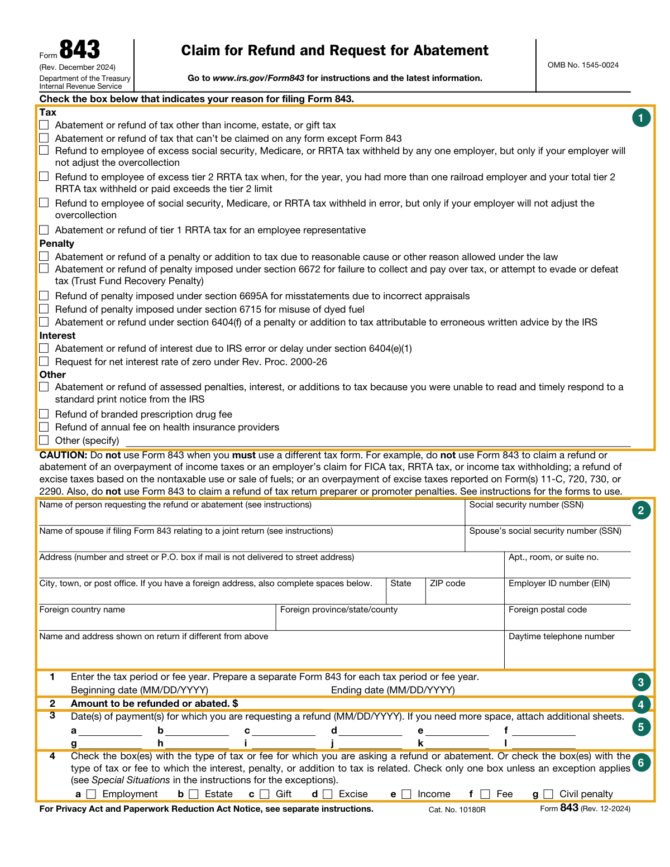
| Marker | Where on the form | What to enter |
|---|---|---|
| 1 | Reason boxes: Tax, Penalty, Interest, Other | One box only. Use “Other (specify)” and write the reason only when nothing listed fits and no other form is required |
| 2 | Name, identification number and address | Your name and SSN, ITIN or EIN; for a claim about a joint return, the spouse’s name and SSN from that return; the name and address on the return if different, and a daytime telephone number |
| 3 | Line 1 | Beginning and ending dates of the tax period, MM/DD/YYYY; for the branded prescription drug fee, the fee year on the beginning date line |
| 4 | Line 2 | The dollar amount you want refunded or abated |
| 5 | Line 3 | The date of each payment you want back; boxes a to l hold twelve dates, more go on an attached sheet |
| 6 | Line 4 | Type of tax or fee: employment, estate, gift, excise, income, fee or civil penalty; for a penalty or interest claim, the tax it relates to |
The reason boxes are grouped. Under Tax are the general refund or abatement of a non-income tax, a tax that can only be claimed on Form 843, excess social security, Medicare or RRTA tax from one employer, excess tier 2 RRTA tax from more than one railroad employer, tax withheld in error, and tier 1 RRTA tax for an employee representative. Under Penalty are reasonable cause, the Trust Fund Recovery Penalty under section 6672, the appraisal penalty under section 6695A, the dyed fuel penalty under section 6715 and erroneous written IRS advice under section 6404(f). The reasonable cause box also covers the section 6676 penalty for an erroneous refund claim, which is 20% of the amount found excessive. Interest has two boxes (IRS error or delay under section 6404(e)(1), and the net interest rate of zero under Rev. Proc. 2000-26), and Other covers the notice-reading box for taxpayers with visual impairments, the branded prescription drug fee and the annual fee on health insurance providers.
Enter a P.O. box only if the post office does not deliver to your home. With a foreign address, the city goes on the city line, the country name is written out in full and the postal code follows that country’s practice. If you move after filing, tell the IRS on Form 8822; a business or other entity uses Form 8822-B.
Line 1 drives a rule printed right on it: one Form 843 per tax period or fee year. The instructions add one per type of tax or fee, with two exceptions covered below (interest abated for a single IRS act, and the net interest rate of zero).
Page 2: return type, penalty section, reason and explanation
Page 2 ties the claim to a return, gives the reason in coded form and then in your own words, and carries the signatures.
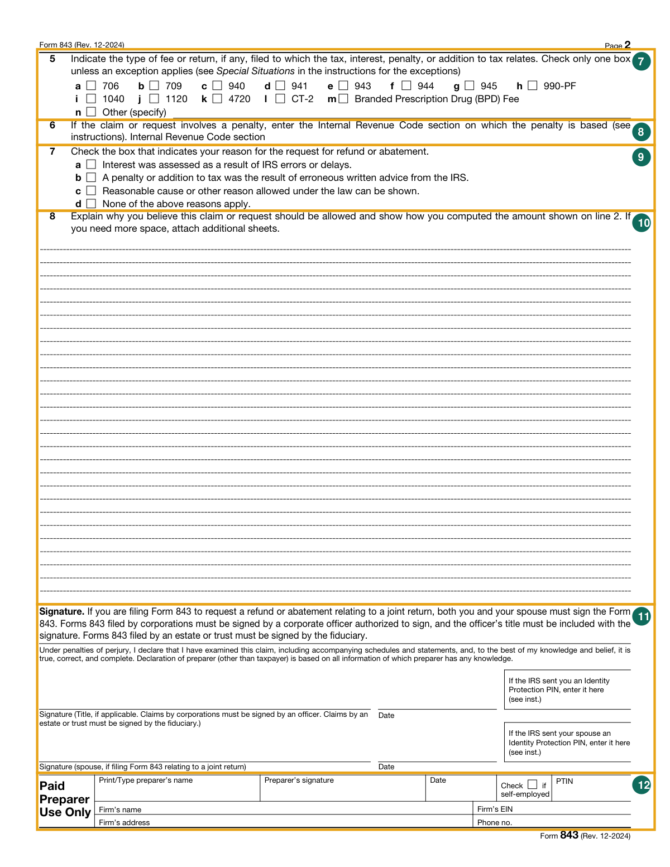
| Marker | Where on the form | What to enter |
|---|---|---|
| 7 | Line 5 | The return or fee involved: 706, 709, 940, 941, 943, 944, 945, 990-PF, 1040, 1120, 4720, CT-2, branded prescription drug fee, or Other. Box i (1040) also covers 1040-SR, 1040-NR and 1040 (sp) |
| 8 | Line 6 | For an assessed penalty, the Internal Revenue Code section it is based on; the Notice of Assessment generally shows it |
| 9 | Line 7 | a: interest from IRS errors or delays; b: erroneous written advice from the IRS; c: reasonable cause or another reason allowed by law; d: none of these |
| 10 | Line 8 | Why the claim should be allowed and how you computed line 2; every extra sheet carries your name and SSN, ITIN or EIN; attach supporting evidence |
| 11 | Signature and IP PIN | Your signature and date; both spouses for a joint return claim; an authorized officer with title for a corporation; the fiduciary for an estate or trust; the Identity Protection PIN if the IRS sent one |
| 12 | Paid Preparer Use Only | Completed and signed only by a paid preparer, who must give you a copy; someone who helps without charging does not sign |
Line 8 carries the substance of the claim. A penalty relief request built on reasonable cause, for example, checks the reasonable cause box at the top, enters the penalty’s Code section on line 6, checks box c on line 7 and then uses line 8 for the facts and the arithmetic behind the line 2 amount.
Filling in Form 843 for particular claims
The Special Situations part of the instructions changes which lines you complete and what you attach.
Penalty from erroneous written IRS advice
The IRS abates the penalty or addition to tax only if you reasonably relied on written advice, the advice answered a specific written request from you or your authorized representative, and the penalty did not come from inadequate or inaccurate information you gave. Complete lines 1 to 4, put the payment date on line 3 if you paid, enter the Code section on line 6 and check box b on line 7. Attach your written request, the IRS’s written advice and any report of tax adjustments that identifies the penalty. The request must be made within the period for collecting the penalty, or the penalty must have been paid within the period for claiming a refund of it.
Interest caused by IRS error or delay
Section 6404(e)(1) relief requires an unreasonable error or delay in a managerial or ministerial act, with no significant part caused by you, and it applies only to taxes that need a notice of deficiency: income, generation-skipping transfer, estate and gift taxes and certain excise taxes. Interest on employment taxes or other excise taxes cannot be abated. Complete lines 1 to 4, show the dates of payments of interest or tax on line 3 and check box a on line 7. On line 8, state the type of tax, when the IRS first notified you in writing, the period you want abated, the circumstances and why not abating would be grossly unfair. If one IRS act affected several years or types of tax, file a single Form 843 and check every applicable box on line 4.
Net interest rate of zero
When you owe interest on an underpayment and are due interest on an overpayment for the same period, you can ask for the net rate of zero under section 6621(d). Leave line 1 blank, enter an amount on line 2 or leave it blank, and check as many boxes on lines 4 and 5 as apply; lines 3, 6 and 7 stay empty. Line 8 lists the overpaid and underpaid periods, when you paid the tax or received the refund if either is no longer outstanding, the overlap and its amount, a computation (or why you cannot make one), and, if more than one TIN is involved, why they are the same taxpayer. Include the statement that each period has been used only once in a net zero request.
Social security, Medicare and RRTA tax
For excess tax withheld by one employer, or tax withheld in error, attach a statement from the employer showing what it repaid you and what credit or refund it claimed or you authorized it to claim. If the employer will not provide one, write your own statement with the same information and say why. Attach a copy of Form W-2 either way. For excess tier 2 RRTA tax from more than one railroad employer, complete lines 1 and 2, skip line 3, check box a (Employment) on line 4, skip lines 5 to 7, label line 8 “Excess tier 2 RRTA” with the computation and attach all your Forms W-2 for the year; Pub. 505 has a worksheet. Nonresident aliens are directed to Pub. 519.
Trust fund recovery penalty (TFRP)
Before filing a refund claim for a TFRP assessment, pay the part of the penalty for one employee if it rests on employment taxes, or for one transaction if it rests on excise taxes, for each tax period.
Branded prescription drug fee
Enter the fee year on line 1, complete line 2, skip line 3, check Fee on line 4 and box m on line 5, skip lines 6 and 7, and label line 8 “Branded prescription drug fee” with the reason. Attach the Form 8947 the fee was based on, say whether anyone has filed an earlier claim for the same amount, and do not combine the fee claim with any other claim. Interest on this fee cannot be abated.
Notices you could not read
If a disability kept you from reading and answering a standard print notice in time, line 8 can describe the disability, when you received the notice and what it said, when you learned of the issue, and whether and when you asked for the notice in an alternative format.
Time limit for a refund claim
A claim for credit or refund generally has to be filed within 3 years from the date the original return was filed or 2 years from the date the tax was paid, whichever is later. After that you may no longer be entitled to the money. Pub. 556 covers claims and appeal rights in more detail. The written advice penalty has its own timing, described above.
Filing Form 843 for someone else
An authorized representative can file for you if the original or a copy of Form 2848, signed by you, is attached. A legal representative of a decedent who filed the decedent’s return attaches a statement saying so and that they still act as representative; one who did not file it attaches certified letters testamentary, letters of administration or similar evidence. Form 1310 goes with Form 843 when you are the decedent’s legal representative.
Where to mail Form 843
There is no single address. The December 2024 instructions match the address to the reason for filing:
| If you are filing | Mail to |
|---|---|
| In response to an IRS notice about a tax or fee | The return address on the notice |
| A refund claim in a Form 706 or 709 matter | Internal Revenue Service, Attn: E&G, Stop 824G, 7940 Kentucky Drive, Florence, KY 41042-2915 |
| In response to Letter 4658 (branded prescription drug fee) | Internal Revenue Service, Mail Stop 4921 BPDF, 1973 N. Rulon White Blvd., Ogden, UT 84201-0051 |
| In response to Letter 5067C (health insurance providers fee) | Internal Revenue Service, Mail Stop 4921 IPF, 1973 N. Rulon White Blvd., Ogden, UT 84201 |
| For a net interest rate of zero | The service center where you filed your most recent return |
| As a nonresident alien, for social security or Medicare tax withheld in error | The address in Pub. 519, following its document rules |
| About Form 8300 (cash payments over $10,000) | Internal Revenue Service, Rosa Parks Federal Building, P.O. Box 32621, Detroit, MI 48232 |
| For a penalty or any other reason | The service center where you would file a current-year return for that tax, from that return’s instructions |
A form mailed to an address that has since changed is forwarded. Claims for fully paid interest and penalties that cite Kwong v. United States follow a separate IRS page posted July 1, 2026: individuals with an IRS Online Account can submit them electronically through the application on the Mobile-friendly forms page, and businesses, or individuals who prefer paper, mail the current Form 843 to Internal Revenue Service, 1973 N Rulon White Blvd., Ogden, UT 84201 with “Kwong vs. United States” written across the top. At the time of that notice, only Kwong claims were accepted electronically.
The official Form 843 PDF has fillable fields, so it can be completed on screen, printed, signed and mailed.
Questions about Form 843
Can I file Form 843 online?
Only for one group of claims: individuals with an IRS Online Account can send Kwong v. United States claims for fully paid interest and penalties electronically. Every other Form 843 is mailed to the address for its reason.
Can I use Form 843 to get back income tax I overpaid?
The instructions rule that out; an individual uses Form 1040-X. Form 843 can still cover a penalty or interest connected to income tax, with Income checked on line 4.
Do I list several years on one Form 843?
Generally one form per tax period or fee year, and per type of tax or fee. A single IRS error or delay affecting several years, and a net interest rate of zero request, are the exceptions.