Moving home does not require waiting until the next tax return to tell the IRS. Form 8822 supplies the old and new mailing addresses, identifies the taxpayers affected and records their signatures. Mail it separately; the form says not to attach it to a return.

Who needs a separate address change?
Use Form 8822 for home mailing addresses associated with individual, gift, estate or generation-skipping transfer returns. This guide follows the February 2021 revision currently supplied by the IRS. A business address change uses Form 8822-B.
When a move also affects a child who has filed an income tax return, prepare a separate 8822 for that child. For spouses who filed jointly and still live together, supply both names and Social Security numbers and have both spouses sign.
If spouses now live at different addresses, each should notify the IRS of their separate address. The extra checkbox beneath line 1 identifies a person establishing a separate residence from the spouse on the last joint return.
How to complete lines 1 through 7
Start by selecting the returns affected. The form’s numbered entries distinguish taxpayer identity from the addresses that are being replaced.
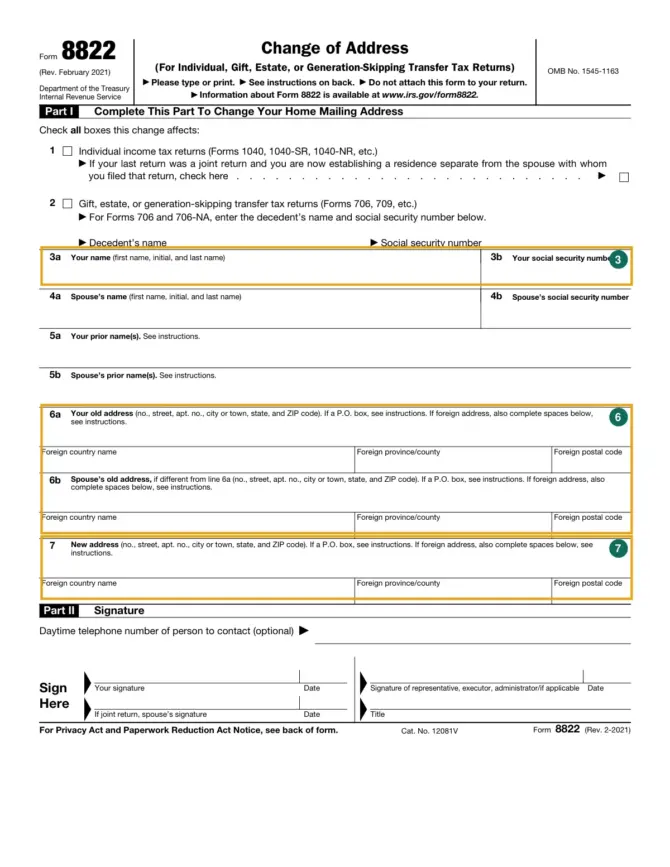
| Line | Entry | Record to use |
|---|---|---|
| 1–2 | The affected return types; line 2 also requests the decedent’s details for Forms 706 and 706-NA | The return whose mailing address is changing |
| 3–4 | Your name and SSN, and the spouse’s details when applicable | Taxpayer identification records |
| 5 | Prior names if either taxpayer changed their name | The names used before the change |
| 6a–6b | Your old address and the spouse’s old address if different | The previous mailing details |
| 7 | New mailing address, including apartment or suite | The complete destination for IRS correspondence |
For a foreign address, complete the country, province or county, and postal-code fields using local postal practice. Write the country name in full. Use a PO Box in place of a street address only where the post office does not deliver to the street address.
If correspondence goes through an accountant or attorney, the instructions allow a C/O entry followed by that person’s name and address. Naming a recipient for mail does not replace the authority needed for a representative to sign.
Signatures and representatives
Part II requires the taxpayer’s signature and date. For the joint-return situation, the spouse also signs unless the separate-residence box on line 1 applies. The daytime contact number is optional.
A representative signing for a taxpayer must attach a copy of the power of attorney; the instructions identify Form 2848 as an option. The IRS says it will not complete a change submitted by an unauthorized third party. An executor or administrator uses the applicable signature and title spaces.
An estate address change and a deceased person’s state refund claim are different procedures. For a Nebraska refund due to a deceased person, the separate Form 1310N guide covers the state claim.
Where to send it and when the change is processed
Choose the mailing destination from page 2 using the old home mailing address. If line 2 is checked, the form gives Department of the Treasury, Internal Revenue Service Center, Kansas City, MO 64999-0023. Other cases use the applicable row, including the specific rows for foreign addresses and territories.
The IRS gives a general processing estimate of four to six weeks after receipt. Its address-change guidance also lists alternatives, such as a signed written statement or using the new address on a return. Postal-service forwarding alone is not a substitute for notifying the IRS: some post offices do not forward government checks.
Official PDF: Form 8822 — Official PDF (irs.gov)