Form 373, the Wholesale Exemption Certificate, is the paper a Delaware wholesaler keeps when an out-of-state buyer picks up goods in Delaware and takes them straight out of the state. Without it, the sale counts as a delivery inside Delaware and goes into the wholesaler’s taxable gross receipts. The current version is marked “Revised 12/26/13” and has two pages: the certificate itself and a page of instructions.
When a Delaware wholesaler needs Form 373
Delaware has no sales tax. Its gross receipts tax is charged to the seller, and for a wholesaler it applies to goods physically delivered within the state to the purchaser or the purchaser’s agent. Title 30, § 2901(8)b.6 of the Delaware Code leaves one kind of pickup out of those receipts: the purchaser’s vehicle or vessel is not headquartered or dispatched from within Delaware, the property is immediately taken outside Delaware, and the purchaser gives the wholesaler an exemption certificate. Form 373 is that certificate.
The Division of Revenue’s gross receipts FAQ puts the condition plainly: the wholesale pickup is not taxed only if Form 373 is completed prior to or concurrent with the sale. A certificate signed weeks after the goods left the dock does not meet that wording.
Three nearby situations work differently:
- Goods you ship yourself to a customer outside Delaware, by mail or common or contract carrier, are not taxable gross receipts either. Form 373 is not the document for them; the FAQ asks you to keep documentation of the interstate shipment.
- A retail sale picked up in Delaware is taxable no matter where the customer takes the goods afterward. Form 373 covers wholesale sales only.
- A resale certificate from the buyer’s home state does not help. The Division’s exemption certificates page says sales tax exemption and reseller certificates are not applicable in Delaware and that sales for resale are not exempt.
How to fill out Form 373, section by section
The certificate has no printed numbers. The image below numbers its six blocks in the order you meet them on the page, and the table uses the same numbers. The PDF on the Division’s site has no fillable fields, so it is printed and completed by hand.
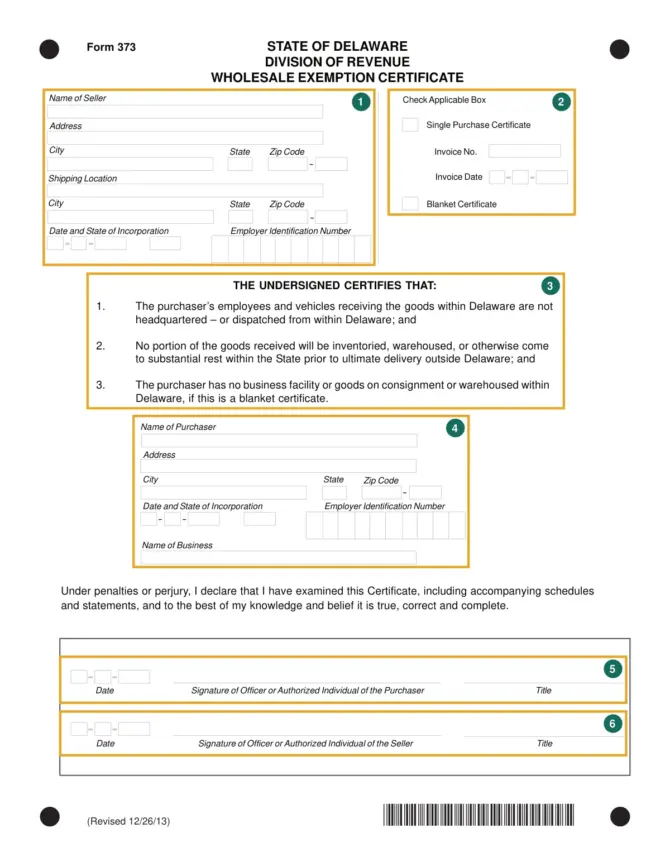
| Block | Printed labels | What goes in it |
|---|---|---|
| 1 | Name of Seller, Address, City, State, Zip Code, Shipping Location, Date and State of Incorporation, Employer Identification Number | The Delaware wholesaler’s details; the instructions list the shipping location among the seller’s items. The incorporation date has three date boxes plus a separate box for the state; the EIN row has nine cells. |
| 2 | Check Applicable Box: Single Purchase Certificate (Invoice No., Invoice Date) or Blanket Certificate | Tick one. A single purchase certificate needs the invoice number and date of that one sale. |
| 3 | The undersigned certifies that, statements 1 to 3 | Nothing to write. Statement 1: the purchaser’s employees and vehicles receiving the goods are not headquartered or dispatched from within Delaware. Statement 2: no portion of the goods will be inventoried, warehoused or otherwise come to substantial rest in Delaware before delivery outside the state. Statement 3, for a blanket certificate: the purchaser has no business facility, consigned goods or warehoused goods in Delaware. |
| 4 | Name of Purchaser, Address, City, State, Zip Code, Date and State of Incorporation, Employer Identification Number, Name of Business | The out-of-state buyer’s details, with its federal EIN in nine cells. The instructions call the last item the nature of business of the purchaser, while the form labels it Name of Business. |
| 5 | Date, Signature of Officer or Authorized Individual of the Purchaser, Title | The purchaser’s officer or authorized individual certifies the purchaser’s statements. Both signatures sit under the perjury declaration printed above the box. |
| 6 | Date, Signature of Officer or Authorized Individual of the Seller, Title | The seller’s officer or authorized individual certifies the seller’s statements. |
The instructions say the seller completes the form with all pertinent information, and the FAQ addresses the wholesaler in the same way (“only if you complete Form 373”). The Delaware Code describes the certificate as one the purchaser provides to the wholesaler. On the form both sides sign, each for its own statements, and the FAQ wants the form completed prior to or concurrent with the sale.
The purchase orders on which the exemption is claimed must show the name and address of the destination when it differs from the purchaser’s address. An exemption claimed by a parent or affiliated company does not extend to its subsidiaries, affiliates, officers or employees; each buying entity needs its own certificate.
Single purchase or blanket certificate
A single purchase certificate covers one invoice. A blanket certificate covers repeat pickups by the same out-of-state purchaser, as long as the seller holds a properly executed certificate dated within one year before each sale. Every later sales slip or invoice under the blanket certificate must carry a note that an exemption is being claimed.
What turns an exempt pickup into a taxable sale
These points come from the form’s instructions and the Division’s FAQ, which name them as reasons the exemption is lost:
- No certificate completed by the time of the sale.
- No list of valid exemption certificates kept by the seller, or invoices without the note that an exemption is claimed. The instructions say either failure makes the sale taxable.
- A blanket certificate dated more than one year before the sale.
- Information the Director of Revenue requests about the nature of the sale or the purchaser’s organization is not supplied. That can lead to revocation of the exemption.
- A certificate claimed under a parent or affiliated company’s name by a subsidiary that bought the goods.
Who owes the tax if a certificate turns out to be wrong
The two official texts do not say the same thing here. The page 2 instructions of the 12/26/13 form say that when a wholesaler relies on an untrue or incomplete certificate furnished by a purchaser and does not pay tax, the wholesaler is still liable for the tax, penalty and interest.
The current text of 30 Del. C. § 2902(c)(6) says a wholesaler is entitled to rely on an exemption certificate that is valid on its face and complies with the Director’s regulations, and is not liable for tax on sales covered by invalid certificates. The person who provided an invalid certificate is liable for the tax, calculated without the monthly exclusion, plus interest and a penalty under § 535(a) equal to 75% of the underpayment, in addition to possible prosecution.
The Division’s Business Tax Forms page still links the version revised 12/26/13. If a certificate you accepted turns out to be untrue, ask the Division’s gross receipts tax department, (302) 577-8780, before relying on either reading, or get advice from a Delaware tax adviser.
Records to keep after the pickup
- The signed Form 373, kept for three years from the end of the calendar year in which the sale occurs.
- A current list of valid exemption certificates.
- Invoices or sales slips noting the exemption claim, and purchase orders showing the destination when it differs from the buyer’s address.
- Tax records and invoices organized so Division of Revenue staff can match each exempt sale to a certificate, as the instructions require.
The instructions give no address for sending Form 373 to the Division. That sets it apart from a payment voucher such as Form CIT-VCH, which travels with a corporate income tax payment. Form 373 stays in the wholesaler’s files for review.
How exempt pickups relate to the gross receipts return
A sale covered by a valid certificate does not result in taxable gross receipts for the wholesaler. Under § 2902(c)(1) wholesalers pay 0.3983% of aggregate gross receipts from goods physically delivered in Delaware, after a $100,000 deduction for each month. Quarterly filers, whose taxable receipts in the lookback period do not exceed the $1,500,000 threshold (adjusted annually), get a $300,000 deduction per quarter. Monthly returns are due by the 20th of the following month and quarterly returns by the last day of the month after the quarter ends. Delaware has required online filing of gross receipts returns at tax.delaware.gov since January 1, 2021; the FAQ points to TIM 2020-2 for the exceptions that allow paper.
Where to get Form 373
The Form 373 PDF is listed under “Wholesale Exemption” on the Division of Revenue’s Business Tax Forms 2025-2026 page. Page 1 is the certificate and page 2 the instructions. The instructions allow the form to be reproduced without the Division’s permission, and copies are also available from the Division of Revenue.
Questions about Form 373
Does Form 373 apply to retail sales in Delaware?
Form 373 covers wholesale sales. The Division’s FAQ says gross receipts tax is due when a retail customer picks up or takes delivery in Delaware, regardless of where the goods end up.
Can an out-of-state buyer give me its home-state resale certificate instead?
The Division states that sales tax exemption and reseller certificates are not applicable in Delaware and that sales for resale are not exempt. The out-of-state pickup exclusion is documented on Form 373.
How long is a blanket Form 373 good for?
Under the instructions, a blanket certificate supports a sale only if it is dated within one year before that sale. After that, the seller needs a newly executed certificate for further exempt pickups.
Official sources
- Delaware Division of Revenue, Form 373, Wholesale Exemption Certificate, revised 12/26/13, with instructions
- Delaware Division of Revenue, Business Tax Forms 2025-2026
- Delaware Division of Revenue, Gross Receipts Tax FAQs
- Delaware Division of Revenue, Exemption Certificates
- Delaware Code, Title 30, Chapter 29, Retail and Wholesale Merchants’ License Requirements and Taxes (§§ 2901, 2902)
- Delaware Division of Revenue, Form CIT-VCH, Electronic Filer Corporation Payment Voucher, 2025