When someone dies and their final Delaware income tax return shows a refund, the Division of Revenue needs to know who may receive that money. Form PIT-CFR, Claim for Refund Due on Behalf of Deceased Taxpayer, answers that question. It is a one-page form for 2025 (revision 20250515) that the Division lists under miscellaneous forms on its personal income tax page, and the form itself says it is “to be submitted with the tax return seeking the refund”.
Who signs Form PIT-CFR
The 2025 resident instructions say a deceased person’s final return is filed by the executor, the administrator or another person responsible for the decedent’s property. The same booklet adds, in its signature section, that PIT-CFR must be completed if the deceased taxpayer’s refund check is to be issued to the estate.
Part 1 of the form sorts claimants into two groups, and you check only one box:
- Box A: a personal representative appointed or certified by a court. A court certificate showing the appointment must be attached.
- Box B: anyone else claiming the refund for the decedent’s estate. This person also completes Part 2 and attaches a copy of the death certificate or other proof of death.
Box B is not always the end of it. The form states that if a personal representative has been appointed (question 2a) or will be appointed (question 2b), the personal representative must file for the refund.
The federal return is a separate matter. An executor who wants to tell the IRS about the fiduciary relationship uses Form 56, Notice Concerning Fiduciary Relationship; PIT-CFR covers only the Delaware refund.
How to fill out Form PIT-CFR, part by part
The fillable PDF has two identification blocks at the top and three numbered parts below them. The image marks them 1 to 5 in the order you complete them.
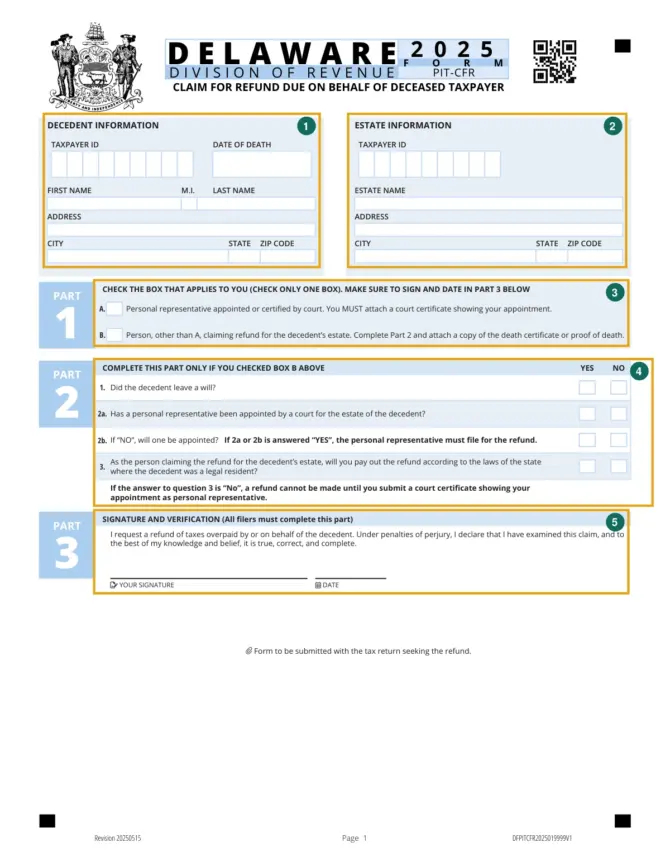
| Marker | Section on the form | What you enter |
|---|---|---|
| 1 | Decedent information | The decedent’s taxpayer ID (nine cells), date of death, first name, middle initial, last name and address with city, state and ZIP code. |
| 2 | Estate information | The estate’s taxpayer ID, the estate name and the estate’s mailing address. |
| 3 | Part 1 | One check mark: box A for a court-appointed or court-certified personal representative, box B for any other person claiming for the estate. |
| 4 | Part 2 (box B only) | Yes or no to four questions: 1, did the decedent leave a will; 2a, has a court appointed a personal representative; 2b, if not, will one be appointed; 3, will you pay out the refund under the laws of the state where the decedent was a legal resident. |
| 5 | Part 3 | Signature and date. Every filer completes this part, whichever box was checked in Part 1. |
The Part 3 statement is made under penalties of perjury: the signer requests a refund of taxes overpaid by or on behalf of the decedent and declares the claim true, correct and complete.
Part 2 works as a filter. A yes on 2a or 2b sends the claim to the personal representative, who files with box A and a court certificate. A no on question 3 stops the refund until you submit a court certificate showing your own appointment as personal representative. Question 1, about the will, has no instruction attached to its answer on the form.
Naming the decedent on the PIT-RES
The return that carries the claim has its own rule for the decedent’s name. The resident booklet asks you to write DECD after the decedent’s first name on page 1 of the return. When there is a surviving spouse, the spouse’s details go first, under “Your Taxpayer ID” and “Your Last Name”, and the decedent’s details go in the spouse fields.
Filing electronically, and what the booklets leave open
The form says to submit it with the return that claims the refund. The 2025 resident booklet also says that a return filed electronically needs no paper copy. Neither the PIT-CFR nor the 2025 PIT-RES and PIT-NON instructions explain how a PIT-CFR, court certificate or death certificate is sent along with an e-filed return. The Division’s contact page lists Personal Income Tax Assistance at (302) 577-8200 and Refund Assistance at (302) 577-8784; ask there before relying on an e-filed claim.
The 2025 nonresident booklet (PIT-NON) has a second problem. Its signature section says “Form PIT-CRS” must be completed if the deceased taxpayer’s check is to be issued to the estate. PIT-CRS is the Delaware Income Tax Credit Schedule in the same booklet, and the forms page lists no deceased-taxpayer form other than PIT-CFR. The nonresident booklet also refers readers to a “Deceased Taxpayer” section on page 11, and that page has no such section. Nonresident estates should confirm the form with the Division before mailing.
What goes in the envelope
- The 2025 return showing the refund, with DECD after the decedent’s first name.
- Form PIT-CFR with the decedent and estate blocks filled in, one box checked in Part 1 and Part 3 signed and dated.
- For box A, the court certificate showing the personal representative’s appointment.
- For box B, Part 2 answered and a copy of the death certificate or proof of death.
- The other attachments the return itself needs, listed in the booklet under “What Documents to Attach”.
When and where to send Form PIT-CFR
The 2025 Form PIT-CFR is a fillable PDF on the Division’s personal income tax forms page, with a Prepare For Print button above the decedent block. The Division publishes no separate instructions for it.
PIT-CFR has no due date of its own because it goes with the return. Delaware returns for calendar year 2025 were due on or before April 30, 2026; fiscal-year filers have until the last day of the fourth month after their tax year ends. A return showing a refund is mailed, according to both the PIT-RES and the PIT-NON instructions, to:
State of Delaware
Division of Revenue
P.O. Box 8710
Wilmington, DE 19899-8710
That box is for refund returns. Returns with a balance due go to P.O. Box 508, and zero-due returns to P.O. Box 8711.
Questions about Form PIT-CFR
What if no court has appointed anyone for the estate?
Check box B, answer Part 2 and attach a copy of the death certificate or proof of death. If you answer no to question 3, the refund waits until you send a court certificate naming you as personal representative.
Does a court-appointed executor answer Part 2?
The form limits Part 2 to people who checked box B. An executor who checks box A attaches the court certificate, skips Part 2 and signs Part 3.
Official sources
- Delaware Division of Revenue, Form PIT-CFR, Claim for Refund Due on Behalf of Deceased Taxpayer, 2025, revision 20250515
- Delaware Division of Revenue, Personal Income Tax Forms Current Year (2025-2026)
- Delaware Division of Revenue, 2025 Individual Income Tax Return, Resident Instructions (PIT-RES)
- Delaware Division of Revenue, 2025 Individual Income Tax Return, Non-Resident Instructions (PIT-NON)
- Delaware Division of Revenue, Contact Information
- Internal Revenue Service, About Form 56, Notice Concerning Fiduciary Relationship