A settlement can require a penalty payment, environmental cleanup and changes to business operations under the same agreement. Form 1098-F separates those amounts. The government official responsible for reporting prepares the form; the business named as payer receives a statement for its records.
The April 2025 form and instructions apply to tax year 2025 and later years until replaced. The form reports amounts required by the order or agreement, including qualifying costs of providing property or services.
Who files Form 1098-F at the $50,000 threshold?
The appropriate official of a government, governmental entity or qualifying nongovernmental entity files under section 6050X. The reporting threshold is an aggregate amount of $50,000. The instructions cover orders and agreements becoming binding on or after January 1, 2022.
Related suits, orders or agreements concerning the same violation, investigation or inquiry are aggregated for the threshold. Splitting a settlement into several smaller payments does not remove the reporting requirement. Prepare a separate Form 1098-F for each payer with an obligation under the order or agreement.
Completing the payment boxes and case details
Copy the filer and payer names and addresses into their separate areas. The filer is the reporting entity; the payer is the person whose payment obligation is being reported. The marked Copy B shows boxes 1, 3 and 9.
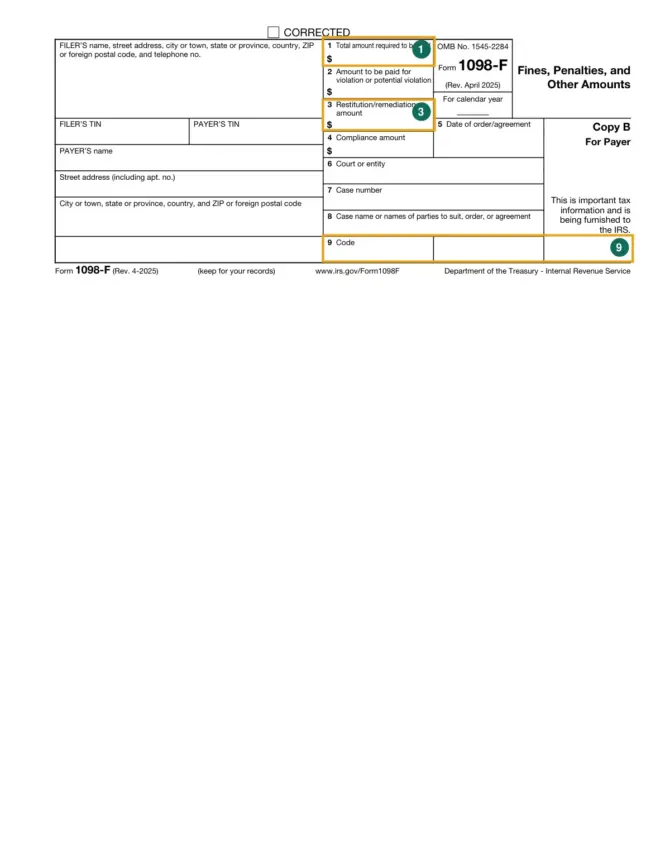
| Box | What belongs here | Where to look |
|---|---|---|
| 1 | Total required payment amount | All covered obligations in the order or agreement, including services or property costs |
| 2 | Amount for the violation or potential violation | Penalty or other violation-related amount identified in the document |
| 3 | Restitution or remediation amount | Amounts designated for restoring losses or remedying harm |
| 4 | Compliance amount | Amounts designated to bring the payer into compliance with law |
| 5 | Date of order or agreement | Date the court entered the order or the agreement was fully executed |
| 6-8 | Court or entity, case number and case or party names | Case heading and approval record, as applicable |
| 9 | One or more applicable letter codes | Payment structure and identification of amounts |
The IRS settlement example has $40,000 in civil penalties, $80,000 in restitution, $50,000 in site remediation and $60,000 in compliance upgrades. It puts $230,000 in box 1, $40,000 in box 2, $130,000 in box 3 and $60,000 in box 4. Other agreements may produce a box 1 amount different from the sum of boxes 2 through 4; follow the obligations in the actual document.
Which box 9 codes apply?
Use A for multiple payments, B for multiple payers, C for multiple payees and D when services or property must be provided. Code E identifies an amount that the order or agreement does not specify. More than one code can apply.
When some or all of the aggregate payment is unidentified and the reporting entity reasonably expects at least $50,000, the box 1 instructions say to enter $50,000 and code E. For an unidentified amount in one of the categories in boxes 2, 3 or 4, leave that category’s box blank and enter E. Do not replace an unknown category amount with an estimate.
Download the PDF and distinguish Copy A from Copy B
The IRS PDF includes a fillable Copy B for the payer. Keep that copy with the agreement and supporting records. Copy A downloaded from the website is informational and cannot be printed and filed as the scannable IRS copy. Order the official scannable forms if filing on paper.
The instructions point filers to the General Instructions for Certain Information Returns for deadlines, submission addresses, corrections and payer-statement rules. The electronic filing threshold is generally ten information returns, counted across the covered return types. The IRS identifies IRIS as an electronic information-return filing option.
A payer’s TIN can be shortened on the statement furnished to the payer. The copy filed with the IRS requires the complete TIN, and the filer’s own TIN cannot be shortened. Ask the reporting entity to address incorrect payer information; keep the statement with the legal papers for your tax adviser to review.