Form 5500-EZ is the annual return for a retirement plan that covers only a business owner (and spouse) or only partners (and their spouses), and for certain pension plans kept outside the United States for nonresident aliens. It is filed with the IRS under section 6058(a) of the Internal Revenue Code, either on paper to Ogden, Utah, or electronically through EFAST2. This guide follows the 2025 Form 5500-EZ (Catalog Number 63263R) and the 2025 Instructions for Form 5500-EZ dated July 7, 2025, which cover plan years that began in 2025.
Who has to file Form 5500-EZ
The instructions call the first group one-participant plans. That means a defined benefit pension plan, or a defined contribution profit-sharing or money purchase pension plan, other than an employee stock ownership plan (ESOP), that covers only you, or you and your spouse, when the two of you own the whole business, incorporated or not. A plan covering only one or more partners in a business partnership, or partners and their spouses, also qualifies, and a 2% shareholder of an S corporation (as defined in section 1372(b)) is treated as a partner. In both cases the plan must not provide benefits for anyone else.
The second group is foreign plans: pension plans maintained outside the United States primarily for nonresident aliens. A foreign plan has to file when the employer maintaining it is a domestic employer, or a foreign employer with U.S.-source income (foreign subsidiaries of domestic employers included) that deducts its plan contributions on a U.S. income tax return. A qualified foreign plan under section 404A(e) that does not qualify for the treatment in section 402(d) files no annual return at all.
These plans cannot use Form 5500 or Form 5500-SF, even if they filed one of those in earlier years. A plan that is subject to the reporting rules of section 104 of ERISA files Form 5500 electronically, or Form 5500-SF if eligible, instead of Form 5500-EZ.
An eligible combined plan (a defined benefit plan and a 401(k) plan held in one trust) that files Form 5500-EZ reports everything either type of plan would report.
The $250,000 asset test and the final plan year
A one-participant plan does not have to file for the 2025 plan year if, at the end of that plan year, its assets plus the assets of every other one-participant plan the same employer maintains total $250,000 or less. The figure to use is the end-of-year total plan assets on line 6a, column (2). The exception does not apply in the plan’s final year: a return is due for the year in which all assets are distributed, whatever the balance was. The exception is written for one-participant plans; the instructions set no asset threshold for foreign plans.
Once the combined total goes over $250,000, every one-participant plan of that employer files, including the smaller ones. Say a consultant maintains a profit-sharing plan worth $180,000 and a defined benefit plan worth $90,000 at the end of the 2025 plan year: neither plan alone exceeds the limit, but together they hold $270,000, so a Form 5500-EZ is due for each plan.
How to fill out Form 5500-EZ, part by part
The 2025 return has two pages and five parts. The numbers in the image were added for this guide and match the first column of the table; page 2 (lines 7 to 12 and the signature) is not shown.
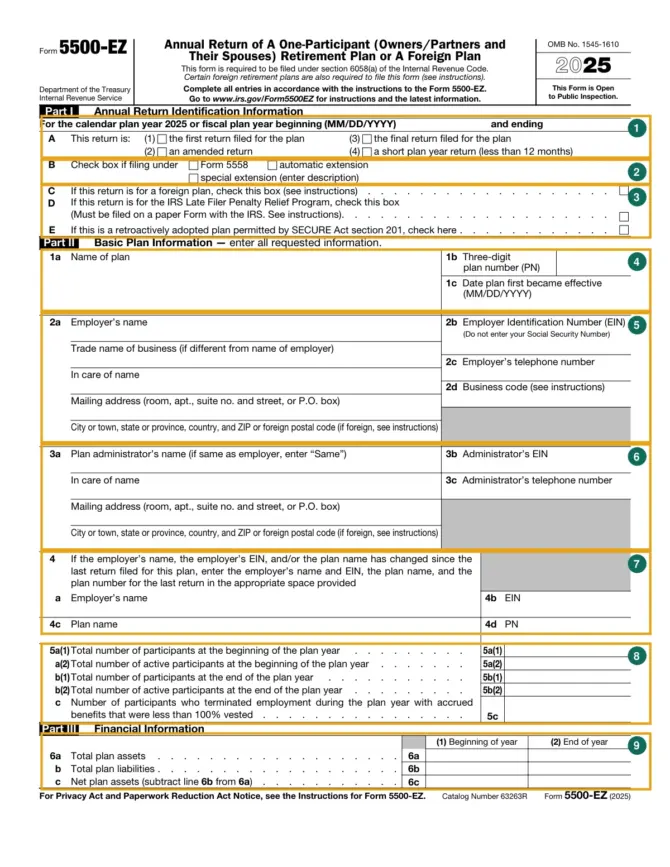
| Marker | Lines | What goes there |
|---|---|---|
| 1 | Plan year, box A | Beginning and ending dates for a fiscal or short plan year in MM/DD/YYYY; first, amended, final or short plan year return. |
| 2 | Box B | Form 5558 extension, automatic extension tied to the employer’s income tax return, or special extension with a description. |
| 3 | Boxes C, D, E | Foreign plan; Late Filer Penalty Relief Program (paper only); plan adopted retroactively under SECURE Act section 201. |
| 4 | Lines 1a to 1c | Formal plan name, three-digit plan number starting at 001, date the plan first became effective. |
| 5 | Lines 2a to 2d | Employer’s name, trade name, in care of name and address; nine-digit EIN (not an SSN); telephone; six-digit business code. |
| 6 | Lines 3a to 3c | Plan administrator’s name, address, EIN and telephone, or “Same” when the administrator is the employer. |
| 7 | Lines 4a to 4d | Employer name, EIN, plan name and plan number as they appeared on the last return, only if any of them changed. |
| 8 | Lines 5a(1) to 5c | Participants and active participants at the beginning and end of the plan year; participants who left with accrued benefits less than 100% vested. |
| 9 | Lines 6a to 6c | Total plan assets, total liabilities and net assets, each at the beginning and end of the year, in whole dollars. |
| (page 2) | Lines 7a to 7c | Contributions received or receivable from the employer, from participants, and from others, including rollovers. |
| (page 2) | Line 8 | Two-character plan characteristic codes from the list in the instructions. |
| (page 2) | Lines 9 to 12 | Participant loans, defined benefit minimum funding (Schedule SB line 40), money purchase minimum funding, pre-approved plan opinion letter. |
| (page 2) | Sign here | Signature, date and printed name of the employer or plan administrator. |
Part I: plan year and the boxes at the top
Enter the plan year’s beginning and ending dates as MM/DD/YYYY, for example 01/01/2025; a plan year cannot be longer than 12 months. For a short plan year, enter the actual dates and check box A(4); the short year ends on the date the accounting period changes or the plan’s assets are fully distributed. Box A(1) is only for a plan that has never filed any annual return, including a Form 5500. Box A(3) marks the final return, checked when all assets, including insurance and annuity contracts, have been distributed to participants and beneficiaries or transferred to another plan. A short final year gets both A(3) and A(4).
Box E is for a plan the sponsor adopted during the 2025 plan year, by the due date (with extensions) of its 2024 tax return, and elected to treat as adopted on the last day of the 2024 taxable year under section 201 of the SECURE Act. Such a plan does not file a 2024 Form 5500-EZ. If it is a defined benefit plan, the enrolled actuary still completes and signs a 2024 Schedule SB as well as the 2025 one, and the sponsor keeps both.
Part II: plan, employer and administrator
The plan number on line 1b stays with the plan for every future return and is never reused for another plan, even after termination. Line 2a has five rows, one each for the employer’s name, trade name, “C/O” name, street address and city/state/ZIP; a P.O. box is allowed only when the Post Office does not deliver to the street address.
An employer without an EIN applies online (IRS.gov/Businesses, “Employer ID Numbers”) or with Form SS-4 by mail or fax. Foreign plans cannot apply online; they use Form SS-4 or call 267-941-1099, which is not toll free. The business code on line 2d comes from the list of principal business activity codes at the end of the instructions; for example, 541211 is offices of certified public accountants and 541110 is offices of lawyers. If the employer’s own address has changed, the instructions point to Form 8822-B to tell the IRS.
On line 3a, write “Same” when the employer is the administrator, and leave the rest of 3a and all of lines 3b and 3c blank. A different administrator must have its own EIN for this return.
For lines 5a(1) to 5b(2), a participant includes active participants (anyone currently earning or keeping credited service, including people eligible to defer under a 401(k) arrangement), retired or separated people receiving benefits or entitled to future benefits, and deceased individuals whose beneficiaries receive or are entitled to benefits. People whose benefits an insurance company has irrevocably committed to pay are left out. Line 5c counts anyone who left employment during the year with accrued benefits less than 100% vested, whether or not they had a break in service or received a cash-out.
Part III: assets, liabilities and contributions
Use the cash, modified cash or accrual method, as long as it is applied consistently. The beginning-of-year figures on lines 6a to 6c must equal the end-of-year figures on the previous year’s return. Total plan assets include rollovers and transfers received, unrealized gains and losses, real estate, employer securities and participant loans. Contributions designated for the 2025 plan year stay out of column (1). Liabilities on line 6b include benefit claims payable, operating payables and acquisition indebtedness, but not the value of future distributions to participants.
Lines 7a and 7b are cash contributions received or receivable during the plan year from the employer and from participants. Line 7c takes all other contributions, including rollovers and transfers from other plans, valued on the date they were contributed.
Part IV: plan characteristic codes on line 8
Line 8 cannot be left blank. Enter every code that applied during the year. Among the codes in the 2025 list are 2E (profit-sharing plan), 2J (section 401(k) feature), 2C (money purchase plan other than target benefit), 1A or 1B (defined benefit with pay-related or flat-dollar benefits), 1C (cash balance plan), 3A (non-U.S. plan maintained primarily for nonresident aliens), 3B (plan covering self-employed individuals), 3D (pre-approved pension plan with a favorable IRS opinion letter) and 3H (sponsor in a controlled group or affiliated service group). An eligible combined plan enters the codes for both its defined benefit and defined contribution features.
Part V: loans, funding and the opinion letter
Line 9 is “Yes” if any participant loan was outstanding at any time during the plan year, with the balance at year end: unpaid principal plus accrued unpaid interest, residential mortgage loans subject to section 72(p) included, deemed-distributed loans excluded.
Line 10 is “Yes” for a defined benefit plan subject to the minimum funding standards of section 412, and line 10a takes the unpaid minimum required contributions for all years from Schedule SB, line 40. The enrolled actuary completes and signs the 2025 Schedule SB and gives it to the person filing Form 5500-EZ by the filing due date. The schedule is not filed with the return; it is kept with the plan’s records.
Line 11 is for a defined contribution plan subject to the minimum funding requirements of section 412. Line 11a is the date of the letter ruling if a waiver of the minimum funding standard for a prior year is being amortized this year; in that case lines 3, 9 and 10 of Schedule MB are completed and kept, not attached. Lines 11b to 11d compare the minimum required contribution with what the employer contributed (enter a minus sign for a negative result), and line 11e asks whether any shortfall will be met by the funding deadline.
Line 12 applies when the sponsor adopted a pre-approved plan with a favorable IRS opinion letter. Enter the date of the most recent letter and its serial number, which is one capital letter followed by six numbers. A plan modified in a way that negates the opinion letter is treated as an individually designed plan, and the sponsor is no longer an adopting employer of a pre-approved plan.
Signature
The employer (owner) or the plan administrator signs and dates the paper return and prints the signer’s name.
When Form 5500-EZ is due and how to get more time
The return is due by the last day of the 7th calendar month after the plan year ends. For a calendar 2025 plan year that was July 31, 2026. A short plan year is due by the last day of the 7th month after the short year ends. When the date falls on a Saturday, Sunday or legal holiday, the return may be filed the next business day.
There are three ways to extend the date, each checked in box B:
- Form 5558, filed by the normal due date, gives one extension of up to 2½ months. The Form 5558 (Rev. January 2025) instructions say a timely, complete request is approved automatically to no later than the 15th day of the 3rd month after the normal due date, which for a calendar 2025 plan year was October 15, 2026. Keep a copy with the plan’s records and do not attach it to Form 5500-EZ.
- The automatic extension applies without Form 5558 when the plan year and the employer’s tax year are the same, the employer has an extension to file its income tax return to a date later than the normal Form 5500-EZ due date, and a copy of that income tax extension request is kept with the plan’s records. It cannot be stretched further with a Form 5558 filed after the normal due date.
- A special extension announced by the IRS, for example for a Presidentially declared disaster or for service in a combat zone, is claimed by checking “special extension” and describing the announcement that grants it.
Since January 1, 2025, Form 5558 can be filed electronically through EFAST2 or on paper to the Department of the Treasury, Internal Revenue Service Center, Ogden, UT 84201-0045. Each plan needs its own Form 5558.
Where to file: paper to Ogden or electronically through EFAST2
A filer that is not required to e-file chooses between paper and EFAST2. Paper returns can be the fillable 2025 Form 5500-EZ from irs.gov, printed and signed, the official printed form completed by hand in black or blue ink, or approved software. Mail them to:
Department of the Treasury
Internal Revenue Service
Ogden, UT 84201-0020
A designated private delivery service uses the street address Internal Revenue Submission Processing Center, 1973 Rulon White Blvd., Ogden, UT 84201, and can meet the timely mailing as timely filing rule.
EFAST2 is the Department of Labor’s filing system (www.efast.dol.gov), used through its web-based filing system or an EFAST2-approved vendor. E-filing is mandatory under Treasury Regulations section 301.6058-2 (T.D. 9972) for a filer required to file at least 10 returns of any type with the IRS during the calendar year that includes the first day of the plan year. Forms W-2, Forms 1099, income tax, employment tax and excise tax returns all count. A filer covered by the rule that mails a paper return is treated as not having filed. The IRS may waive the requirement year by year for undue economic hardship (Rev. Proc. 2023-31), and the filer should keep documentation supporting the reason for not filing electronically.
Do not file Schedule MB or Schedule SB with Form 5500-EZ, on paper or through EFAST2. The 2025 schedules are available only electronically on the EFAST2 website, where they can be completed and printed for the plan’s records.
An amendment checks box A(2) and follows the route of the original. A return first filed electronically on Form 5500-EZ or Form 5500-SF is amended electronically on Form 5500-EZ, never on Form 5500-SF. A return first filed on paper Form 5500-EZ is amended on paper with the IRS.
The 2025 Form 5500-EZ PDF and the 2025 Instructions for Form 5500-EZ are on irs.gov. The IRS help desk for the form is 877-829-5500; EFAST2 questions go to 1-866-GO-EFAST (1-866-463-3278), Monday through Friday. Section 6104(b) makes the information on the form available to anyone who asks, but one-participant and foreign plan returns are not published on the internet, whether filed on paper or through EFAST2.
Late returns: the penalty and the relief program
Section 6652(e) imposes $250 a day, up to $150,000 per plan year, for a return not filed by its due date. The IRS page on the relief program adds interest and a $1,000 penalty under section 6692 for each late actuarial report.
The Late Filer Penalty Relief Program under Rev. Proc. 2015-32 covers one-participant plans and foreign plans that are not subject to Title I of ERISA. It is not available for a year in which the IRS has already sent notice CP 283, Penalty Charged on Your Form 5500 Return. Delinquent returns cannot be sent through EFAST2 under the program. The steps on the IRS page are:
- Prepare a paper Form 5500-EZ for each late year, on that year’s form for 1990 and later years, and check box D on the 2025 form.
- For years whose form has no box D, write in red at the top of the return: “Delinquent Return Filed under Rev. Proc. 2015-32, Eligible for Penalty Relief.”
- Attach Form 14704 to the front of the oldest delinquent return in the submission. Each plan is a separate submission.
- Pay $500 per delinquent return, up to $1,500 per submission for the same plan, by check payable to “United States Treasury.”
- Mail to Internal Revenue Service, 1973 Rulon White Blvd., Ogden, UT 84201 (first class mail), or to the Internal Revenue Submission Processing Center at the same street address by private delivery service.
Instead of the program, a sponsor can attach to the late return a statement of reasonable cause signed by a person in authority. If that request is denied, a CP 283 notice follows and the year can no longer go through the program.
Before you file
- Combined end-of-year assets of all the employer’s one-participant plans checked against $250,000, or the final-year rule applied.
- Column (1) of lines 6a to 6c matches column (2) of last year’s return, in whole dollars.
- Line 8 has at least one plan characteristic code.
- Box B checked if the return relies on Form 5558, the automatic extension or a special extension; the extension request kept with the plan’s records.
- Schedule SB or Schedule MB, where needed, completed and kept with the plan’s records, not attached.
- An EIN, not a Social Security number, on lines 2b and 3b.
- No arrows, notes, glue or felt tip ink on a paper return, and no markings on the blank side of a one-sided page.
- Paper return signed and dated by the employer or plan administrator.
Questions about Form 5500-EZ
Does a solo 401(k) with less than $250,000 need Form 5500-EZ?
A one-participant plan files for the 2025 plan year only if its year-end assets, added to those of the employer’s other one-participant plans, exceed $250,000, or if 2025 is the plan’s final year. A plan that terminates and distributes everything files a final return even with a smaller balance.
Can a one-participant plan file Form 5500-SF instead?
The instructions rule this out: one-participant plans and foreign plans cannot file Form 5500 or Form 5500-SF, even if they did in the past. Form 5500-EZ is filed on paper or through EFAST2, and an amendment of an earlier Form 5500-SF filing is also made on Form 5500-EZ.
Is a Form 5500-EZ filed through EFAST2 posted online?
The information is available to the public on request under section 6104(b), but the instructions say returns of one-participant and foreign plans are not published on the internet, whichever way they were filed.
Official sources
- Internal Revenue Service, Form 5500-EZ, Annual Return of A One-Participant (Owners/Partners and Their Spouses) Retirement Plan or A Foreign Plan, 2025 (Catalog Number 63263R)
- Internal Revenue Service, Instructions for Form 5500-EZ (2025), dated July 7, 2025
- Internal Revenue Service, About Form 5500-EZ
- Internal Revenue Service, Form 5558 and instructions (Rev. January 2025)
- Internal Revenue Service, Penalty relief program for Form 5500-EZ late filers