An organization that needs more time to prepare its Form 990-EZ can request a six-month filing extension on Form 8868. File the request by the return’s original due date. Any tax due still has its original payment deadline.
This article uses Form 8868, revised January 2025, with the January 2026 instructions. Form 5330 has a separate approval procedure in Part III.
Who can request an extension on Form 8868?
Part I lists the eligible returns. Forms 990 and 990-EZ share return code 01; Form 990-PF uses 04. Form 990-T has different codes according to the filer, including code 15 for governmental entities. Trustees filing Forms 1041-A and 5227 also use this application. A request covers one return type, so an organization filing both Form 990-PF and Form 4720 needs separate applications.
Form 990-N cannot be extended with Form 8868. Corporations filing income tax returns other than Form 990-T, partnerships, REMICs and trusts requesting income tax return extensions are directed to Form 7004 by the form’s opening instructions.
How to fill out Parts I and II
Start with the name and taxpayer identification number used for the underlying return. The first marked area shows those identification fields; the lower frame surrounds the line 3 tax calculation.
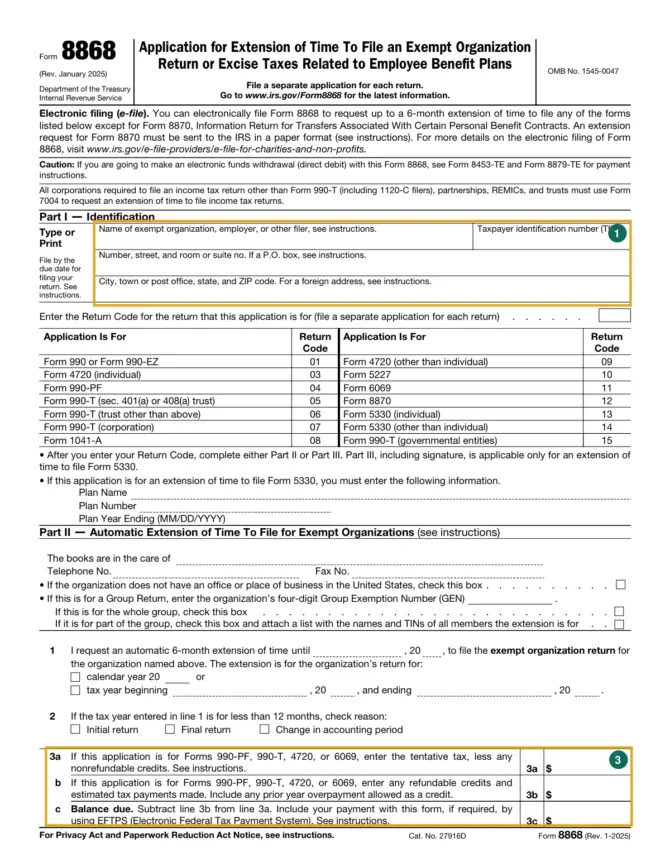
| Field | Entry | Record to use |
|---|---|---|
| Part I, return code | One code for the return being extended | Return type and the code list printed on Form 8868 |
| Part II, books in care of | Custodian’s details and contact numbers | Organization’s records |
| Line 1 | Requested extension date and calendar or fiscal tax year | Original return due date; requested date cannot exceed six months after it |
| Line 2 | Reason for a tax year shorter than twelve months | Initial return, final return or accounting-period change |
| Lines 3a and 3b | Estimated tax after nonrefundable credits, then refundable credits and estimated payments | Underlying return calculation, including an allowed prior-year overpayment credit |
| Line 3c | Line 3a less line 3b | Balance payable by the original due date |
The January 2026 instructions require all Part II filers to complete lines 3a, 3b and 3c, including filers expecting no tax liability. Enter zero where appropriate. Part II does not require a signature.
A central organization requesting a group-return extension enters its four-digit group exemption number and indicates whether the request covers the whole group. For a partial group, attach the names, addresses and TINs of the organizations covered.
When and where to file the application
File by the original due date of the return being extended. The IRS allows electronic filing for the returns listed in Part I except Form 8870, which requires a paper extension request. For paper filing, the January 2026 instructions give: Internal Revenue Service, Mail Stop 6054, 1973 N Rulon White Blvd., Ogden, UT 84201-0045.
Send the extension application separately. Attaching it to a return filed after the original deadline does not make the extension effective. Pay any balance by the original due date using the applicable deposit rules; exempt organizations must make federal tax deposits electronically.
Form 5330 filers complete Part III
For employee benefit plan excise taxes, complete Part I with return code 13 for an individual or 14 for another filer, and provide the plan name, plan number and plan-year end. Use Part III instead of Part II. State the requested date, tax Code sections, estimated payment and detailed circumstances preventing timely filing, then sign.
Submit the request early enough for the IRS to act before the normal due date. This extension requires approval and can run for up to six months; the IRS sends a notice approving or denying it. Separate plans and Form 5330 sections can require separate applications. A plan administrator or tax adviser should resolve which excise taxes and filing dates apply.