When Irish property is sold for more than €500,000, or a house or apartment for more than €1 million, the buyer has to keep back 15% of the price and pay it to Revenue unless the seller produces a CG50A clearance certificate. CG50 is the application form; CG50A is the certificate Revenue issues in reply.
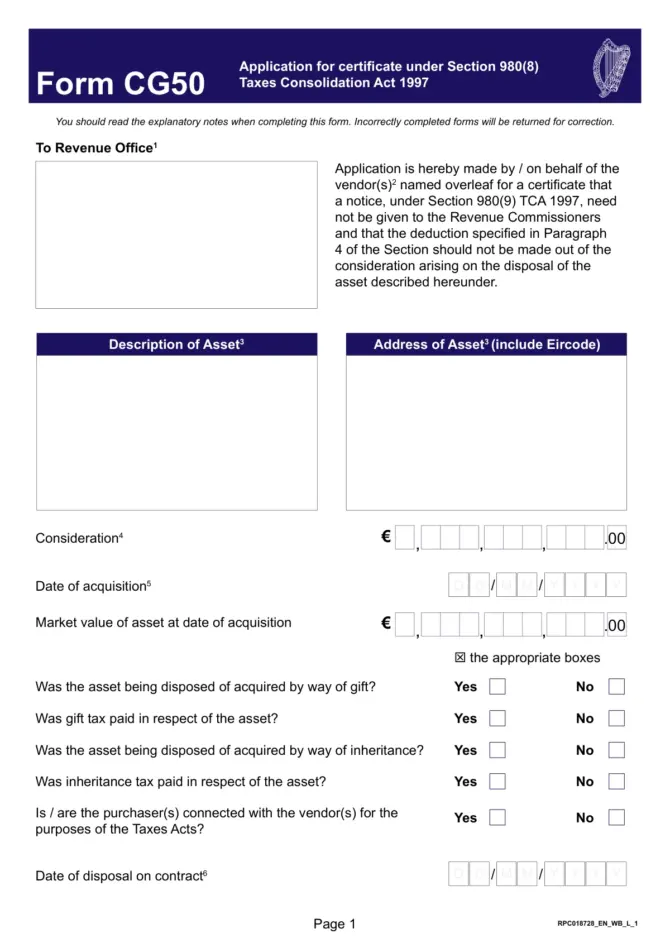
Applications can be made online through myAccount or ROS. Revenue still accepts the paper Form CG50, “Application for certificate under Section 980(8)”, from people who cannot apply online, and the form’s explanatory notes set out what each box needs.

Which sales are caught
The thresholds on Revenue’s page: any asset sold on or after 25 March 2002 for over €500,000, and a house or apartment sold on or after 1 January 2016 for over €1 million. The notes on Form CG50 list the assets section 980 covers:
- land and buildings in the State, including any interest in land such as a lease
- mineral assets in the State, and exploration or exploitation rights in a designated area
- unquoted shares that take their value from those assets, and unquoted shares received in exchange for them under section 584 relief
- the goodwill of a business carried on in the State
- some transactions where the buyer gets no asset, such as a redemption of loan notes or a liquidator’s distribution
Selling in pieces does not avoid it. Parts sold to the same person, to people acting together or to connected people are added together as one disposal. Transfers inside a group are also within section 980.
The three grounds: tick one
The vendor’s declaration on page 2 offers three grounds, and Revenue issues the certificate if any one is met:
(a) Resident in the State
For a vendor resident in the State. The notes ask for no tax computation under this ground. The vendor still has to return the disposal by 31 October of the following year and pay the tax on time (see below).
(b) No Capital Gains Tax is payable on the disposal
The notes ask for a computation of the gain or loss to go with the application.
(c) The tax on this disposal, and on any gain from an earlier disposal of the same asset, has been paid
For (b) and (c), the notes say a computation of the gain or loss must come with the application, with payment of any tax. They add that this matters most for non-resident applicants.
Filling in page 1
Description and address of the asset
A full description, and for land or buildings a clear location with the Eircode.
Consideration
The total consideration, VAT included. If it differs from the contract, explain why. The notes give examples under section 547: the vendor stays on rent-free, or the buyer agrees to build a house for the vendor.
Date of acquisition and market value at that date
Where interests were acquired at different times, give each date and what was acquired.
Gift or inheritance
Whether the asset came by gift or inheritance, and whether gift or inheritance tax was paid on it.
Date of disposal on contract
The date of the contract for sale, not the date of the conveyance. If the closing date in the contract has already passed, confirm the money has not changed hands and give the new closing date.
Connected purchaser
Yes or no: is the buyer connected with the vendor for the purposes of the Taxes Acts?
Vendors, purchasers and who signs
Page 2 has room for up to four vendors and four purchasers, each with name, address and Eircode, and tax reference number for vendors. A “care of” address is not enough. For a company, give the registered office. If an asset is bought in trust, name the real purchaser, not the person buying on their behalf.
Each individual vendor signs. A company signs through its secretary or the officer doing that job. Trustees or personal representatives sign for a trust or unadministered estate. An agent can apply, but must give the vendor’s name and address, and the PPSN or tax reference if the vendor is resident. An application for a non-resident company or trust also lists the beneficial shareholders, or the settlor and beneficiaries.
Sending it, and the tax after
Online, choose “Other services” and then the Capital Gains Clearance (eCG50) facility in myAccount or ROS. Revenue’s guide for applicants is Tax and Duty Manual Part 42-03-01a. On paper, send Form CG50 with a complete copy of the contract to the Revenue office that deals with the vendor’s tax, by post or through MyEnquiries. Forms filled in wrongly are returned for correction.
For a resident individual cleared under ground (a), Capital Gains Tax on a disposal made between 1 January and 30 November is due by 15 December of the same year. For a disposal in December, it is due by 31 January of the next year.
If the sale falls through, the certificate goes back to the Revenue office that issued it. It cannot be reused for a later sale of the same asset under a different contract.
Official PDF: CG50A — Official PDF (revenue.ie)
Two common questions
What if the buyer has already withheld the 15%?
The buyer gives the vendor a Form CG50B, and the vendor uses it to reclaim the amount from Revenue later. CG50B is also available through the Capital Gains Clearance facility online.
Can a non-resident get a CG50A?
Revenue’s page says you must either be resident or have paid the Capital Gains Tax due on the disposal. A non-resident therefore applies under ground (b) or (c), with a computation.
Sources used
- Revenue, Form CG50 Application for certificate under Section 980(8) Taxes Consolidation Act 1997, with explanatory notes, RPC018728 (revenue.ie)
- Revenue, CGT Clearance Certificate (CG50A), published 25 November 2024 (revenue.ie)
- Revenue, Tax and Duty Manual Part 42-03-01a, eCG50 Guide for Applicants (revenue.ie)