A farmer who extends a cubicle shed with invoices dated November 2025 and February 2026 cannot put them on one VAT 58. Each claim has to sit inside a single calendar year, so this job becomes two claims, one for 2025 and one for 2026. That rule, the €125 floor and the short list of spending that qualifies decide most VAT 58 claims before any box is filled in.
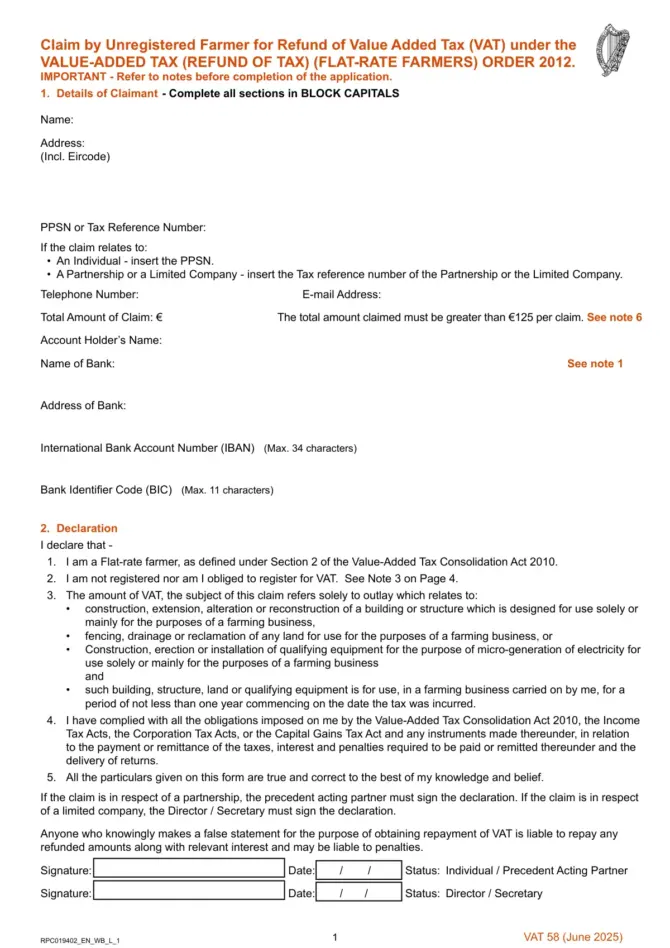
VAT 58 is Revenue’s claim by an unregistered farmer for a refund of VAT under the Value-Added Tax (Refund of Tax) (Flat-rate Farmers) Order 2012, statutory instrument 201 of 2012. The current version is dated June 2025 and runs to four pages: claimant details and declaration, details of the claim, an invoice breakdown and a page of notes.
Who can claim
The declaration on page 1 has you confirm that you are a flat-rate farmer as defined in section 2 of the Value-Added Tax Consolidation Act 2010, and that you are neither registered nor obliged to register for VAT. Note 3 widens this: registration for any other trade, profession or vocation also rules out VAT 58, and a registered farmer claims the deduction on the VAT3 return instead. The one exception is a farmer registered for VAT only in respect of intra-community acquisitions, who may still use VAT 58.
Two further conditions sit outside the form’s boxes. Farming activity has to be identifiable in the income tax or corporation tax records you have already submitted, and the eRepayments guidance puts it as having demonstrated farming income on previously filed income tax returns. You must also be compliant with your other taxes and have the relevant returns filed; for a partnership, the Tax and Duty Manual applies that to every partner.
What the VAT has to be for
Only three kinds of outlay qualify:
- the construction, extension, alteration or reconstruction of a building or structure designed for use solely or mainly in the farming business
- fencing, drainage or reclamation of land used for the farming business
- the construction, erection or installation of qualifying equipment for micro-generation of electricity used solely or mainly in the farming business
Whatever was built, fenced or installed must stay in use in your farming business for at least one year from the date the VAT was incurred.
Page 2 of the form lists what is never refundable: purchase of equipment and machinery, roadways to dwelling houses, repair and servicing of equipment and machinery, the ESB supply, and fuel, oil and diesel, along with silage covers, medicines and weedkillers. The Tax and Duty Manual on the Refund Order, last reviewed October 2026, adds more, among them clothing, computers, fertiliser, furniture, land rental, safety equipment and security monitoring systems. Repairs to a building are excluded too, though altering or reconstructing walls and roofs counts as work on the building.
The manual’s line between fixtures and fittings decides many shed claims. Cubicles, feed barriers, gutters, ventilation, water pipes and doors are on its list of allowable fixtures. Equipment that is only bolted to a wall or floor is a fitting and does not qualify, and animal mats count only when they are fixed with adhesive, concrete, nails or anchor bolts.
For wells and farm roads, the form asks whether they serve the farm only, the dwelling house only, or both. Where a road or well serves both and the use cannot be measured, the manual splits the VAT 50-50. Wind turbine and photovoltaic systems must be named on the Triple E Product Register kept by the Sustainable Energy Authority of Ireland, and electricity sold to the grid does not count as farming use.
Periods, deadlines and the €125 floor
A claim covers a calendar year or a period inside one, and it cannot be more than four years old. Revenue’s page counts the four years from the end of the year: in the shed example above, the November 2025 invoice has to be claimed by 31 December 2029, the February 2026 invoice by 31 December 2030. A building project that runs over more than one year needs a claim for each year in which invoices were issued.
The wording of the minimum differs between Revenue’s documents. The form and the “How to reclaim VAT on certain farm expenditure” page say the claim must be greater than €125. The Tax and Duty Manual and the eRepayments guidance say €125 or more. A claim of exactly €125 is the only case where the difference matters.
The form, part by part
Part 1, details of the claimant
Everything goes in block capitals. An individual gives a PPSN; a partnership or limited company gives its own tax reference number. The address includes the Eircode. Bank details are required for a refund to issue: account holder, bank name and address, IBAN (up to 34 characters) and BIC (up to 11).
Part 2, declaration
An individual signs for themselves. For a partnership the precedent acting partner signs, and for a limited company a director or the secretary. The form warns that a false statement made to obtain a repayment leads to repayment of the refund with interest and possible penalties.
Part 3, details of claim
A is the claim period, from and to, within one calendar year. B covers farm buildings and structures: a detailed description of the work, with start and completion dates, and the farm, dwelling or both question for any well or roadway. C is for micro-generation equipment, giving the type and where it is installed; the form notes that apportionment may apply because the refund covers only electricity used for farming. D is three tick boxes for fencing, drainage and reclamation. For drainage and reclamation, the manual asks for the folio number of the land and the acreage reclaimed, plus photographs of the works.
Part 4, breakdown of amount claimed
One line per invoice: supplier, invoice date and reference, and the refundable VAT in euro, totalled at the foot. Invoices often mix qualifying and non-qualifying items, and only the refundable VAT goes in this column.
Invoices Revenue will accept
- date of issue and a sequential number unique to the invoice
- supplier’s name, address and VAT registration number
- your name and address
- a detailed description of each item or service; “miscellaneous hardware” is refused
- the cost, the VAT rate and the VAT charged
- for goods imported, the customs receipt in place of an invoice
- for outlay under a lease or hire agreement, a copy of the agreement, the invoice and the finance company’s schedule of VAT payable with the first claim, and the schedule alone for later claims; for hire purchase, the agreement and the invoice
Delivery dockets, statements, quotations, advice notes and ordinary receipts are not accepted. Keep business records, invoices included, for six years.
Sending the claim through eRepayments
Revenue’s page says VAT 58 claims should be completed and submitted online through eRepayments, which opens from “Other Services” in ROS or from “Payments/Repayments” in myAccount. The form itself says existing mandatory efilers must use eRepayments, and still prints a postal address: Collector-General’s Division, VAT Repayment Section (Farmers and Touring Coaches), Sarsfield House, Francis Street, Limerick V94 R972. An agent can file in ROS only if registered as your agent for at least one other tax.
Online, the questions follow the paper form, with a few rules of their own. The supplier’s VAT number goes in as seven digits and one or two letters, such as 1234567AA. The invoice reference is typed exactly as printed, so SI-000123 stays SI-000123. The full invoice value goes in the invoice amount field and only the qualifying VAT in the claimed amount field. Every invoice is uploaded, in the order entered, with up to 50 attachments of 5 MB each; anything beyond 50 goes through MyEnquiries.
If you owe Revenue tax that is already on file, the refund is set against it first. Claims not picked for review are approved for payment within 5 working days. Reviewed claims can be approved, rejected or partially approved, and a rejected or partly approved claim comes with notice of the right to appeal to the Tax Appeals Commission. Queries go through MyEnquiries under Collector General’s, VAT Repayments, VAT Unreg (Farmers/Tour Bus Operators), or by phone on 01 738 3663.
Official PDF: VAT 58 — Official PDF (revenue.ie)
The review a year later
A refund comes with a check of your own. One year from the date the VAT was incurred, and no later than the 28th day after that year ends, you review whether the conditions still hold and keep a record of the review. If the building, land or equipment was disposed of in that year, or used mainly for something other than farming, the VAT is repayable with interest. Note 8 on the form sets a penalty of €4,000 where it is not repaid within a further 28 days.
Sources
- Revenue, Form VAT 58, Claim by Unregistered Farmer for Refund of Value Added Tax (VAT), June 2025 (revenue.ie)
- Revenue, How to reclaim Value-Added Tax (VAT) on certain farm expenditure, published 26 February 2026 (revenue.ie)
- Revenue, VAT 58 Guidance for Customers Claiming Refund of VAT for Flat-Rate Farmers, last reviewed December 2025 (revenue.ie)
- Revenue, Tax and Duty Manual: Flat-Rate Farmers Refund Order, last reviewed October 2026 (revenue.ie)