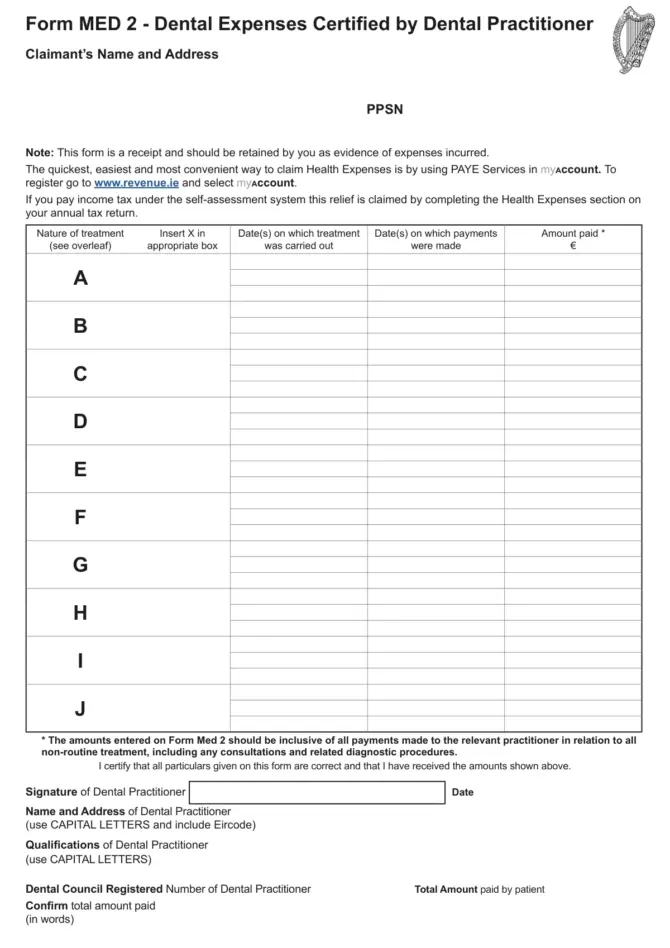
The Med 2 is not a claim form. It is a receipt your dentist fills in for non-routine treatment, and it proves the amount you put into your health expenses claim. Revenue does not want to see it unless it checks your claim, so you keep it.
Relief on health expenses is generally given at the standard rate of 20%. Only the non-routine treatments listed on the back of the Med 2 qualify.

Routine care that never qualifies
The law excludes extractions, scaling and filling of teeth, and providing or repairing artificial teeth or dentures. The note on the form adds that these stay excluded even when a medical condition caused the problem, or when a dentist considers the treatment non-routine in your case.
The ten treatments on the form
The front of the Med 2 has ten rows, A to J, one for each kind of treatment. The back explains them:
| Row | Treatment | What the form says about it |
|---|---|---|
| A | Crowns | Made outside the mouth and cemented on. Core preparation and temporary conditioning crowns qualify too. |
| B | Veneers and etched fillings | Treated as a type of crown |
| C | Tip replacing | Counts as a crown when a large part of the tooth is replaced with something made outside the mouth |
| D | Post and core build-ups | Inserts in the nerve canal to hold a crown, gold or other materials |
| E | Inlays | Only if made outside the mouth |
| F | Root canal treatment | Filling the nerve canal, not filling the tooth |
| G | Periodontal treatment | Root planing, curettage and debridement, gum flaps, chrome cobalt splints without teeth, implants after gum disease treatment including bone grafting |
| H | Orthodontic treatment | Braces and similar, including temporary implants that are part of the orthodontic plan |
| I | Surgical extraction of impacted wisdom teeth | In a hospital or in a dental surgery |
| J | Bridgework | Enamel-retained or tooth-supported bridges |
Among extractions, only the surgical extraction of an impacted wisdom tooth qualifies.
What your dentist writes on it
For each treatment: an X in the right row, the dates the treatment was carried out, the dates you paid and the amount in euro. The amounts should include everything you paid that practitioner for the non-routine treatment, consultations and related diagnostic procedures included. Below that go the total, the total again in words, and the dentist’s signature, name, address with Eircode, qualifications and Dental Council registration number.
Your own name, address and PPSN go at the top. Check them before you leave the surgery.
Treatment that runs over two years
For braces and other treatment that runs into a second year, Revenue says the dentist must complete a separate Med 2 for each year, so the payments made in each tax year sit on their own certificate.
Treatment abroad
Non-routine treatment outside Ireland can qualify. The dentist must be a qualified dental practitioner under the laws of that country, and they still have to fill in a Med 2 for you.
Claiming the relief
PAYE taxpayers claim through PAYE Services in myAccount, putting the amount under the non-routine dental heading of the health expenses claim. Self-assessed taxpayers use the health expenses section of the annual return. You cannot claim for any part of the bill that insurance, the HSE or another source has paid or will pay.
Claims for a refund must be made within four years after the end of the tax year concerned. A Med 2 for treatment paid in 2022, for example, has to be claimed by the end of 2026.
Official PDF: Med 2 — Official PDF (revenue.ie)
Questions
Do I post the Med 2 to Revenue?
It stays with you. Revenue says you do not need to send it, but it may ask for it if it checks your claim.
Is a new set of dentures covered if a medical condition caused the tooth loss?
Dentures are excluded by the legislation, and the Med 2 note says the exclusion applies even when an underlying medical condition led to the treatment.
Sources
- Revenue, Form MED 2 Dental Expenses Certified by Dental Practitioner, RPC020168_EN_WB_L_1 (revenue.ie)
- Revenue, Health expenses: overview, published 12 June 2026 (revenue.ie)
- Revenue, Dental expenses, published 12 June 2026 (revenue.ie)